Mr. Cherubini,
Yes, big city biology students and professors know that most frogs in
Minnesota's farmlands look like perfectly normal frogs (and ARE
perfectly normal frogs, as far as anyone knows). You see, that's part
of what makes the malformed frogs interesting. In fact, those big
city professors and students have put thousands of hours into studies
(in the field, no less!) on the prevalence and distribution of frog
malformations in Minnesota, so they have a better idea how abundant
normal frogs are than pretty much anyone.
Ecology is a science, and in science, you don't just come up with a
hypothesis and consider your work done. You have to get out and test
that hypothesis, and this takes a lot of reasoning, planning, and hard
work. Personally, pouring loads of thought and effort into my
research has made me a bit techy about people assuming that scientists
are too stupid and lazy to leave the big city and look at the subject
of their owm research.
I suppose we ecologists haven't done all we could to let people know
just what it is we do, so I probably shouldn't blame you for imagining
that we just sit in our offices and figure out ways to pin the
problems of the world on our favorite bogeymen. But a simple Google
search reveals that you have a history of attacks on the results of
careful ecological research, attacks based on little or no truthful
evidence, so I won't apologize for my tone.
Jim Crants


Quoting Paul Cherubini <[EMAIL PROTECTED]>:
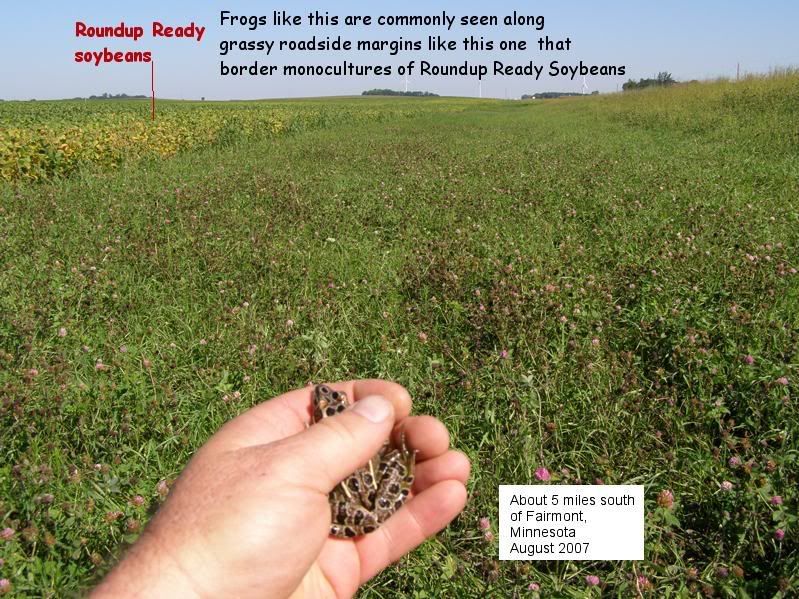
Ironically, I've found undeformed frogs are abundant
in Minnesota along the margins of it's vast monocultures
of herbicide tolerant GMO corn and soybeans
http://i85.photobucket.com/albums/k75/4af/frogb.jpg

Of course, most school kids who lives on farms in Minnesota
knows this too.  But do big city biology students and
professors?

Paul Cherubini
El Dorado, Calif.