Dr. Rick Relyea wrote:

> Pitt Research Shows That Low Concentrations of Common Insecticide
> Can Decimate Tadpole Populations Through the Food Chain
Dr. Relyea, your study did not show that any routine, legally compliant
applications Malathion insecticide (such as the aerial applications typically
used for mosquito control) can decimate tadpole populations through the
food chain in a natural wetland system. It also did not demonstrate these
routine applications are capable of wiping out the zooplankton in
natural wetland systems, causing surface dwelling algae to grow rapidly
hence preventing sunlight from reaching the bottom-dwelling algae, which
tadpoles eat.

Instead, your studies were conducted in small, confined cattle tanks
http://www.chronicle.pitt.edu/?p=660 Monsanto has previously
pointed out that "It is not unusual for studies conducted in artificial
systems to demonstrate greater toxicity than studies conducted under
actual environmental conditions." A detailed rebuttal response from
Monsanto to your Roundup herbicide work can be found on Monsanto's
website:http://www.monsanto.co.uk/news/ukshowlib.phtml?uid=8800

> Leopard and wood frogs naturally range across North America,
> including Pennsylvania and the Northeastern United States. Once
> plentiful, leopard frogs have declined in recent years.

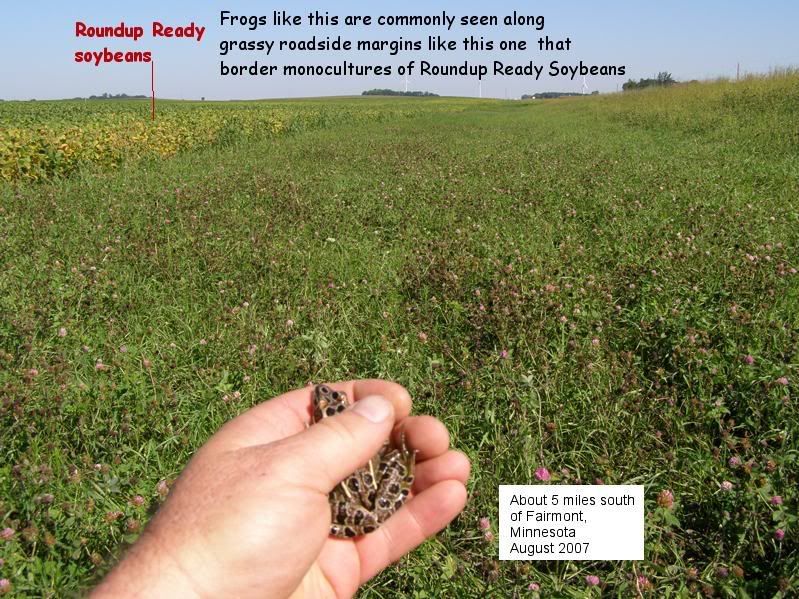
Ironically, leopard frogs are still very abundant in regions of the USA
where Roundup herbicide and insecticide use has been very high
such as around the Roundup Ready soybean and corn monocultures
that cover ~70% of the land mass of southern Minnesota and Iowa:
http://i85.photobucket.com/albums/k75/4af/frogb.jpg

Example: Just two months ago during an evening thunderstorm I saw
hundreds of leopard frogs hopping across the farm roads in southern
Minnesota (Klossner, Minnesota) and hundreds of them ended up
being smashed by cars. I've experienced the same phenomenon along
the farm roads of Iowa many times.  The chemical giants like Monsanto
and Dupont could make a documentary film for the public and
academic community substantiating this abundance if they wanted to.

Paul Cherubini
El Dorado, Calif.