I can't speak for the other studies, but I can speak on the Atrazine issue.
Atrazine is an estrogen mimic. It imitates estrogen when it enters organisms.
Numerous studies were published, not just by Hayes, but also others.
I don't see anything sensational about his claims.
In fact, you might want to read the long string of papers on the
subject by multiple independent investigators who have come up with
essentially similar results and published their findings in the
leading journals in science, environmental toxicology, and
environmental health.

See below.

Hayes et al.  2002. Proceedings of the Natl Acad of Sci.
http://www.pnas.org/content/99/8/5476.short

Allran & Kasalrov 2009. Env. Tox & Chem.
http://onlinelibrary.wiley.com/doi/10.1002/etc.5620200411/full

Tavera-Mendoza et al. 2009. Env. Tox & Chem.
http://onlinelibrary.wiley.com/doi/10.1002/etc.5620210621/full

Howe et al. 1998. Env. Tox & Chem.
http://onlinelibrary.wiley.com/doi/10.1002/etc.5620170324/full

Diana et al. 2009. Env. Tox & Chem.
http://onlinelibrary.wiley.com/doi/10.1002/etc.5620191217/full

Storrs et al. 2004. Env. Health perspectives
http://www.ncbi.nlm.nih.gov/pmc/articles/PMC1247376/

Hayes et al. 2002. Nature.
http://www.nature.com/nature/journal/v419/n6910/abs/419895a.html

Rohr et al. 2006. Env. health perspectives
http://www.ncbi.nlm.nih.gov/pmc/articles/PMC1332655/

Reeder et al. 1998. Env. Health Perspectives
http://www.ncbi.nlm.nih.gov/pmc/articles/PMC1533093/

Hayes et al. 2003. Env. Health Perspectives.
http://www.ncbi.nlm.nih.gov/pmc/articles/PMC1241446/

Carr et al. 2003. Env. Tox & Chem.
http://onlinelibrary.wiley.com/doi/10.1002/etc.5620220222/full

Beasley et al. ???. Book.
http://courses.nres.uiuc.edu/nres456/BeasleyEtAlRiskFactorsLannoo-5April05-GK046-1460G-C13%5B075-086%5D1.pdf


> The UC Berkeley story said sensationally: "its [atrazine
> herbicide] effect on sexual development in male frogs
> could be one of many factors in the global decline of
> amphibians"
>
> Syngenta says: http://tinyurl.com/6fobfnk
> "Does atrazine affect frog sexual development?
> The facts are clear: atrazine does not. Government bodies
> reviewing the science have concluded that atrazine is safe
> to use. The EPA and independent researchers around the
> world have rejected claims made by Dr. Tyrone Hayes
> about atrazine, noting that his data do not support his
> conclusions and questioning why he refuses to make
> his raw data available for independent scientific review."

On Mon, Apr 11, 2011 at 7:13 PM, Paul Cherubini <[email protected]> wrote:
> [email protected] wrote:
>
>> Exactly how are these stories "sensational."  Is there
>> anything in them that is not factual?  Tyrone Hayes
>> work with atrazine and frog development is given
>> substantial credence by knowledgeable folks in the field.
>
> The UC Berkeley story said sensationally: "its [atrazine
> herbicide] effect on sexual development in male frogs
> could be one of many factors in the global decline of
> amphibians"
>
> Syngenta says: http://tinyurl.com/6fobfnk
> "Does atrazine affect frog sexual development?
> The facts are clear: atrazine does not. Government bodies
> reviewing the science have concluded that atrazine is safe
> to use. The EPA and independent researchers around the
> world have rejected claims made by Dr. Tyrone Hayes
> about atrazine, noting that his data do not support his
> conclusions and questioning why he refuses to make
> his raw data available for independent scientific review."
>
> The 1999 Cornell University story said sensationally:
> "Pollen from Bt-corn could represent a serious risk to
> populations of monarchs and other butterflies".
>
> But since 1999 Bt corn has been widely adopted by
> by American farmers. Worse, Roundup Ready corn
> and soybeans also were widely adopted and the resulting
> heavy use of Roundup herbicide eliminated most of
> the milkweed plants that used to grow within these crops
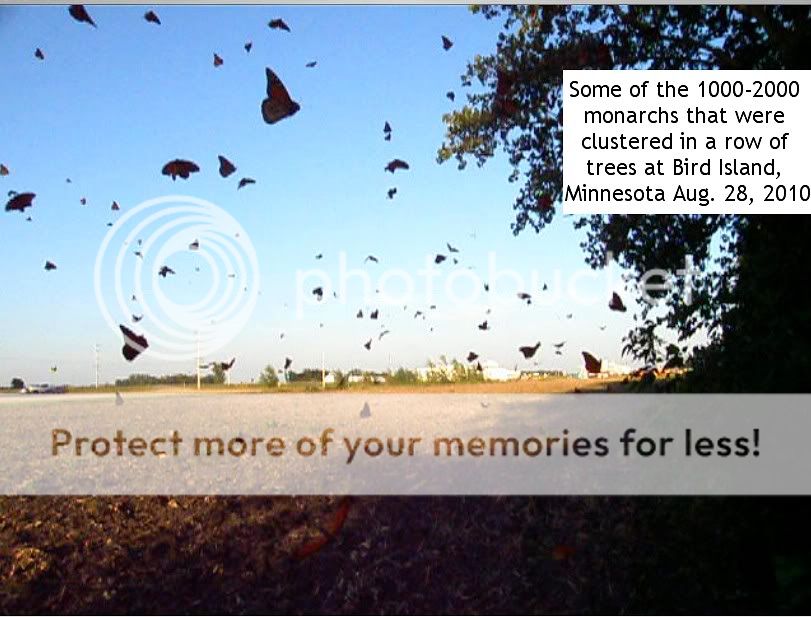
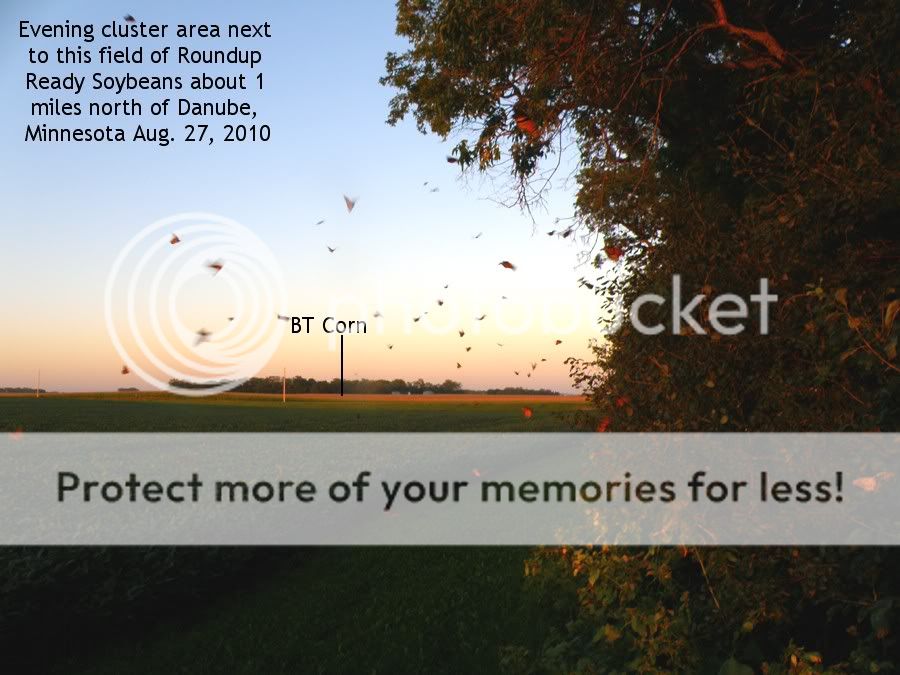
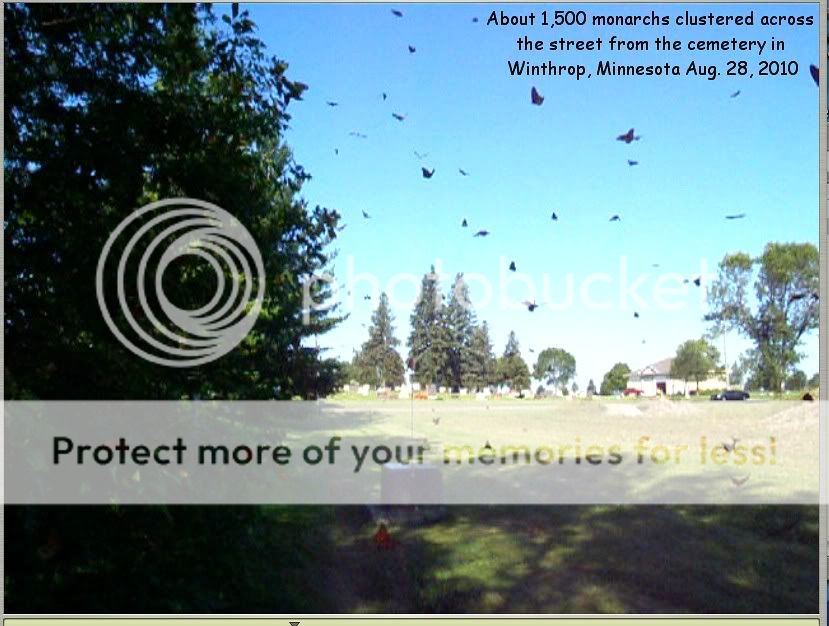
> What was the effect of this one-two punch on monarch
> abundance? These butterflies are still spectacularly
> abundant in the most intensive corn and soybean regions
> of the upper Midwest such as in southern Minnesota:
>
> Still photo:
> http://i959.photobucket.com/albums/ae78/18R-C/bia.jpg
> Video of the same butterflies:
> http://www.youtube.com/watch?v=j4e3S2sm13g
>
> Still photo:
> http://i959.photobucket.com/albums/ae78/18R-C/danub.jpg
>
> Still photo: http://i959.photobucket.com/albums/ae78/18R-C/wintf.jpg
> Video of the same butterflies:
> http://www.youtube.com/watch?v=WJCnU7PB9to
>
> The Cal Poly State University story said sensationally:
> "Studies since the early 1990s indicate Western U.S. populations
> of the monarch butterfly are headed for extinction...under
> the direction of biology professor Francis Villablanca, Monarch
> Alert helps generate data needed to determine just how experts
> can bring about a monarch resurgence."
>
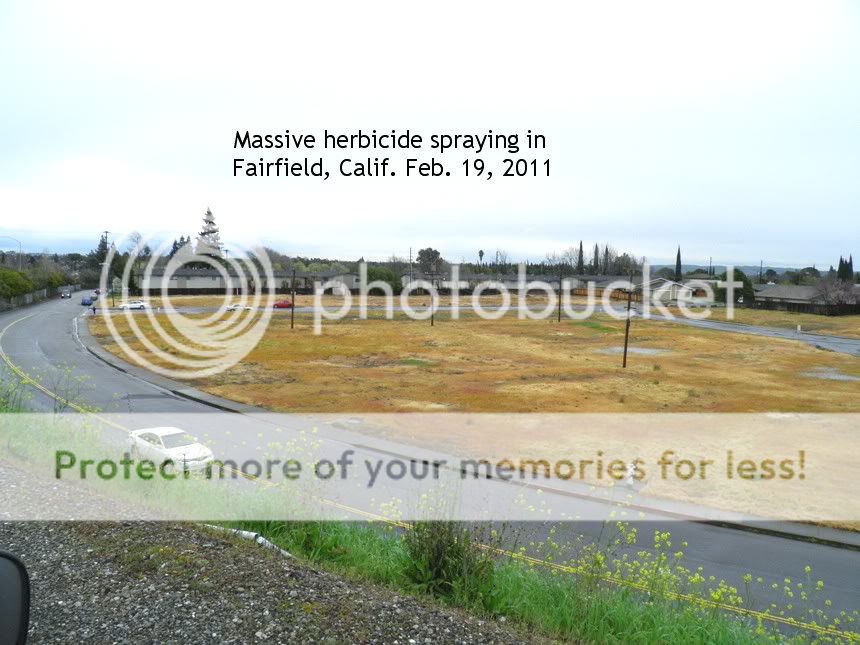
> But the serious decline of the western USA monarch parallels
> serious landscape scale declines in western milkweed abundance
> caused by greatly increased herbiciding of roadsides, vacant lots,
> crop margin, railway lines, etc.
> http://i959.photobucket.com/albums/ae78/18R-C/herba.jpg
> http://i959.photobucket.com/albums/ae78/18R-C/herbd.jpg
> in combination with urban sprawl:
> http://i959.photobucket.com/albums/ae78/18R-C/sprawla.jpg
> http://i959.photobucket.com/albums/ae78/18R-C/sprawlb.jpg
>
> Since Cal Poly does not know how this ongoing intensive weed
> control or sprawl can be stopped, there's no conceivable way
> Cal Poly could: "generate data needed to determine just how
> experts can bring about a monarch resurgence [in milkweed,
> hence monarch] abundance."
>
> Paul Cherubini
>


--
Malcolm L. McCallum
Managing Editor,
Herpetological Conservation and Biology
"Peer pressure is designed to contain anyone with a sense of drive" -
Allan Nation

1880's: "There's lots of good fish in the sea"  W.S. Gilbert
1990's:  Many fish stocks depleted due to overfishing, habitat loss,
            and pollution.
2000:  Marine reserves, ecosystem restoration, and pollution reduction
          MAY help restore populations.
2022: Soylent Green is People!

Confidentiality Notice: This e-mail message, including any
attachments, is for the sole use of the intended recipient(s) and may
contain confidential and privileged information.  Any unauthorized
review, use, disclosure or distribution is prohibited.  If you are not
the intended recipient, please contact the sender by reply e-mail and
destroy all copies of the original message.