Brian Olson wrote:
On Aug 13, 2009, at 9:18 AM, Kristofer Munsterhjelm wrote:
Brian Olson wrote:
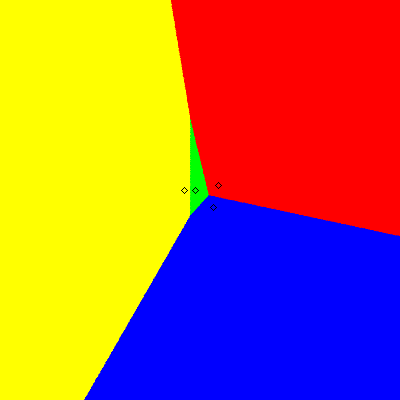
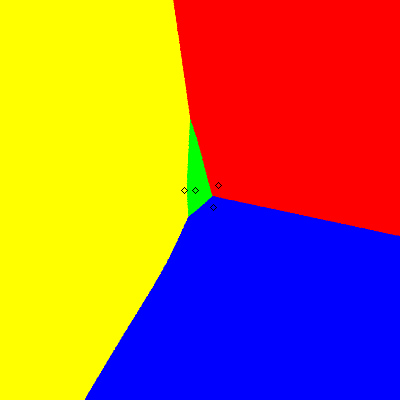
http://bolson.org/voting/sim_one_seat/20090810/
I think a few of these plots show Single Transferrable Vote behaving
badly in the same ways IRV does, with discontinuities and irregular
solution spaces.
I also ran Condorcet and IRNR using combinatoric expansion.
Combinatoric variants of single winner election methods adapt to
multiwinner situations by enumerating all possible winning sets of
the available choices and using a simulated voter's preferences on
the choices in each set to determine a preference for each
winner-set. Voting on the n-choose-k preferences for winner-sets then
procedes as for a single-winner election.
How does the combinatorial expansion work? The way you describe it, it
seems like it's general purpose - that you could combine it with any
single-winner method.
It's pretty general purpose but works well when there are ratings
backing each voter. It's easy to derive a rating for a winner-set by
just adding up the individual ratings. There would be more ties if there
was an initial conversion from rankings to ratings, as 1st + 4th would
be equal to 2nd + 3rd.
So, basically, if you have a vote of the type A: 100, B: 50, C: 20, and
there are two seats, you get:
AB: 150, AC: 120, BC: 70

and hence

AB > AC > BC ?
Wouldn't that be majoritarian? Say 50%+1 prefer A > B > C, and the rest
prefers C > B > A (C: 100, B: 50, A: 20). Then a majority plus one will
prefer AB to the rest. However, Droop proportionality would mean that
each bloc should get one candidate (hence one should elect AC).
The Condorcet Internet Voting Service has their own combinatorial
method, see here:
http://www.cs.cornell.edu/w8/~andru/civs/proportional.html . It may be
more proportional - I haven't tried it.
One could also try adding Schulze STV to the list of methods, since it
reduces to Condorcet in the single-winner case. It is combinatorial, but
maybe it'll help us know what we "ought to see" without discontinuities
and such.
I think based on this I'm going to have to think more about making
native multiwinner methods. Combinatoric expansion gets pretty
expensive for large numbers of choices or seats to elect. I had been
kinda resigned to STV being the state of the art in multiwinner
methods, but we seriously ought to be able to do better.
You could try implementing my DAC/DSC-based method (see
http://www.mail-archive.com/[email protected]/msg04001.html )
or Quota-Preferential by Quotient (QPQ,
seehttp://www.votingmatters.org.uk/ISSUE17/I17P1.PDF ), even if the
latter is nonmonotonic (to my knowledge).
Thanks for the links. Those both seem to be party-based proportional
systems and I have so far been going (for partly ideological and partly
technical reasons) for party-agnostic candidate-based systems. But
perhaps I have misunderstood 'setwise highest'. I must have missed these
the first times around and am now reading up and thinking about them more.
They aren't. They're both based on party systems, but they aren't party
systems themselves. QPQ could be considered an IRV-type method that uses
quotients (like the divisor methods do with respect to parties) instead
of straight score propagation.
Setwise Highest Average is Sainte-Laguë applied to DAC/DSC type
coalitions instead of parties. Looking at the example, it uses
acquiescing coalitions derived from the (candidate-only) ballots. Like
highest average party-based methods, it reweights the groups according
to which include candidates that have already been elected, but those
groups are determined based on voters' ballots alone.
It may also be that the construction of the voter preference profiles
(Gaussian centered on a particular point) means that the ideal maps
will look like Condorcet majoritarian elections. If so, they won't
help distinguish proportional methods from disproportional ones, only
show errors like clone problems.
Proportionality might show itself somewhat like the distortions Borda
counts show in single winner elections:
http://bolson.org/voting/sim_one_seat/zoomout/4a_Condorcet.png
http://bolson.org/voting/sim_one_seat/zoomout/4a_Borda.png

http://bolson.org/voting/sim_one_seat/zoomout/4c_Condorcet.png
http://bolson.org/voting/sim_one_seat/zoomout/4c_Borda.png

(above from this page http://bolson.org/voting/sim_one_seat/zoomout/ )
The lines shift a bit and twist in weird ways, but have basically the
same shape and none of the IRV discontinuities.
The IRV discontinuities in single-winner Yee diagrams are visual proof
of IRV's nonmonotonicity. Consider it like this: if you draw a line from
the center of a candidate's support (the circle or point) outwards, then
if that line goes from "candidate wins" to "candidate doesn't win", and
then back to "candidate wins", then the "doesn't win -> wins" transition
can only have happened because of nonmonotonicity.
As for multiwinner, I'm not sure what the diagrams would be like. I
wrote an argument that they would be like Condorcet majoritarian
elections, but now I'm not so sure. If we're to reason to find the
optimum, we'd probably do better if we knew why the optimum is a Voronoi
diagram in the single winner case.
A rangevoting.org page (http://rangevoting.org/BlackSingle.html) says this:
"MORAL: For L² distance, Condorcet voting methods always yield the L²
Voronoi diagram for voters centrosymmetrically distributed about each
pixel (by part b of theorem). Also (as you can prove using facts about
convolutions) this always is the same as the socially-best-winner
picture. Thus, with utilities based on L² distance, for honest voters
distributed centrosymmetrically, Condorcet voting methods are always
optimum and in particular are superior to range voting."
A problem here is that we don't have any equation that describes
"socially best" in the multiwinner case (the issue being the tradeoff
between proportionality and getting "your" best). Methods like LPV0+ and
PAV try to construct such equations, but they don't seem to be very
proportional.
----
Election-Methods mailing list - see http://electorama.com/em for list info