⸘Ŭalabio‽ wrote:
2011-04-17T07:47:56Z, “Kristofer Munsterhjelm”
<[email protected]>:
⸘Ŭalabio‽ wrote:
The cuberoot of 300 million is:
669
I could reform the United States Of America, this is what I would
do:
Expand the House Of Representatives to 1024.
Why? 1024 is much greater than 700. Even if we assume a perfect
turnout, the cube root of 2x 300 million is 843, not 1024.
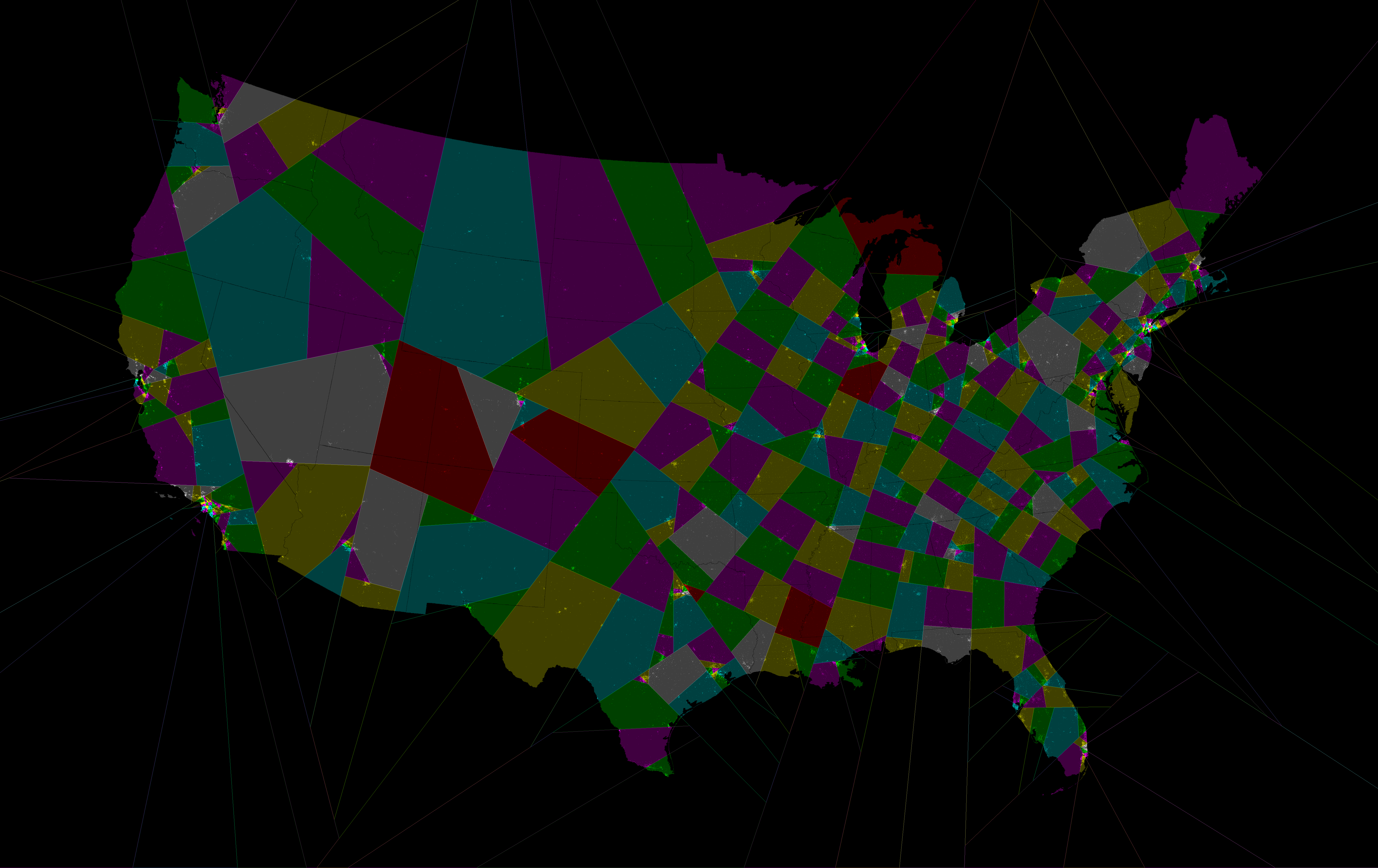
Because I would use the SplitLineAlgorrithm.  The next power of 2
over 700 is 1024.  ¿Do you want to see how the United States of
America would look without Gerrymandering:

http://rangevoting.org/USsplitLine.png

The SplitLineAlgorithm did that.
The splitline algorithm advocated by the CRV doesn't need a power of
two. Here's an example with 3:
1. Start with the boundary of the state.
2. Let N = A + B so that A and B are as close to N/2 as possible.
          (here 3 = 1 + 2).
3. Choose the shortest splitline that splits the state in the ratio A:B.
          (i.e. split 1:2)
4. Recurse with one of the states having its N = our A, the other having
its N = B. (No need to recurse if their N is 1.)
So you start with 3 districts, splitting the state into a 2/3 chunk and
a 1/3 chunk. The 1/3 chunk is finished (no recursion needed there). The
2/3 chunk is split again to give two 1/3 chunks. Now the state has been
partitioned into three 1/3 chunks and we're done.
Use the SplitLineAlgorithm
http://rangevoting.org/GerryExamples.html
for redistricting the country.  Redistrict without regard for
state-boundaries (all politics are local).  Have Representatives
elected by ScoreVoting.
Why not just dissolve the problem by using a multimember method?
Furthermore, using range/score for electing representatives makes
the outcome less proportional/representative, as I've mentioned
elsewhere; it would make the house of representatives more like the
Senate, except population-weighted.
The ideas of districts is that the politicians are accountable to the
people in their districts.  If a proposed dam would flood a district,
the Representative would try to stop it.  With proportional
representation, none in the legislature may try to save the district.


With district-based systems, groups which are not at least a
plurality somewhere receive no representation.  It is good to have a
house of proportional representation and a separate house of
district-absed representation.
If politicians are only looking out for their own hides (which seems to
be a prerequisite for what you're saying), then you have two situations:
- In a district-based system, you would have one representative that is
very concerned about the dam, and (n-1) representatives that aren't at
all (because the district's votes don't go to them).
- In a PR system, you would have n representatives that are all somewhat
concerned about the dam, because the people who would be in the district
all affect the composition of the council.
Thus, on the average, you would have the same result; only that in one
case, all the concern for the dam is concentrated on a single candidate
whereas in the other, it is spread throughout. So I don't see any
advantage to single-member representation here, and quite a lot of
disadvantages: A Single-member district method requires either an
independent redistricting commission or equivalent, a program that will
draw sometimes-unusual regions, or that the people endure
gerrymandering, whereas multimember proportionality gets rid of this
problem.
There are of course reasons for not having too large multimember
districts, such as that it's hard to rank 10 candidates (or to know
their positions), and that feedback becomes too weak, but the good news
is that gerrymandering runs into diminishing returns pretty quickly, so
small multimember constituencies would be good enough. AFAIK,
gerrymandering an n-member district using a Droop proportional method
would only let you swing 1/(n+1) of the vote in the very worst case.
Even that disproportionality can be handled - at least on a party level
- by something like Schulze's STV-MMP suggestion, if exact
proportionality is very important.
----
Election-Methods mailing list - see http://electorama.com/em for list info