A technical article like this needs to be on -tech.  Please make all replies
to -tech.
Ed


  _____

From: [email protected] [mailto:[EMAIL PROTECTED]
On Behalf Of Caliendo Dan
Sent: Friday, August 29, 2008 3:19 PM
To: Ercoupe Flying ercoupe
Subject: [ercoupe-flyin] How to get the most out of your fuel


A fuel-saving announcement from your ASI

By Dave Hirschman


 <http://www.aopa.org/images/aircraft/080825asi.jpg>

The airspeed indicator (ASI) can tell you a great deal about how to fly more
efficiently, but few pilots know how to decode its drag-reducing,
fuel-saving, and range-extending message.

According to Jack Norris, an aerospace engineer and technical director for
the 1986 Voyager around-the-world flight, a simple, mechanical ASI (and an
understanding of the aerodynamic drag chart and an airplanes best rate of
climb speed) is all we need to maximize speed vs. drag. Minimizing drag is
the key to reducing fuel burn and extending range.

The airspeed indicator tells us a lot more than just ram air pressure, said
Norris, author of The Logic of Flight, a self-published book on aircraft
efficiency and propeller design. Your ASI can also tell you the most logical
and efficient way to fly without being wasteful of fuel or time.

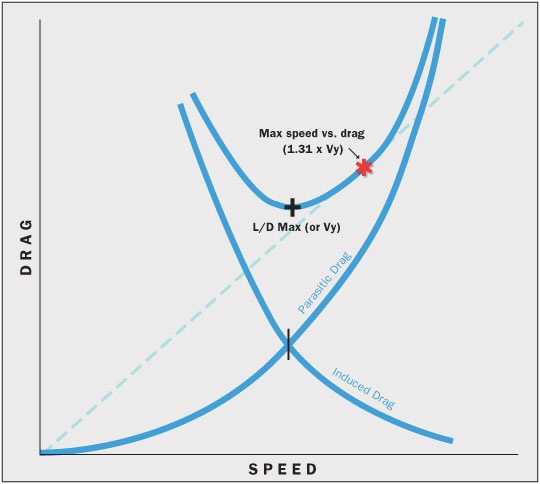
All pilots learn in ground school that any airplanes best rate of climb and
longest range is found at L/D max, that point on the drag chart where the
induced and parasitic drag curves meet, and total drag is lowest. Pilots
seeking peak efficiency can climb as high as possible and fly at L/D max for
the absolute minimum fuel burn over the greatest distance.

But here in the real world, few of us would ever choose to fly so slowly.

No one wants to plod along at some low speed with mushy controls, said
Norris, a private pilot for 60 years. You do that if youre flying the
Voyager around the world. But even then, it took nine days, three minutes
and 44 seconds. What were really looking for is flying as fast as possible
with as little drag as possible.

Norris points to what he calls the Max Speed vs. Drag point on the chart.
There, pilots can gain 31 percent more speed while paying a paltry 15
percent drag penalty. Since true airspeed (TAS) increases with altitude, at
12,500 feet, for example, pilots can obtain an additional 21 percent payoff
for a total 59 percent speed gain over L/D max.

Who wouldnt want to go 59 percent faster for 15 percent more drag? Norris
says. Aerodynamics is full of tradeoffsbut this ones a bargain.

The best speed vs. drag point is always 1.31 times L/D max (or VY, the
best-rate-of-climb speed), Norris says. Higher speeds are possible at lower
altitudes and higher power settings. But since parasitic drag increases at
the square of indicated airspeed, the additional speed carries a high price
in dramatically higher fuel consumption and reduced range.

Very few pilots really understand that the shape of the total drag curve is
really a leaning, lazy J, Norris says. Theres a place where the curve
flattens out and you can fly much faster for a very small increase in drag.
You dont need any special equipment or fancy math to figure it out. All you
need to know is your aircrafts VY and add 31 percent.

Max efficiency profile

Norris recommends the following profile for virtually all piston-engine,
general aviation aircraft: After takeoff, simply cruise climb at (1.31 times
VY) as high as possible with the throttle wide open. When youve reached the
maximum altitude at which you can maintain your target IAS with the mixture
properly leaned, youre done.

The pilots operating handbook for the AOPAs IO-550-powered Beechcraft
Bonanza BE36 seems to bear out Norris IAS-based strategy.

At a total weight of 3,400 pounds, VY is 96 knots, making the ideal target
IAS 126 knots. On a standard day, with the throttle wide open and 2,500 rpm,
mixture set 20 degrees lean of peak, the Bonanza shows 129 KIAS at 14,000
feet, 157 KTAS, and a fuel burn of 10.6 gph.

Thats about 14 KTAS less than the Bonanzas best-power setting at 6,000 feet
where the airplane travels 171 KTAS at 14.4 gph. So, on a 500-mile trip,
flying at high altitude and optimal IAS adds less than 15 minutes flying
time and saves 8.7 gallons of avgas (or more than $52 at current prices).
Put another way, optimal IAS at altitude reduces speed 8.2 percent while
slashing fuel consumption 20 percent.

Norris says his IAS-based approach works equally well for planes with
fixed-pitch and constant-speed propellers and all engine sizes.

Flying is subject to the same physical laws, and the drag curves apply to
all aircraft, he said. Airplanes only know indicated airspeed. A wing doesnt
know how fast its moving over the ground, and it doesnt care. Understanding
IAS allows pilots to minimize drag, fly more intelligently, and get the most
efficiency and utility out of their aircraft.

Give it a try

Try Norris IAS method and let us know how it works for you.

Environmental factors such as winds aloft and icing levels are sure to
influence your aeronautical decisions. One rule of thumb is to climb as
quickly as possible when tailwinds are present to maximize the time such
favorable conditions can act upon your aircraft. In strong headwinds, lower
groundspeeds at altitude can negate any gains in TAS or reductions in hourly
fuel burn.

Also, physiological factors and the availability of supplemental oxygen can
come into play at the higher altitudes Norris IAS-based strategy suggests.
Federal aviation regulations mandate that pilots use of supplemental oxygen
whenever theyre above 12,500 feet cabin pressure altitude more than 30
minutes, and at all times above 14,000 feet. (But studies show hypoxia can
begin at significantly lower altitudes for many people, and headaches,
dehydration, and fatigue are common after prolonged periods at 8,000 or
10,000 feet without supplemental oxygen.)

Are you willing to fly higher and give up some speed for better fuel
efficiency? Have fuel price increases changed the way to operate your
aircraft? Share your thoughts and efficiency strategies
<http://blog.aopa.org/blog/?p=542> on Hirschmans blog.

August 25, 2008
<<image001.jpg>>