Dear Mr. Caldwell,
How does one access or get on a list to timely receive all FAA safety
recommendations proposed for light aircraft?
The following are supplemental comments to your Airworthiness Concern
Sheet (ACS) of August 14, 2009, referencing the 12/13/08 accident which
is the subject of NTSB ERA09FA087.
As the comment period for subject ACS expires, no response to my
original request for information of 9/14/09 or any of the eighteen
followup requests (IRs) in my comments to you on 9/23/09 via email (and
later via U.S.P.S. with attachments) has been received. To such extent
as "FAA safety recommendation 09.087 to revise AD 2003-21-01" is not
withdrawn or rescinded as presently written please consider above
requests for information repeated herein.
I specifically object to the proposal via "FAA safety recommendation
09.087 to revise AD 2003-21-01". "Unauthorized maintenance" consisting
specifically of "unauthorized holes" has not been demonstrated to pose
greater risk(s) to Ercoupes than such holes drilled in other light
aircraft airframes in accordance with methods and practices acceptable
to the Administrator. The same can be said with regard to holes not
drilled in accordance with methods and practices acceptable to the
Administrator. There are regulatory means more appropriate to
addressing such general maintenance concerns as pertain equally to all
aircraft than what is proposed.
Any new AD as would selectively review or inspect holes drilled in
Ercoupes to a different standard than holes drilled in other light
aircraft airframes in accordance with methods and practices acceptable
to the Administrator would violate constitutional guarantees of equal
application of the law/regulation. The same can be said with regard to
holes not drilled in accordance with methods and practices acceptable
to the Administrator. To implement such selective enforcement by
purporting to change an existing Ercoupe-specific AD presently
applicable only to outer wing panels can not serve to rendering such
constitutional issue objection moot.
At the time my earlier comments were drafted I presumed that all NTSB
information collected on subject accident had been forwarded to the FAA
and had been duly considered in overall appropriate context before "FAA
safety recommendation 09.087 to revise AD 2003-21-01" was written. I
now understand that the NTSB and FAA are required to make substantially
independent evaluations and it is by no means clear what NTSB
information the FAA has had access to.
Subject ACS states that "At this time the FAA has not made a final
determination on what type of corrective action should be taken".
Again calling attention to the fact that the NTSB report of this
accident remains "preliminary" and subject to change some ten months
later...and quoting the NTSB @:
http://www.ntsb.gov/Aviation/Manuals/MajorInvestigationsManualApp.pdf
Page F4 (last sentence): "Common sense and good judgment must prevail
to avoid potential action on preliminary information that proves to be
untrue."
Please consider this my request for timely personal notification if and
when any FAA "Notice of Proposed Rulemaking" whatsoever related to this
12/13/08 accident is released for publication in the Federal Register.
≈≈≈≈≈≈≈≈≈≈≈≈≈≈≈≈≈≈≈≈≈≈≈≈≈≈≈≈≈≈≈≈≈≈≈≈≈≈≈≈≈≈≈≈≈≈≈≈≈≈≈≈≈≈≈≈≈
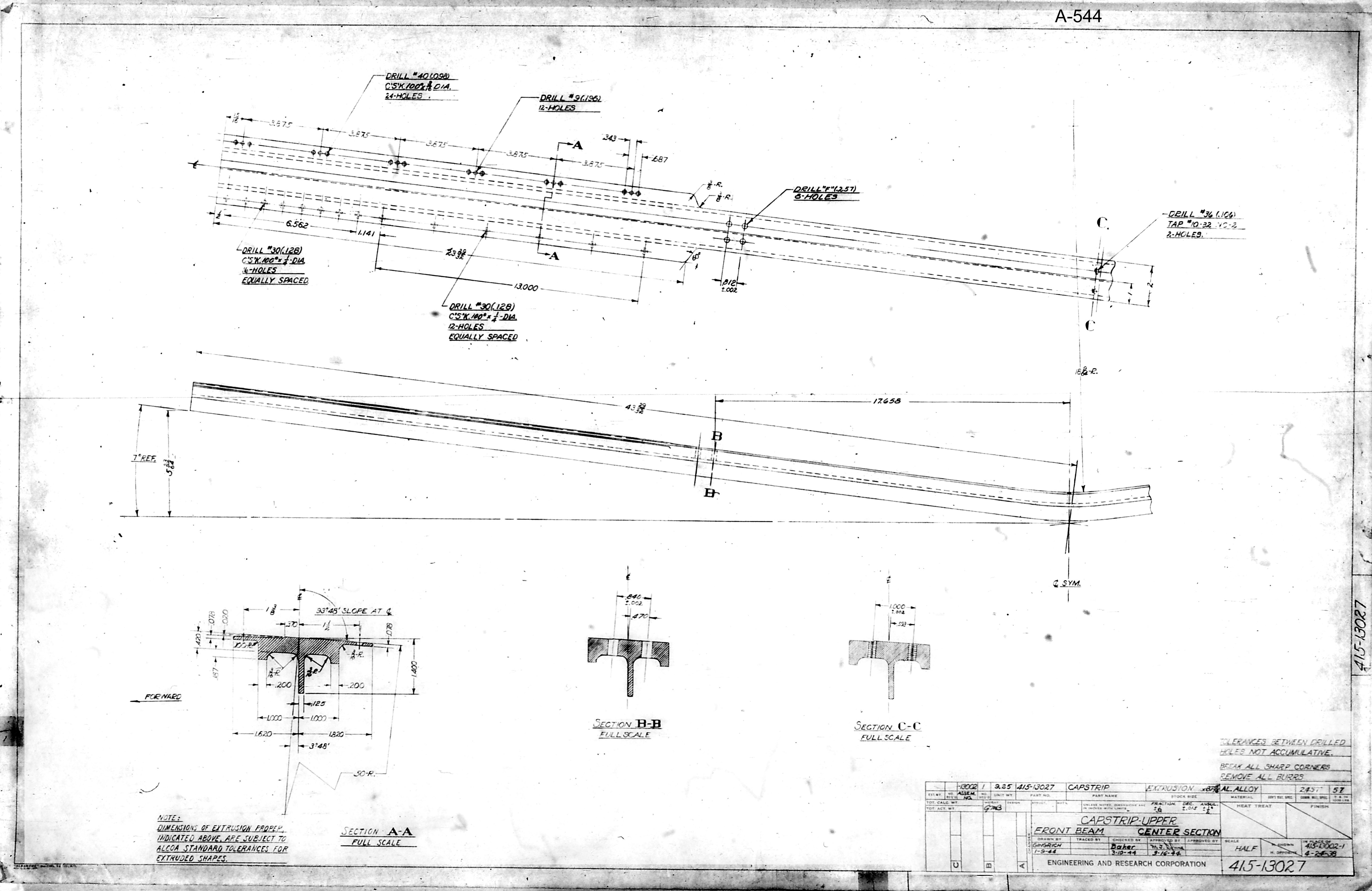
Since forwarding my comments and IRs of 9/23/09 I have examined ERCO
production drawing 415-13027, titled "Capstrip-Upper", "Front Beam"
(space) "Center Section" drawn 1-9-44, Checked 3-10-44, Approved
3-16-44, which replaced 15-1002-1 of 4-24-38. This drawing can be
viewed online at:
http://www.ercoupe.info/uploads/Main/drawings/a-544.jpg
I have compared above drawing with Forney Drawing F-13027 Rev.I dated
4-22-58 titled "Front Beam Center Section" (Main Spar) Capstrip-Upper.
Both of these drawings show a total of eight holes 'Drill "F" (.257)'
in diameter (just over a quarter inch) through said Cap Strip for
attachment of fuselage Frame C brackets. The centerlines of the first
pair of said holes are drilled 17.658" outboard from the fore-aft spar
centerline at a slight angle .470 fore and aft of the port-starboard
centerline of the horizontal Cap Strip extrusion, .840 apart. The
fore-aft centerlines of the second pair of said holes are .812 "
further outboard.
There are two additional #36 (.106) holes drilled fore-aft at the
fore-aft spar centerline, the first centerline being .593 aft of the
port-starboard centerline of the horizontal Cap Strip extrusion and the
second centerline being 1" forward of the first centerline. These
holes are then tapped 6-32 NC-2.
Since the information described above is identical on both drawings, it
is logical to presume that it would be applicable to the accident
aircraft, both as produced as a 415-C and as modified to 415-D
specification; inasmuch as these drawings "anchor" a design/production
period from 3-16-44 to 4-22-58, and both the manufacture of the
accident aircraft and any and all 415-D model Ercoupes originally
produced or subsequently modified would have logically conformed to the
common production standards applicable throughout said period.
The current ACS seems to presume that any hole in any aircraft primary
structure is a "major alteration" and therefore requires submittal and
subsequent approval of an STC or 337 in order to be "authorized", as
opposed to "unauthorized". This presumption is not, insofar as I can
determine, supported factually in applicable FARs nor can I confirm it
by any official interpretation.
To the contrary, a letter authored by the designer of the Ercoupe, Fred
Weick (attached below), dated December 14, 1987, addresses the effect
on spar strength of drilling five 1/4" holes in the spar top flange
(cap strip). I would call particular attention to Mr. Weick's
statements "...that the bending moment is substantially constant in the
spar all the way across the fuselage" and that "The top flange of the
spar is in compression for the highest load condition...". The latter
refers to a positive G loading.
It would seem that the sudden forward ejection of both occupants
together with the seat pan in this accident strongly suggests that the
spar in the accident Ercoupe was subjected to sudden and excessive
negative G loading. As an aside, I personally knew Fred Weick. I can
produce other original examples of his correspondence and signature for
comparison should anyone doubt as to whether or not this attached
letter is genuine.
≈≈≈≈≈≈≈≈≈≈≈≈≈≈≈≈≈≈≈≈≈≈≈≈≈≈≈≈≈≈≈≈≈≈≈≈≈≈≈≈≈≈≈≈≈≈≈≈≈≈≈≈≈≈≈≈≈
You now have information in the overall strongly suggesting that some
combination of aileron flutter and airspeed in excess of Vne caused
catastrophic structural failure and in-flight airframe disintegration.
This was likely the predictable result of any airframe when subjected
to loads clearly and significantly in excess of applicable design
parameters. ERCO was aware and made it known long ago to the CAA/FAA,
dealers and owners that excess free play in the aileron control system
can result in flutter. It has been confirmed that flutter can progress
rapidly to the point where effective control of the aircraft is lost.
Did autopsies performed rule out sudden incapacitation and a slump
forward against the yoke as possibly initiating the dive necessary to
exceed Vne in an Ercoupe?
None of above reasonably supports the hypothesis that "improper
maintenance" or the drilling of "improper holes" was the primary cause
of this structural failure. In the absence of any empirical
engineering structural evaluation showing that the load carrying
capability of this particular airframe structure was reduced below
applicable design requirements, no "airworthiness concern" is
reasonable or justified.
To such extent as "improper maintenance" or the drilling of "improper
holes" was merely the "weakest link" in a chain which would have broken
anyway under massive and irresistible overload(s), no "airworthiness
concern" is reasonable or justified. It takes more than a "fluke"
accident to credibly suggest a structural design "weakness" exists in
Ercoupe wing spars, latent some sixty years. The Ercoupe airframe
design has been validated over many years of reliable service and the
operational fleet has an exemplary safety record when maintained in
accordance with applicable factory maintenance bulletins and flown
within the specified range of operational performance.
To such extent as evidence may suggest one or more preexisting cracks
at a point of failure, due consideration should be given that such
cracks likely resulted from some previous negative-G overstress
undetected in subsequent annual or 100 hr. inspections. Since such
failure has thus far been documented in only this single airframe, we
are left to speculate whether at some time previous some owner engaged
in prohibited aerobatics in this normal category airframe.
Should the FAA redirect subject "safety concern" to require annual or
100 hr. compliance with applicable factory aileron maintenance
bulletins, such action could only improve the present operational
safety of the fleet and would likely have prevented subject accident.
Sincerely,

William R. Bayne, Director
Texas Ercoupe Museum
.____|-(o)-|____.
(Copyright 2009)