EV Digest 3401

Topics covered in this issue include:
  1) Re: Flaming wreckage...
        by Mark Farver <[EMAIL PROTECTED]>
  2) Re: Generator and AC motor
        by Mike Chancey <[EMAIL PROTECTED]>
  3) Why am I not supposed to parallel cells/batteries?
        by Lightning Ryan <[EMAIL PROTECTED]>
  4) Re: Fast charging
        by Rich Rudman <[EMAIL PROTECTED]>
  5) Tektronix 475 Scope
        by "Don Cameron" <[EMAIL PROTECTED]>
  6) Re: Fast charging
        by Rich Rudman <[EMAIL PROTECTED]>
  7) Re: Flaming wreckage...
        by Rich Rudman <[EMAIL PROTECTED]>
  8) Re: Fast charging
        by "Joe Smalley" <[EMAIL PROTECTED]>
  9) Re: fun with powerwheels 2...-motors
        by "Joe Smalley" <[EMAIL PROTECTED]>
 10) Re: Flaming wreckage...
        by "David Chapman" <[EMAIL PROTECTED]>
 11) Re: Tektronix 475 Scope
        by Peter VanDerWal <[EMAIL PROTECTED]>
 12) Re: Why am I not supposed to parallel cells/batteries?
        by Justin Southam <[EMAIL PROTECTED]>
 13) Re: battery trouble
        by "Mark Brueggemann" <[EMAIL PROTECTED]>
 14) Re: fun with powerwheels 2...
        by "Joe Smalley" <[EMAIL PROTECTED]>
 15) RE: Tektronix 475 Scope
        by "Don Cameron" <[EMAIL PROTECTED]>
 16) Re: Flaming wreckage...
        by "Joe Smalley" <[EMAIL PROTECTED]>
 17) Re: Fast charging
        by Reverend Gadget <[EMAIL PROTECTED]>
 18) Re: Fast charging
        by "Joe Smalley" <[EMAIL PROTECTED]>
 19) Re: Fast charging
        by Reverend Gadget <[EMAIL PROTECTED]>
 20) Re: Why am I not supposed to parallel cells/batteries?
        by "Kevin Silbert" <[EMAIL PROTECTED]>
 21) RE: Flaming wreckage...
        by David Brandt <[EMAIL PROTECTED]>
 22) Re: battery charge profile
        by "Mark Hanson" <[EMAIL PROTECTED]>
 23) Re: Flaming wreckage...
        by Lee Hart <[EMAIL PROTECTED]>
 24) Catapiller DC Electric Motor
        by "1sclunn" <[EMAIL PROTECTED]>
 25) RE: Fast charging
        by "Andre Blanchard" <[EMAIL PROTECTED]>
 26) Re: Fast charging
        by "1sclunn" <[EMAIL PROTECTED]>
--- Begin Message ---
Tom Shay wrote:
I'm disappointed.  The title of your message led to expect something awesome
:).
Heh.. but I got you to read it, didn't I? ;-)
It looks like you can repair the damaged connection, check if any other
connections
are loose, clean up the mess and be back on the road.
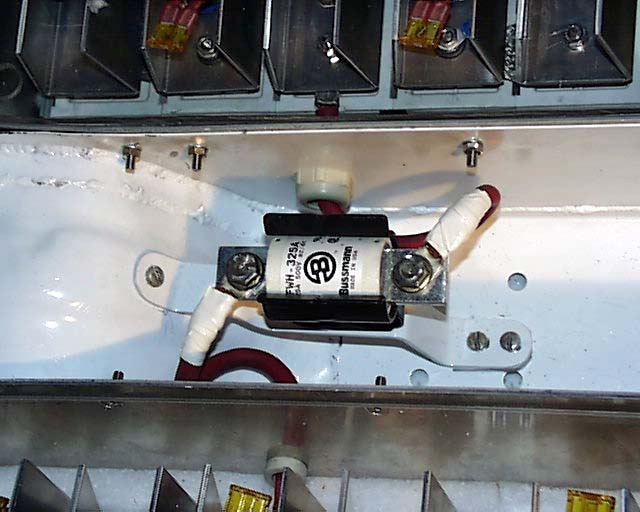
As it turns out most the the obvious blackening is just soot and washed
off easily. In a few spots the paint was burned thru. The real mistake
was not so much the loose connection but that I had not put washers on
that connection, and vibration must have loosened it.
I've been putting one fuse in the middle of each pack of batteries,
under the theory that a short circuit in an accident is most likely
going to be in the cabling between groups. It might be a good idea in
terms of safety, but it does make mounting fuses a pain.
Mark
--- End Message ---
--- Begin Message ---
Hi Rod and all,
Alain has a write up of it on the web in both French and English at:
http://www.rocler.qc.ca/levehiculevert/generateur.htm
He included emails from the EVDL "Gods" explaining the "how", even some of
Lee's ASII art.
I have been collecting parts for one as well, I have a 13 HP Honda engine
and a 10 HP 3 Phase Dayton motor. Now if only I could get an EV running
and find some spare time. The Civic EV is apart and the Force's new
batteries came in with the wrong posts and had to be returned. I am so
sick of talking EVs, reading EVs, but not driving an EV!
Thanks,
Mike Chancey,
'88 Civic EV
'95 Solectria Force (almost there)
Kansas City, Missouri
EV List Photo Album at: http://evalbum.com
My Electric Car at: http://www.geocities.com/electric_honda
Mid-America EAA chapter at: http://maeaa.org
Join the EV List at: http://www.madkatz.com/ev/evlist.html
At 07:19 PM 3/11/2004, you wrote:
It's been posted before, but I don't have the
details.  I think Allen St Ives? has a similar
generator setup.
I'm looking for detailed plans on connection of
a 3 phase AC induction motor to an ICE motor
to produce DC power for range extension on the
Dodge TEVan.  I have a couple of Baldor 3HP 3 phase
AC induction motors available for this project.
Since I'm time limited I would like information on
how to make this work without doing all of the
engineering myself.
Any help would be appreciated.
Thanks,
Rod
--- End Message ---
--- Begin Message ---
I brought a "battery" that I assembled out of 1.2-1.4Ah 18650 cells
to the Seattle EVA meeting on tuesday, everyone enjoyed it and we
even spun up an E-Tek that was there aswell.  The battery is made
out of 20 cells, 10 "packs" of 2 cells each with mini surface mount
?regulators for each pack of 2 cells.  I have 5 packs in parallel,
and 2 packs (4 cells) in series, for ~12-16v and ~6Ah.  Each of
the cells interconnects are connected with a solid series/parallel
grid of solid copper wires. So...
I have 5 cell strings in parallel, and 4 of these in series.
I connected each in parallel to try to keep them balanced,
since otherwise each cell was at a different voltage. It seems
to be working great, only a 0.04v variance between parallel
sets at either end of the SOC. like 4.20v, 4.21v, 4.17v, 4.17v.
Noone mentioned anything at the meeting, but I have this gut
feeling that what I've done is potentially very bad for some
reason.  But all I can figure is that if 1 cell "dies" that
the other 4 which are in parallel with it will discharge into
the bad call, perhaps lighting it up like a bad fireworks
display.  But I feel that this is an unlikely long shot.  Cell
death should be a slow degradation, that eventually shows up
when one parallel set begins to self discharge more rapidly.
Would using fueses, or smaller (vaporizeable) wire make it safe?
They are only there to keep the parallel cells in balance, these
wires don't carry the load, the series interconnects are much
larger and this is where the heavy load flows through.
It seems to me that this is a much simpler way to keep large
numbers of small cells in balance, and makes me question my
preconceptions of how the T-Zero pack might be layed out.
After seeing the 20 unbalanced cells I realized that they
might have 68 parallel cells in a single module, at 2.2Ah
per cell that's a 3.6v 150Ah "module" which would have a
regulator to keep it from going over voltage on charge.
100 of these modules brings the voltage up to 360v.  These
150Ah modules would be able to deliver 8C, 1200Amps.  Otherwise
with 100 cells in series for 360v 2.2Ah modules, and 68 of them
in parallel you would end up with 6800 cells all out of balance.
But a 3.6v module of 68 cells would be managable, 1 regulator.
Why should I not parallel these cells like I have?
L8r
 Ryan
PS. Might build a second pack and try using them on
my 24v scooter in some sort of Hybrid setup.
(can't afford a car sized pack, but still wanna play)
Otherwise I can dis-assemble it and use the packs on my RC Plane.
PPS. Anyone know where to get the 2000mah, 2200mah, or 2250mah versions?
--- End Message ---
--- Begin Message ---
Reverend Gadget wrote:
>
> Just making plans for now. I'm budgeting for my solar
> recharging station. sounds like I'll need about 2k of
> solar panels and a bunch of floodies. The question is
> do I need to set up a PFC-50 in a special way. I would
> like to be able to leave the charger in the car so I
> can plug it in here at the shop (grid power) and then
> go home and plug it in to the dump pack (solar power).
> Or do I need 2 PFC-50s?
>
>                       Gadget
>
> --- Rich Rudman <[EMAIL PROTECTED]> wrote:

If you do this we will have to leave the power stage set up for AC line
values, The Buck enhancer will have to be AC/Dc capable, This is doable.
Clearly you will want to put a 100 amp DC rated fuse in the "Input"
cables. Use the same one that I have as a outout fuse Little fuse L50S
100 rectifier fuse. Also you will have to live with the input line
rectifier losses. If your source pack is greater than about 96 DC the
unit should run as designed.
        Warrente less of course, but without any ill will, I just fix what ya
broke and send the bill.
Knowing the input source pack and output target pack voltages will help
me figure out What I can get away with. If you have a really low source
pack then having a little 140 to 300 watt 12 volt input and 120VAC ouput
inverter fire off the 15 volt supply will allow you to actually feed the
PFC50 from 12 to 24 volts. To get close to the full power of the unit
you still will need close to 100 volts of DC.  The power stage is
designed to not draw hard below 100 volts. This can be reprogrammed, but
I don't think we can make one do both Well.
Joe????
        I was having trouble getting one to make 75 amps into a 50 volt load,
until I relised that my "120" was 105, Adding back the sag to 120 under
load brought back the 75 amp ouput. Alot depends on the innys and
outties.

I need to actually do this...I have been shipping so fast that I usually
don't have a unit around to play with.

--
Rich Rudman
Manzanita Micro
www.manzanitamicro.com
1-360-297-7383,Cell 1-360-620-6266
--- End Message ---
--- Begin Message ---
* LP8.2: HTML/Attachments detected, removed from message *
--- End Message ---
--- Begin Message ---
Lightning Ryan wrote:
>

> You should be able to do it with just one charger, because
> you always want it onboard for oppertunity charging anywhere.
> I'm sure that Rich would be more than happy to help make it
> work. I'm pretty sure he's done "duel profile" stuff with
> just the flip of a switch for standard AC and Dump Pack DC.
>
> L8r
>   Ryan

The answer to that is NO I havn't Joe has on the battery cycler project.
Some of the niftyiest stuff we don't dare let out of our shop. It's just
too easy to Umm have a Event.
but lets talk...

I need source pack voltages......
--
Rich Rudman
Manzanita Micro
www.manzanitamicro.com
1-360-297-7383,Cell 1-360-620-6266
--- End Message ---
--- Begin Message ---
Mark Farver wrote:
>
> Lee Hart wrote:
> > One other thing I see. This type of fuse is intended to be held in a
> > fuseholder; not suspended from free leads. When a fuse blows from a
> > heavy overload, it can blow the ends off, throwing its guts all over the
> > place. The fuseholder is supposed to restrain it from doing this.
>
> Is there a standard source for these?  All of the EV parts sources just
> sell the fuses.  Or should I just put it in a enclosed box?
>
> Mark

Stud mount fuses, can be mounted....... by the studs....
        Little fuse sells them, We make them for the chargers since we can make
them by hand for less than the cost of them. I think Dad got a new batch
from  AMP for about 1/6 th the cost from Littlefuse. Every PFC charger
except Stock 20s use a stud mount fuse of some kind. Since about
September '03. We started melting fuse holders once we put in the buck
enhancers.  The stud mount 50 amp fuse was pretty cool until I Up reved
the PCB and asked for 40 amps from a PFC30, now I am getting 30 to 50
Deg F rise on the fuse. Time to find 60 amp fuses.
        No fuse holder needed, just securly tighten the Bevel washers to hold
blasted ends.
I have never had a fuse part. I don't think it's a real issue.


--
Rich Rudman
Manzanita Micro
www.manzanitamicro.com
1-360-297-7383,Cell 1-360-620-6266
--- End Message ---
--- Begin Message ---
OK. What is the question?

I was suggesting that a DC input PFC-50 can run at 100 amps if the input
rectifiers were eliminated. If you run the DC through the rectifiers, the
heat sink will heat up and cut the power back to 75 amps just like normal. I
doubt that you can run 100 amps continuous through a PFC-50 with the
rectifiers hooked up especially in the southwestern summers.

You might put a relay in the system that bypasses the rectifiers when fed
from a DC source. That would drive the cost up but would increase the power
level. You could also do an interlock to keep the AC from feeding out the DC
input or vice versa. The DC sensor can also reprogram the calibration
resistors to make the machine make the same current regardless of input
voltage. The problem with this is, it disables the PFC on the DC setting
which you don't need in that configuration.

Joe Smalley
Rural Kitsap County WA
Fiesta 48 volts
NEDRA 48 volt street conversion record holder
[EMAIL PROTECTED]


----- Original Message -----
From: "Rich Rudman" <[EMAIL PROTECTED]>
To: <[EMAIL PROTECTED]>
Sent: Thursday, March 11, 2004 8:30 PM
Subject: Re: Fast charging


> Reverend Gadget wrote:
> >
> > Just making plans for now. I'm budgeting for my solar
> > recharging station. sounds like I'll need about 2k of
> > solar panels and a bunch of floodies. The question is
> > do I need to set up a PFC-50 in a special way. I would
> > like to be able to leave the charger in the car so I
> > can plug it in here at the shop (grid power) and then
> > go home and plug it in to the dump pack (solar power).
> > Or do I need 2 PFC-50s?
> >
> >                       Gadget
> >
> > --- Rich Rudman <[EMAIL PROTECTED]> wrote:
>
> If you do this we will have to leave the power stage set up for AC line
> values, The Buck enhancer will have to be AC/Dc capable, This is doable.
> Clearly you will want to put a 100 amp DC rated fuse in the "Input"
> cables. Use the same one that I have as a outout fuse Little fuse L50S
> 100 rectifier fuse. Also you will have to live with the input line
> rectifier losses. If your source pack is greater than about 96 DC the
> unit should run as designed.
> Warrente less of course, but without any ill will, I just fix what ya
> broke and send the bill.
> Knowing the input source pack and output target pack voltages will help
> me figure out What I can get away with. If you have a really low source
> pack then having a little 140 to 300 watt 12 volt input and 120VAC ouput
> inverter fire off the 15 volt supply will allow you to actually feed the
> PFC50 from 12 to 24 volts. To get close to the full power of the unit
> you still will need close to 100 volts of DC.  The power stage is
> designed to not draw hard below 100 volts. This can be reprogrammed, but
> I don't think we can make one do both Well.
> Joe????
> I was having trouble getting one to make 75 amps into a 50 volt load,
> until I relised that my "120" was 105, Adding back the sag to 120 under
> load brought back the 75 amp ouput. Alot depends on the innys and
> outties.
>
> I need to actually do this...I have been shipping so fast that I usually
> don't have a unit around to play with.
>
> --
> Rich Rudman
> Manzanita Micro
> www.manzanitamicro.com
> 1-360-297-7383,Cell 1-360-620-6266
>
--- End Message ---
--- Begin Message ---
No, that is not the motor I used. I have one on my grader to lift the blade,
so I have used them.

The motor I used was 8 inches long. Is 4 inches in diameter. Has four brush
holder sticking out. Has four nipples sticking out (apparently for cooling
air.) They are slow speed motors.

Any idea how much voltage these will take?

Joe Smalley
Rural Kitsap County WA
Fiesta 48 volts
NEDRA 48 volt street conversion record holder
[EMAIL PROTECTED]


----- Original Message -----
From: "Rod Hower" <[EMAIL PROTECTED]>
To: <[EMAIL PROTECTED]>
Sent: Thursday, March 11, 2004 5:58 AM
Subject: Re: fun with powerwheels 2...-motors


>
> --- Joe Smalley <[EMAIL PROTECTED]> wrote:
> > We currently have an 18 volt tape drive motor with
> > an 8:1 dual reduction
> > chain drive to a differential. The jeep has a 4 inch
>
> I have a couple of these 18V tape drive motors
> on Ebay right now,
>
> Item 3802746338
>
http://cgi.ebay.com/ws/eBayISAPI.dll?ViewItem&item=3802746338&category=42920&sspagename=STRK%3AMESSE%3AIT&rd=1
>
> Item 3802745949
>
http://cgi.ebay.com/ws/eBayISAPI.dll?ViewItem&item=3802745949&category=42920&sspagename=STRK%3AMESSE%3AIT&rd=1
>
> Rod
>
--- End Message ---
--- Begin Message ---
Bill Griffen was building just such a fuse holder out of Delrin I believe.
He is/was planning to market them. Maybe he will see this and post on his
units? Regards, David Chapman.

----- Original Message -----
From: "Victor Tikhonov" <[EMAIL PROTECTED]>
To: <[EMAIL PROTECTED]>
Sent: Thursday, March 11, 2004 7:51 PM
Subject: Re: Flaming wreckage...


> Lee Hart wrote:
> > Victor Tikhonov wrote:
> >
> >>One example for these fuses:
> >>http://www.metricmind.com/ac_honda/images/fuse_inst.jpg
> >
> >
> > This one worries me, Victor. If the fuse blows an end off, you have a
> > dangling high voltage wire that could easily contact ground or something
> > else.
>
> If it breaks in half, perhaps. Although the drive system is
> isolated from the vehicle and I did connect + and - of the
> pack to the body (not simultaneously!! :-) ) to check that
> this is no problem. The only problem I see is if both flying
> ends somehow join together again.
>
>   Also, that looks like a plastic clip. Remember that fuses are
> > resistors, and get hot! Even at currents that don't blow the fuse, it
> > can melt that plastic clip!
>
> This is a holder for a liquid hose of an ICE, and made from high temp
> withstanding plastic, not polyethylene (or such) thermoplastic.
> http://www.metricmind.com/ac_honda/images/fuse_bracket.jpg
>
> Well, all criticism is correct. A proper way to do it is to have
> an insulated base with threaded posts and mount a fuse on them,
> and have a cover. Then the leads can't fly away no matter what.
>
> If I'm to implement all the requirements how it really should be,
> I may as well build another EV :-)
>
> ... which I will...
>
> Thanks for comments!
>
> --
> Victor
> '91 ACRX - something different
>
--- End Message ---
--- Begin Message ---
Hmm, that's sort of like asking if a BMW is a good car for general
transportation.

I don't think Tektronics makes a "bad" scope. It might have more
features than you need, but that's ok.

--
+++++++++++++++++++++++++++++++++++++++++++++++++++++++++++++++++++++
The problem with the world is stupidity. Not saying there should be a
capital punishment for stupidity, but why don't we just take the
safety labels off of everything and let the problem solve itself?
--- End Message ---
--- Begin Message ---
Hi Ryan, I recall during the TZero/18650 discussion someone saying Li cells
parallel much better than Ni-Cd or Ni-Mh. I don't recall who said though,
sorry. Maybe they'll speak up.

During the previous discussion i thought it might be practical to build
large parallel cell modules by milling circular recesses into say 1/2"
aluminium plate, insert the cells into it then place a mirror of the bottom
plate on top and clamp the plates together using say threaded nylon rod or
nylon strapping. This would form a building block to build batteries. Kind
of like oversize "D" cells. The spacing between the cells would be
controlled by spacing of the recesses. At its simplist a string of modules
could pressed together the same as the cells in a torch. The large flat
surface of the Aluminium plate would provide plenty of current carrying
capacity, and possibly some heatsinking as well. From my limited
understanding of CNC machining i believe it would be easy to have these
churned out. As i'm typing this it occurs to me plates with recesses both
sides could be used to build up batteries too. Keeping pressure on all the
cell connections and maintaining rigidity could start to be a issue though.

Cheers,

Justin

At 20:15 11/03/04 -0800, you wrote:
>I brought a "battery" that I assembled out of 1.2-1.4Ah 18650 cells
>to the Seattle EVA meeting on tuesday, everyone enjoyed it and we
>even spun up an E-Tek that was there aswell.  The battery is made
>out of 20 cells, 10 "packs" of 2 cells each with mini surface mount
>?regulators for each pack of 2 cells.  I have 5 packs in parallel,
>and 2 packs (4 cells) in series, for ~12-16v and ~6Ah.  Each of
>the cells interconnects are connected with a solid series/parallel
>grid of solid copper wires. So...
>
--- End Message ---
--- Begin Message ---
From: [EMAIL PROTECTED] [mailto:[EMAIL PROTECTED]
Subject: battery trouble

Steve, and all;

I wonder how closely you're following USB's recommended charge
profile. I just replaced my year old set of USB's with a new set of
T105's. The USB's had never delivered the expected range when new,
and after about 8 months started to show signs of degradation. At
the 12 month point they showed serious signs of sulfation and paste
shedding, and range was down to less than 10 miles. Water use,
voltage and current levels all seemed normal during charging, even as
my range was evaporating. Emails to Nawaz revealed that the charge
algorithm for USB's is quite different than what Trojans require, so
much so that my charger (the FrankenLester) is not capable of
delivering it. The USB's require a much higher finish charge
voltage, and a much longer absorption phase time, a charge cycle that
would cook Trojan's. I wish I would've known that before I bought
the USB's. When I mentioned this to Nawaz he said that they
typically qualify/approve a customer's charger before deploying USB's
into customer fleets. For me it doesn't make economic sense to buy a
new charger just to support a different brand of battery. My EV is a
daily driver and must earn it's keep in overall TCO. In the past I
have always had good service from Trojan batteries, so I went back to
what I know will work in my EV. Can't say I'm mad at Nawaz or USB,
I'm the one that wrecked them but wanted to post this as a heads up
to anyone currently using or considering a USB pack. I've been off
the EVDL for a while but thought I'd poke my nose in here and see
what's going on, I see a lot of familiar names still here.

Regards,

Mark Brueggemann
Albuquerque, NM
S-10 EV
--- End Message ---
--- Begin Message ---
Comments inserted...

Joe Smalley
Rural Kitsap County WA
Fiesta 48 volts
NEDRA 48 volt street conversion record holder
[EMAIL PROTECTED]

----- Original Message -----
From: "David Brandt" <[EMAIL PROTECTED]>
To: <[EMAIL PROTECTED]>
Sent: Thursday, March 11, 2004 5:39 AM
Subject: RE: fun with powerwheels 2...


> What I want to know is...how did 7 kids fit onto the jeep?  It must be
> bigger than ours.

Probalby not bigger than yours. Five of them were standing on the rear
bumper or running boards and hanging onto the winshield frame and roll bar.

> That sounds like our girls (make it faster!).  Only problem is they also
> want to play demolition derby occasionally.

We have the same problem here. The jeep has lost its front bumper within the
last week, the windshield a month ago and both front fenders late last year.
It looks like it lost a demolition derby but it keeps on running. I noticed
the roll bar mount on the passenger side is missing tonight. The kid that
was driving said it is "out in the field somewhere". I had to drive a 3/4
inch steel rod down through the base of the birdbath because it kept falling
over while I was at work. It has not fallen over since the rod went in.

> At 36V, the stock breaker may not work.  I like the emergency cutoff I got
> for the go kart I'm working on.  50V, 400A continuous, 2000A surge, lever
> actuated.  I got it from Waytek Wire, about $100.  It's pretty big, but
> provides a definite lever to pull to kill the system.

I think I am going to need one. I had a Blue Seas marine 100 amp breaker
installed when I had the group 31 under the seat but it kept getting kicked
and had to be manually reset. I am currently running with a 35 amp
automotive self resetting breaker on each battery (to save the charger if
connected in reverse).

> Why not bring it to the next NEDRA race?  Maybe he could set a 36V record
to
> go with your 48V record:-)  Seriously, two 13 ah hawkers fit nicely under
> the hood with some judicious plastic work, and you've already found places
> to put others. Less weight for the shorter run.  Maybe you could squeeze
in
> two under the seat for a 48V system.  Switch back to the 26 ah batteries
for
> normal use.

Could a five year old pass tech? I would need to consult the rules on that
one.

I want to go to Woodburn again this year. I was unable to go in 2003 because
of a schedule conflict. Maybe I can get four Orbitals and improve my record.

I can get two Hawker EP12V38s under the seat and one under the hood to run
at 24 Volts.
Three SVR-14s fit under the hood with NO plastic work to run 36 Volts.
If I got really crazy, I could put three SVRs under the hood and four under
the seat for a total of 84 Volts. That is not appropriate for a five year
old unless the current is set very, very low and it has some very short
gears.

Rich, Rod and I discussed running at a NEDRA event. They are worried that
NEDRA will come across as toy drivers instead of serious racers to NHRA. I
got the message that the jeep would be welcome in the pits but running the
eighth mile would not be a very good thing to do. I doubt the jeep would
pass tech because there are no seat belts and the stock roll bar is not tall
enough to cover the driver's head. The body is tall enough so it will not
fit under the Armco, so that should not be a problem. It still has the stock
27 inch wheelbase so the Shortened Wheelbase clause is not a hindrance.
There is no MP/J record, so it would set a record on the first run if we ran
24 volts. The MP/I record was set with a 48 volt golf truck at 25 MPH. I
would need a larger motor to beat that. I wonder what it would be like to
drive 25 MPH through the finish lights on a 27 inch wheelbase and no
suspension. The thought scares me.
--- End Message ---
--- Begin Message ---
Sounds good - thx.

-----Original Message-----
From: [EMAIL PROTECTED] [mailto:[EMAIL PROTECTED] On
Behalf Of Peter VanDerWal
Sent: March 11, 2004 9:36 PM
To: EV
Subject: Re: Tektronix 475 Scope


Hmm, that's sort of like asking if a BMW is a good car for general
transportation.

I don't think Tektronics makes a "bad" scope. It might have more
features than you need, but that's ok.

--
+++++++++++++++++++++++++++++++++++++++++++++++++++++++++++++++++++++
The problem with the world is stupidity. Not saying there should be a
capital punishment for stupidity, but why don't we just take the safety
labels off of everything and let the problem solve itself?
--- End Message ---
--- Begin Message ---
Are those stainless steel bolts?

Whenever I use stainless steel around battery cables, the bolt gets hotter
than the copper.

Is it possible that the bolt was carrying the current rather than the cable
making contact directly to the fuse causing the stainless to get hot thereby
melting the copper where it was touching the bolt?

Joe Smalley
Rural Kitsap County WA
Fiesta 48 volts
NEDRA 48 volt street conversion record holder
[EMAIL PROTECTED]


----- Original Message -----
From: "Mark Farver" <[EMAIL PROTECTED]>
To: <[EMAIL PROTECTED]>
Sent: Thursday, March 11, 2004 2:27 PM
Subject: Flaming wreckage...


> <img
>
src="http://mindbent.org/coppermine/albums/userpics/10001/normal_P3110001.JP
G">
>
> http://mindbent.org/coppermine/displayimage.php?pos=-189
--- End Message ---
--- Begin Message ---
> Yup, $2K get's you about 400Watts of PV
hey Ryan! where ya buyin' ya PVs, 5 bucks a watt is
RETAIL! Three bucks a watt can be had with some good
shopping. The ones I have now were only 2 bucks a
watt.


> Might be better off with wind generation, if it's
> windy where you are.


I'd love to do some wind generation, but I am under
the jurisdiction of the California Costal Commission.
The rule is no visible windmills. However, where
there's a will there's a way. I will be putting large
eaves on my barn(workshop) on the windward side to
pressurize the building and will use this to spin a
blade on the downwind side of the building. The
building faces the ocean and gets a nice daily breeze.
Sometimes we get some really nasty winds so I will
have to have some provision to close these off in a
storm.

           Reverend "off the grid" Gadget

=====
visit my website at www.reverendgadget.com
--- End Message ---
--- Begin Message ---
If you put the windmills in the soffits (sp.?) (under the eves facing the
ground) then you would not need to pressurize the entire building. The
pressure would be on the side of the building and the wind would be through
the attic instead of the entire building. You could have shutters that close
over the turbines to close off the attic in case of a storm.

Joe Smalley
Rural Kitsap County WA
Fiesta 48 volts
NEDRA 48 volt street conversion record holder
[EMAIL PROTECTED]

----- Original Message -----
From: "Reverend Gadget" <[EMAIL PROTECTED]>
To: <[EMAIL PROTECTED]>
Sent: Thursday, March 11, 2004 11:08 PM
Subject: Re: Fast charging


> I'd love to do some wind generation, but I am under
> the jurisdiction of the California Costal Commission.
> The rule is no visible windmills. However, where
> there's a will there's a way. I will be putting large
> eaves on my barn(workshop) on the windward side to
> pressurize the building and will use this to spin a
> blade on the downwind side of the building. The
> building faces the ocean and gets a nice daily breeze.
> Sometimes we get some really nasty winds so I will
> have to have some provision to close these off in a
> storm.
>
>            Reverend "off the grid" Gadget
>
> =====
> visit my website at www.reverendgadget.com
>
--- End Message ---
--- Begin Message ---
I'm a moderninst and I forget that the rest of the
world isn't. Excuse me for not giving more info. both
my house and barn will have no attic space. The "Barn"
and the house are to be postmodern steel, glass and
concrete buildings. I usually run a hugh fan in my
shop for ventilation. I figured I could just let the
wind do it and hitch a ride electrically. Even though
the land is near the ocean it really is a temperate
desert. Temps these few days have been in the high
70's and 80's and rarely go below 60. so having the
air blow through is really quite nice. The barn will
be built above the fog layer and gets about 350 days
of sunshine a year. It's a perfect solar haven. and
the ev batts like it too.

                    Gadget


--- Joe Smalley <[EMAIL PROTECTED]> wrote:
> If you put the windmills in the soffits (sp.?)
> (under the eves facing the
> ground) then you would not need to pressurize the
> entire building. The
> pressure would be on the side of the building and
> the wind would be through
> the attic instead of the entire building. You could
> have shutters that close
> over the turbines to close off the attic in case of
> a storm.


=====
visit my website at www.reverendgadget.com
--- End Message ---
--- Begin Message ---
Ryan,

You might want to check out http://www.modenergy.com/ - they have packs that
do exactly this, including the 2200 mAh versions, including all cell
balancing circuitry.  From 24 Ah to 144 Ah, in 14.8V packs that can be
connected in series!

-Kevin

----- Original Message -----
From: "Lightning Ryan" <[EMAIL PROTECTED]>
To: <[EMAIL PROTECTED]>
Sent: Thursday, March 11, 2004 11:15 PM
Subject: Why am I not supposed to parallel cells/batteries?


I brought a "battery" that I assembled out of 1.2-1.4Ah 18650 cells
to the Seattle EVA meeting on tuesday, everyone enjoyed it and we
even spun up an E-Tek that was there aswell.  The battery is made
out of 20 cells, 10 "packs" of 2 cells each with mini surface mount
?regulators for each pack of 2 cells.  I have 5 packs in parallel,
and 2 packs (4 cells) in series, for ~12-16v and ~6Ah.  Each of
the cells interconnects are connected with a solid series/parallel
grid of solid copper wires. So...

I have 5 cell strings in parallel, and 4 of these in series.
I connected each in parallel to try to keep them balanced,
since otherwise each cell was at a different voltage. It seems
to be working great, only a 0.04v variance between parallel
sets at either end of the SOC. like 4.20v, 4.21v, 4.17v, 4.17v.

Noone mentioned anything at the meeting, but I have this gut
feeling that what I've done is potentially very bad for some
reason.  But all I can figure is that if 1 cell "dies" that
the other 4 which are in parallel with it will discharge into
the bad call, perhaps lighting it up like a bad fireworks
display.  But I feel that this is an unlikely long shot.  Cell
death should be a slow degradation, that eventually shows up
when one parallel set begins to self discharge more rapidly.

Would using fueses, or smaller (vaporizeable) wire make it safe?
They are only there to keep the parallel cells in balance, these
wires don't carry the load, the series interconnects are much
larger and this is where the heavy load flows through.

It seems to me that this is a much simpler way to keep large
numbers of small cells in balance, and makes me question my
preconceptions of how the T-Zero pack might be layed out.
After seeing the 20 unbalanced cells I realized that they
might have 68 parallel cells in a single module, at 2.2Ah
per cell that's a 3.6v 150Ah "module" which would have a
regulator to keep it from going over voltage on charge.
100 of these modules brings the voltage up to 360v.  These
150Ah modules would be able to deliver 8C, 1200Amps.  Otherwise
with 100 cells in series for 360v 2.2Ah modules, and 68 of them
in parallel you would end up with 6800 cells all out of balance.
But a 3.6v module of 68 cells would be managable, 1 regulator.

Why should I not parallel these cells like I have?

L8r
  Ryan

PS. Might build a second pack and try using them on
my 24v scooter in some sort of Hybrid setup.
(can't afford a car sized pack, but still wanna play)
Otherwise I can dis-assemble it and use the packs on my RC Plane.

PPS. Anyone know where to get the 2000mah, 2200mah, or 2250mah versions?
--- End Message ---
--- Begin Message ---
Ken at KTA sells a nice fuseholder.  It has a glassfilled high temperature
plastic base with two threaded mounting studs, and a rubber cover that goes
over the top.  I just got one with the go-kart safety fuse.

Ironically, the one I got for the go-kart is rated the same as the one on my
escort (150 VDC, 400 amps) and is smaller.  If I ever need to replace that
fuse, I'll use one of these.

> -----Original Message-----
> From: Mark Farver [mailto:[EMAIL PROTECTED]
> Sent: Thursday, March 11, 2004 9:42 PM
> To: [EMAIL PROTECTED]
> Subject: Re: Flaming wreckage...
>
> Lee Hart wrote:
> > One other thing I see. This type of fuse is intended to be held in a
> > fuseholder; not suspended from free leads. When a fuse blows from a
> > heavy overload, it can blow the ends off, throwing its guts all over the
> > place. The fuseholder is supposed to restrain it from doing this.
>
> Is there a standard source for these?  All of the EV parts sources just
> sell the fuses.  Or should I just put it in a enclosed box?
>
> Mark
--- End Message ---
--- Begin Message ---
I was told by Trojan that ripple current vs DC charging didn't have any
effect on the battery, just getting the 110% AH used back in. Sounds like
Steve's finish rate of 3.5A is about right. My point was that the
recommended finish rate by US, 12A for equalize is way to high. I tried it
once with the sulfuric gas smell and lots of venting hydrogen. The IEI with
dv/dt=0 finish is the industry standard for lead acids and seams to work the
best. I don't know why US recommends 23.5-31A at start of charge, it
shouldn't matter if you start there or at 12A, it just takes a bit longer.
It is possible that Steve is seeing shortened life on the batteries due to
the high current draw of twin 400A controls/motors without the benefit of a
transmission. It would be interesting to know if all Tropica drivers
experience this same phenomenon. I believe the current draw is above the
recommended and might be better off with Optima,Orbital or Hawker's for the
high acceleration requirements.
----- Original Message -----
From: "Roger Stockton" <[EMAIL PROTECTED]>
To: <[EMAIL PROTECTED]>
Sent: Thursday, March 11, 2004 4:54 PM
Subject: RE: battery trouble


> Mark Hanson [mailto:[EMAIL PROTECTED] wrote:
>
> > Typically I see 2.58V per cell at EOC new/cold and near 2.40V
> > as they get older/hot near 5-600 cycles or around 8k miles.
>
> > I don't see any difference that I'm aware of between the two
> > companies lead acid batteries.
>
> You wouldn't be able to discern a difference in paste/plate composition
> by eye, yet such differences are said to be responsible for the US
> Battery product requiring a higher charge voltage than Trojan's product.
> It is not unbelievable that such differences could also make the US
> Battery product more sensitive to initial inrush current level too.
>
> > I find that Trojan has spent
> > more research on the proper charge regime which works the
> > same on US batteries.
>
> Have you actually tried the US Battery recommendations on your US125s?
> I have tested Trojan's charge recommendations on US2200s and measure
> lower capacity than when I charge according to US Battery's
> recommendations.  If you aren't using all of the capacity you have
> available, you might not notice the difference, but it is entirely
> possible that you might get better even life from your US Battery
> product if you follow their recommendations.
>
> > The final charge equalize US recommends at 12 amps is too high, I set
> > mine around C/40 or 5.5 amps (Jim Drizos-Trojan at the time
> > recommended) for a 220AH lead acid battery regardless of who made it.
>
> Just to be clear, the charge current requirement that we've been
> discussing with respect to US Battery products is the *initial* charge
> rate, not the finish rate.  Steve's charger delivers a solid 12A at the
> start of charge, but US Battery recommends at least 23.5-31A for the
> first few minutes of charge with US125s.  Steve's charger finishes at
> 3.2-3.5A.
>
> Any idea what sort of ripple there is on your charger's output current,
> especially at the start of charge (i.e. maximum current)?  Steve's
> charger puts out nearly pure DC, and while we can't nail anyone down on
> it, there is a possibility that the high peak currents associated with
> conventional chargers' output ripple allow the battery's minimum current
> requirements to be satisfied even though the average charge rate looks
> no higher than Steve's 12A.
>
> > I drive 15 miles each way and charge at work, pay back at
> > 6.5c per kwh and usually go about 10 miles at lunch for
> > parts, hardware, Grainger sometimes Radio Shack for evening
> > projects. So with two cycles per day about 700 cycles for
> > 6Vers and about 500 20 mi cycles for 8vers.
>
> Sounds pretty similar to Steve's usage.
>
> Thanks for the data points!
>
> Cheers,
>
> Roger.
>
--- End Message ---
--- Begin Message ---
Mark Farver wrote:
>
> Lee Hart wrote:
> > One other thing I see. This type of fuse is intended to be held in a
> > fuseholder; not suspended from free leads. When a fuse blows from a
> > heavy overload, it can blow the ends off, throwing its guts all over the
> > place. The fuseholder is supposed to restrain it from doing this.
>
> Is there a standard source for these?  All of the EV parts sources just
> sell the fuses.  Or should I just put it in a enclosed box?

The fuse manufacturers sell the fuseholders, too. But like the fuse
itself, they are expensive.

I'm cheap, so I've generally made my own. You can buy bakelite terminal
blocks with big threaded studs embedded in them. Mount two the right
distance apart, and drop the fuse onto them. Or, make a copper buss bar
that bolts onto two adjacent batteries, and bolt the fuse between the
buss bars. Just arrange things so if the fuse blows in half, there won't
be loose wires to land on something.
--
"Never doubt that a small group of committed people can change the
world. Indeed, it's the only thing that ever has!" -- Margaret Meade
--
Lee A. Hart  814 8th Ave N  Sartell MN 56377  leeahart_at_earthlink.net
--- End Message ---
--- Begin Message ---
I got an e mail for sombody who wanted to know about useing a Catapiller DC
Electric Motor, 10 Horse power,Working Volts 36 - 48 volts. 1550-2180 RPM's
For Electric Lift Truck, Catapiller Part # 97E2010040,This is a Gereral
Electric Motor, GE # 97E20-10040, model # 5BT1335B007A, New Catapiller
dealer Price,$1250.00, with a $1600.00 core charge,Size of motor, 13.0"
long, X 11.0" dia. X (90.0 lbs),motor will except .750 O.D. 12 spline shaft.
They don't have a lot of money and can get this pretty cheep , would this
compare to a 6.7 adc , the spline shaft I would think would be a  problem .
There looking for somthing to go 45mph , in a light car.  I'll forward the
info on , thanks .
steve clunn
--- End Message ---
--- Begin Message ---
How about some big wind turbine vents on top of the barn.  Just don't tell
anyone they are turning a generator instead of pulling air out of the attic.

Thanks,
Andre' B.  Clear Lake Wis.


-----Original Message-----
From: [EMAIL PROTECTED] [mailto:[EMAIL PROTECTED] On
Behalf Of Reverend Gadget
Sent: Friday, March 12, 2004 1:09 AM
To: [EMAIL PROTECTED]
Subject: Re: Fast charging

<<  snip  >>

> I'd love to do some wind generation, but I am under
> the jurisdiction of the California Costal Commission.
> The rule is no visible windmills. However, where
> there's a will there's a way. I will be putting large
> eaves on my barn(workshop) on the windward side to
> pressurize the building and will use this to spin a
> blade on the downwind side of the building. The
> building faces the ocean and gets a nice daily breeze.
> Sometimes we get some really nasty winds so I will
> have to have some provision to close these off in a
> storm.
>
>            Reverend "off the grid" Gadget
>
> =====
> visit my website at www.reverendgadget.com
--- End Message ---
--- Begin Message ---
The other day I fast charged my Mazda 132 v from the ford ranger 196 pack ,
I taped into the ranger pack which was easy as I have them all hooked with
rod sock connectors and was charging nicely at 70 amps  with the PFC going
also , . I had used the Mazda for work that morning and wanted to drive it
on my weekly 30 mile  Okeechobee run and didn't have a lot of time to
recharge it ( had pulled 50 ah out of it) . after 30 minutes the voltage was
up to 14v so I unplugged the ranger and let the PFC keep working , but the
time I had everything loaded it was charged.  Recharging the ranger was easy
also I just ran the  charger till the batteries voltage came up , turned
down the charger and kept an eye on the bat voltage , them rebooked the
ranger pack back to original setup.  This got me thinking about having a
setup where I could put or plug another  car/truck in series with the motor
and charge through the controller, now there would be a way to controller
the amps , buy gas pedal and would be using the whole ranger pack,.
----- Original Message -----
From: "Lee Hart"
>
> > The best way to control the dump charger is with a PWM controller.
>
> I agree. But you should add an inductor in series with the batteries
> being charged. The PWM controller needs the inductance of a motor or its
> current limit won't work. If your EV has a series motor and PWM
> controller, you can use its controller and the field winding of the
> motor for your dump charger controller.

how about the whole motor, it might spin a little but so what , I would
think the controller would be happy , not seeing a almost dead short on its
output ( motor when you start up) .  I'm wondering if this setup could be
used for other stuff , like for welding , or running a plasma cutter? If the
motor is always in line (series) wouldn't this be safe.


> > The way I would do dump charging is with a PFC-50 running as a DC
> > to DC converter.
>
> The PFC-50 is a more elegant solution, that has charge control and that
> big inductor built-in.


> "Never doubt that a small group of committed people can change the
> world. Indeed, it's the only thing that ever has!" -- Margaret Meade
> --
> Lee A. Hart  814 8th Ave N  Sartell MN 56377  leeahart_at_earthlink.net
>
--- End Message ---