http://www.nanowerk.com/news2/green/newsid=33237.php
Li-EcoSafe - more efficient and safer batteries for electric vehicles
Nov 14, 2013  German Aerospace Center (DLR)
[image
http://www.nanowerk.com/news2/green/id33237.jpg
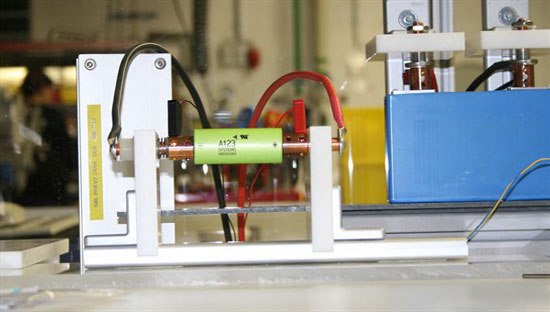
Lithium-ion battery undergoing laboratory tests
]

(Nanowerk News) The range and performance of electric vehicles depends
directly on the batteries used. Lithium-ion batteries are currently
considered very promising for use in alternative vehicle propulsion systems
due to their high energy density and low capacity loss when frequently, but
incompletely, charged and discharged.

In the joint project Li-EcoSafe', battery experts at the German Aerospace
Center (Deutsches Zentrum für Luft- und Raumfahrt; DLR) are working together
with the Centre for Solar Energy and Hydrogen Research Baden-Württemberg
(Zentrum für Sonnenenergie-und Wasserstoff-Forschung Baden-Württemberg; ZSW)
and the University of Ulm because lithium-ion batteries are more efficient,
less costly and safer to manufacture. The scientists wish to contribute to
their everyday practicality, thus improving consumer acceptance of electric
vehicles. In the course of the project, the researchers will consider the
entire development process, from materials to suitable operating strategies.
The network is a Centre of Excellence for Battery Research, which is funded
under the 'Excellent Battery' programme by the German Federal Ministry of
Education and Research (Bundesministerium für Bildung und Forschung; BMBF).

Diversity is the key – different types of lithium-ion batteries

The term lithium-ion battery refers to a type of battery in which lithium
ions are used as charge carriers. These ions usually migrate between the two
electrodes in a liquid medium, the electrolyte. Depending on the design and
materials used, special variants can be created, such as lithium cobalt
oxide or lithium iron phosphate batteries, which sometimes have different
characteristics. "To further develop the concept of the lithium-ion battery,
the chemical reactions at the interface between electrodes and electrolytes
are especially interesting for us, because they affect the properties of
such a battery," explains Norbert Wagner, who supervises the project at the
DLR Institute of Technical Thermodynamics in Stuttgart. With this knowledge,
new materials for use in lithium-ion batteries can be developed or the
surface of the electrodes can be made in such a way that the batteries
exhibit the most desirable properties and can be operated safely.

Overcharging and high temperatures – the 'acid test' for batteries

DLR experts are playing a key part in the joint project – they build
lithium-ion batteries and subject them to extensive laboratory testing.
Based on specific requirements geared toward standard test cycles in the
automotive industry, the batteries are repeatedly charged and discharged in
test cabinets. The scientists observe the evolution of the battery's storage
capacity as well as its behaviour under differing boundary conditions such
as during overcharging or at high temperatures. Specific recommendations are
important to guarantee safe operation, since strict safety requirements are
necessary for vehicle applications. "In this context, we are interested in
finding out under what conditions and at which locations heat build-up
inside the battery leads to damage, mostly due to undesirable side
reactions," says Wagner, describing the work. Heat build-up leads to
decomposition of the electrolyte, which produces oxygen at the cathode. The
pressure inside the battery increases, which can cause rupture or
combustion.

Novel measurement methods for science and user

To record and understand events such as voltage or capacity losses as
accurately as possible, the DLR researchers are also working on novel
measurement techniques. To do this, they systematically divide the surface
of the electrodes into individual segments, and track the reactions
occurring there. Another method, referred to as in-situ diagnostics, allows
the Stuttgart experts to virtually view the inside of the battery and make
measurements while the battery is in operation. These advances in the field
of measurement methodology could also contribute to the development of more
complex battery management systems in the future. For example, these methods
could provide the driver of an electric car with immediate feedback about
the battery's charge, condition and life expectancy at the touch of a
button.
[© 2013 Nanowerk]
...
http://www.dlr.de/dlr/en/
German Aerospace Center (DLR)


For all EVLN posts use:
http://electric-vehicle-discussion-list.413529.n4.nabble.com/template/NamlServlet.jtp?macro=search_page&node=413529&query=evln&sort=date

Here are today's archive-only EV posts:

EVLN: Citroen C-Zero EV deal of the week, £10k off
EVLN: Nissan e-NV200 commercial e-van to be sold worldwide next year
EVLN: Electric Formula E racing will help EV sales
EVLN: One-less barrier to NY's public L3&L2 EVSE growth
EVLN: Tesla's trademark tussles with Chinese squatter who wants $30M
+
EVLN: World EV Record 808mi/1,003.2km @19mph/30kph


{brucedp.150m.com}


--
View this message in context:
http://electric-vehicle-discussion-list.413529.n4.nabble.com/EVLN-DLR-Li-EcoSafe-efficient-and-safer-EV-batteries-tp4666333.html
Sent from the Electric Vehicle Discussion List mailing list archive at
Nabble.com.
_______________________________________________
UNSUBSCRIBE: http://www.evdl.org/help/index.html#usub
http://lists.evdl.org/listinfo.cgi/ev-evdl.org
For EV drag racing discussion, please use NEDRA
(http://groups.yahoo.com/group/NEDRA)