EV drivers can’t sit straight for all the ca$h in their wallets
http://theenergycollective.com/lindsay-wilson/357551/ev-wedge-how-electric-vehicle-fuel-savings-vary-country-and-car
The EV Wedge: How Electric Vehicle Fuel Savings Vary By Country (and Car)
Like it?
by Lindsay Wilson  March 22, 2014

[image
http://shrinkthatfootprint.com/wp-content/uploads/2014/03/EV-wedge.gif
EV wedge

http://shrinkthatfootprint.com/wp-content/uploads/2014/03/EVcostcomparison.gif
Electric vs gasoline fuel costs

http://shrinkthatfootprint.com/wp-content/uploads/2014/03/EVwedgeprius.gif
EVwedgeprius

http://shrinkthatfootprint.com/wp-content/uploads/2014/03/EVwedgecamry.gif
EV Wedge Camry

http://shrinkthatfootprint.com/wp-content/uploads/2014/03/EVwedgetesla.gif
EVwedgetesla
]

Have you ever heard of the EV Wedge?

No? Me neither. Let’s try to define it then.

If you’d asked me to define the ‘Electric Vehicle Wedge’ a few years ago I
would have chuckled a little, and suggested it was the small pile of cash
you needed to afford one.  But due to falling EV prices and rising gasoline
prices that snark is utterly outdated.

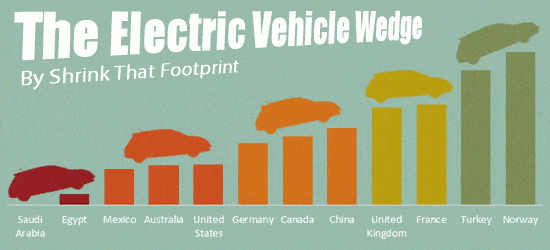
In almost all countries it is cheaper to power an electric vehicle than fuel
a gasoline car.  The cost gap between these two fueling options is what I
like to call the EV Wedge .  In some countries this wedge is so damn big
that EV drivers can’t sit straight for all the cash in their wallet.

Comparing Gasoline and Electric Fuel Costs

This post provides a cheap and cheerful comparison of fuel costs for
electric vehicles and gasoline cars.  To keep it simple I thought we’d look
at the costs of fuel for driving 10,000 miles.  This is about 25% less than
Americans drive each year, or 20% more than Europeans.

The graph ... compares the fuel costs of driving 10,000 miles in a Nissan
Leaf (electric) and Toyota Prius (gasoline hybrid).  I’ve shown this graph
... so we can see how the fuel savings are calculated.  It also shows us
that both the electricity price and gasoline price are relevant when
estimating the fuel savings.

Electric vs gasoline fuel costs

The first thing to note is that the fuel cost of driving a Prius is greater
than the Leaf in all 12 countries we collected data for.  The variation
between both electricity and gasoline prices across countries is enormous.

In countries where gasoline is expensive, like Turkey and Norway, the fuel
cost for driving a Prius 10,000 miles is pushing $2,000 whereas in Saudi it
is just $120.  The fuel cost of driving the Leaf 10,000 miles varies greatly
too. From as high as $980 in Germany down to $116 in Saudi.

The difference between the gasoline and electricity costs is what I call the
EV Wedge.  By showing this graph ... we can see that in places like Germany
and Australia high electricity costs can eat into the wedge.  Where
electricity prices are high savvy EV owners look to solar, or time of use
pricing, to drive down their charging costs.

The EV Wedge: Nissan Leaf [EV] vs Toyota Prius [hev]

In each of the last three months of 2013 the most popular new car in Norway
was either the Nissan Leaf or Tesla Model S.  There are loads of reasons
behind this, including no purchasing tax, free tolls and access to bus
lanes.  On top of this the EV Wedge is enormous!!

Here’s the data we looked at above but now purely looking at the fuels
savings, the wedge that is.

Over the course of driving 10,000 miles a Prius driver in Norway spends
$1,544 more on fuel than a Leaf driver.  In Turkey that figure is $1,360, in
the UK it’s $986, in the US it’s $410 and in Saudi it’s just $5.  Just add a
zero and you’ve got the fuel savings for 100,000 miles assuming constant
prices (the problem with any lifetime comparison).

All the figures assume the typical combined fuel economy for each car and
the 2012 average prices for gasoline and electricity in each country. In
cases where the electricity used to charge is cheaper than the household
grid average this figure will be greater.  This is actually a really
important point because typically a majority of EV owners use off-peak
charging when available.

In the comparison above we’ve compared two compact hatchbacks.  But the 50
MPG Prius is actually pretty damn efficient for a gasoline car.  The EV
Wedge only gets bigger when you start comparing less efficient petrol cars
to electrics.

The EV Wedge: Nissan Leaf vs Toyota Camry

I know that the Toyota Camry is a bigger car than a Leaf but I find this a
fun comparison.  It is basically America’s most popular electric car (the
Leaf) against its most popular sedan (the Camry).  Unlike the Prius, the
Camry only gets 28 MPG.  So the fuel savings from driving a Leaf are
considerable.

When you compare the fuel costs of the Nissan Leaf to a less efficient
petrol vehicle like the 28 MPG Camry they really start to stack up pretty
quickly. Don’t get hung up on it being an American Camry, these figures hold
for any 28 MPG car gasoline car.

In European countries where taxes on petrol are high the savings from going
electric are considerable.  The fuel savings of driving a Leaf instead of a
28 MPG petrol car in the UK are $2,260 for each 10,000 miles.  Even in the
US where gasoline is relatively cheap there is a $1,000 saving.

Finally, just for a laugh let’s run the numbers for some luxury cars.

The EV Wedge: Tesla Model S vs Mercedes

I know very little about luxury cars.  I’m not even sure if someone spending
$100,000 on a car really cares much about fuel costs.  I’m guessing they
love the Tesla because of the torque and the ride.  But then again I may be
wrong.

You see the Tesla Model S has topped monthly sales in Norway twice recently.
Not just for electric cars, but for all cars. The tax exemption for buying
is no doubt a big deal.  As is the ride.

But just check out these fuel savings for the Tesla Model S compared to the
19 MPG Mercedes 550S.

Not only do Tesla Model S drivers enjoy the pleasure of driving the best car
Consumer Reports have ever tested, but in Norway they’ll be able to buy the
next one using fuel savings from their first.

Throw in some very modest rises in petrol price over the next decade and a
Norwegian Tesla driver will save more than the purchase price by the time
they’ve driven 150,000 miles.  Even for places like the UK, France and
Germany the figures are pretty impressive.

When you consider that Tesla offers free supercharging in many places you
start to see why they have waiting lists. With free electricity the US fuel
savings versus the 19 MPG Mercedes jump to $2,000 per 10,000 miles.  In the
UK, France and Germany they go above $4,000.  In Norway and Turkey it’s
above $5,000.

Curiously I actually think the graph above will eventually be more important
for the Pickup Truck market than it is for luxury cars. You see those
numbers aren’t far off what the sums might look like for a ‘Tesla Truck‘ vs
a Ford F-Series.  And while we may be a few years away from batteries cheap
enough to justify electric trucks their potential for fuel savings is just
colossal when you consider a F-150 gets 19 MPG.

What to make of the EV Wedge?

To keep this post a bit of fun I avoided delving into lifetime cost
comparisons and the fuzzy assumptions they involve.  Instead I’m just trying
to point out something that should be clear by now.  Powering a car with
electricity is cheaper than fueling it with gasoline (unless you live in
Caracas).

Here are some basic takeaways:

    Gas prices are key: the higher the gasoline price the bigger your
potential savings are.  This makes electric cars attractive in Europe.

    Electricity prices also matter: the potential benefits of going electric
can be eroded by high electricity prices.  Germany and Australia are good
examples.

    Fuel economy matters too: the poorer the fuel economy of the car you are
switching from the bigger your fuel savings will be.  You can see this in
the more than doubling of the wedge between the Prius and the Camry.

Because of the varying differentials between gasoline and electricity prices
the fuel savings from going electric vary massively from place to place.
But in general the economics for electric vehicles just keep getting better.

If you’re looking at buying an electric vehicle in a couple of years when
prices drop some more there is something worth thinking about.  You see
electric vehicles are a bit like solar was a few years ago.  There are
currently some very attractive grants and tax breaks that take some pain out
of the purchase price, and this means EVs look great from a lifetime cost
perspective.

As battery prices keep falling and production scales increase there is a
good chance electric cars will keep getting cheaper.  As prices go down and
sales go up the current level of subsidy will make less and less sense for
governments, just as it did for high feed-in tariffs with solar.  In fact in
some places they already seem too attractive.

If I was in the market for an electric vehicle I’d be keeping a very close
watch on my local EV grants, tax rebates or other incentives.

If I lived in Norway I’d be on a waiting list, because it would also cut a
lot of carbon.
[© Social Media Today 2013]


For all EVLN posts use:
http://electric-vehicle-discussion-list.413529.n4.nabble.com/template/NamlServlet.jtp?macro=search_page&node=413529&query=evln&sort=date

Here are today's archive-only EV posts:

EVLN: EV test drives @U-High's Earth Club 4/26 Normal IL (video)
EVLN: An EVSE traffic jam that’s good for the environment
EVLN: AZ HB2123 lets EV makers sell direct= vying for Gigafactory
EVLN: LEAF drivers save £52.5M as they clock up nearly a billion km
EVLN: Donor is sour w/ Christie after his Tesla sales ban in NJ
+
EVLN: Electric Brammo Empulse Motorcycle Amps Up Its Sex Appeal


{brucedp.150m.com}


--
View this message in context:
http://electric-vehicle-discussion-list.413529.n4.nabble.com/EVLN-EV-snarking-is-utterly-outdated-co-t-saving-between-EV-petrol-tp4668658.html
Sent from the Electric Vehicle Discussion List mailing list archive at
Nabble.com.
_______________________________________________
UNSUBSCRIBE: http://www.evdl.org/help/index.html#usub
http://lists.evdl.org/listinfo.cgi/ev-evdl.org
For EV drag racing discussion, please use NEDRA
(http://groups.yahoo.com/group/NEDRA)