http://www.goodfruit.com/electric-orchard-equipment-progress/
Electric orchard equipment progress
Richard Lehnert  Apr 7, 2014
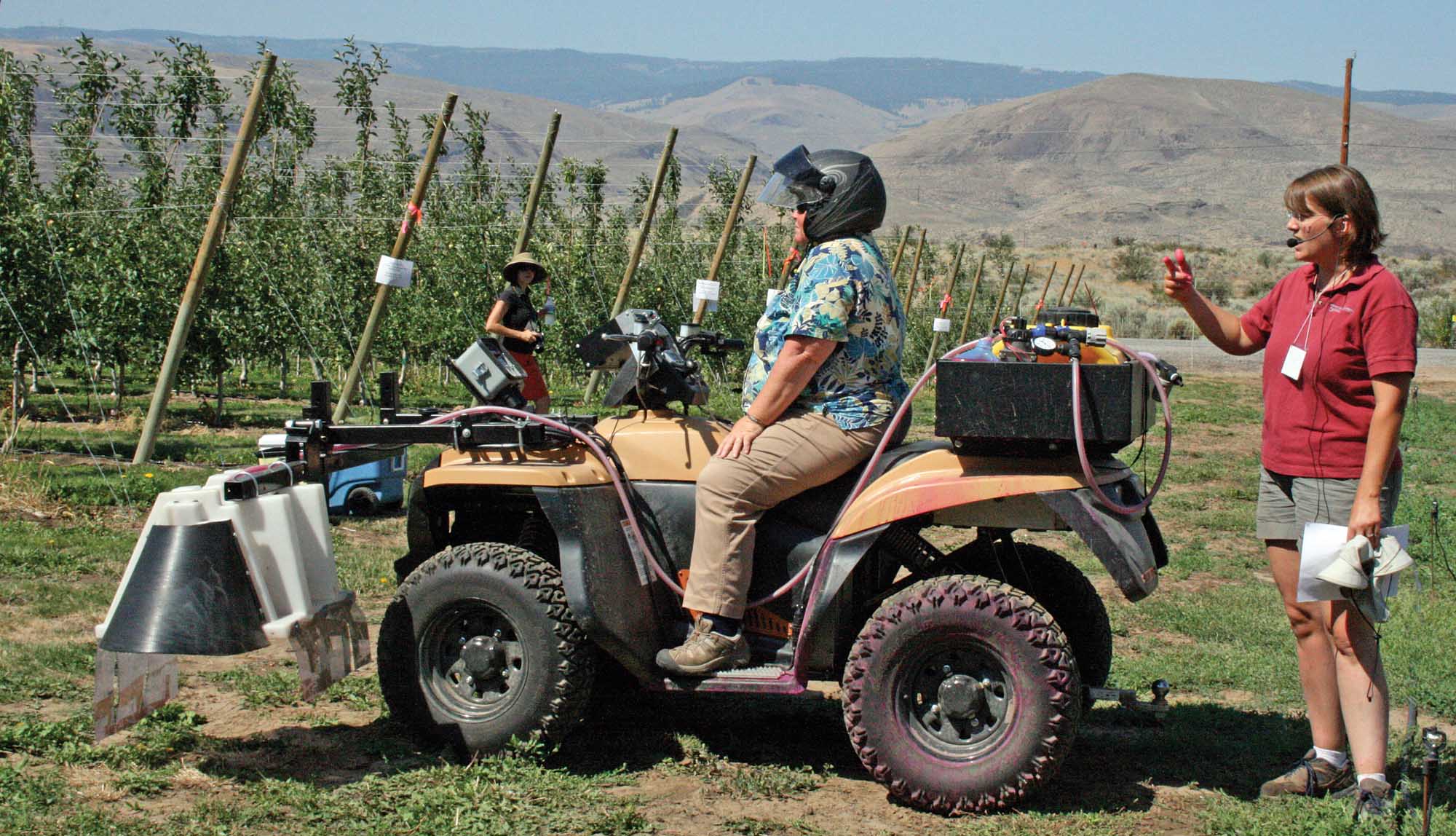
[image http://www.goodfruit.com/wp-content/uploads/ElectricOrchardMachine072810gw.jpg Electric orchard equipment - WSU extension educators Karen Lewis and Gwen Hoheisel (right) demonstrate an experimental electric ATV during a WSU field day in 2010. (Geraldine Warner/Good Fruit Grower) ] Orchardists are showing interest in electric power, and it’s coming, slowly. In the early 1960s, an agricultural engineer at Michigan State University fascinated students as he drove about campus virtually soundlessly in an electric Volkswagen. He’d taken out the original 36-horsepower gasoline engine and gas tank, put in an electric motor, and filled up the back-seat compartment with several hundred pounds of lead acid batteries. Arthur W. Farrall was head of the MSU ag engineering department whose building now carries his name. It took 50 more years before electric cars could be seen more than occasionally on the streets, and the chief reason it’s finally happening is improvement in batteries. But it’s been a long struggle for electric vehicles to make a comeback against those powered by the internal combustion engine, which beat out electric vehicles more than a century ago. So, when will electric vehicles come to orchards? Today, we do see more electric-powered equipment moving into orchard operations, but mostly for smaller tools. Battery packs power several lines of orchard and vineyard pruning equipment. Orchard Master, Felco, Infaco, Pellenc, Campagnola, and Coima offer pruners powered by lithium ion batteries. Orchard Master says its pruners will charge in three to four hours and operate for a workday of six to eight hours on one charge. A handheld blossom thinner, invented by Paul Miller in Michigan and called The Cinch, runs off a portable battery-powered electric drill. We’ve seen the explosion in hand tools—drills and saws—that have come along with smaller, more powerful batteries with greater electric storage capacity. John Deere makes all-electric utility vehicles, like golf carts for farmers, that it claims will run all day on a single charge and haul up to 500 pounds as effectively as its gas engine models. Trout Creek Orchard in Parkdale, Oregon, recently announced it had purchased its first all-electric vehicle and plans to buy more and install solar power to charge them. Gaining in Europe In Europe, the Italian company Windegger Maschinen BmbH has offered electrically powered elevating platforms for several years. The company claims to have sold about 1,000 units to Italian apple, pear, and cherry growers and is now marketing the machines across Europe. The company did not respond to Good Fruit Grower’s e-mail requests for more information, but its website has brochures showing the K8e Alpin platform working on mountain slopes of 30 degrees. The platform, which is powered by 48-volt tubular batteries, is designed for orchard pruning, training, and harvesting. Another Italian company, Alkè, is selling a line of electric vehicles for farm and orchard use. Growing interest At Phil Brown Welding in Conklin, Michigan, owner and machine designer Phil Brown said that nobody in the United States has yet ventured far down the road, but there is growing interest in electric power for orchard machines. “We’re getting more calls about it,” Brown said. “Especially near residential areas, growers are looking for machines that are quieter and emit less pollution.” For machines operating in confined spaces, like forklifts in storages, electricity offers a fume-free option that is safer for people and produce. “When electric power comes to orchard equipment, it will come through the automobile industry,” Brown said. “They’ve spent billions to develop electric car technology.” In fact, on February 26, Tesla Motors announced plans to invest $2 billion—and to gather partners to invest $3 billion more—in a large factory in the southwestern United States to produce batteries for electric cars within the next three years. According to the New York Times, the goal is to further develop batteries and cut their cost. While Tesla has been a driving force behind electric cars and manufactures a highly regarded $70,000 sedan, other manufacturers—General Motors, Ford, Nissan—are also producing electric cars. The battery hurdle “Batteries are still the biggest hurdle,” said Valerie Karplus, a research scientist at Massachusetts Institute of Technology, responding to questions from Good Fruit Grower. “Motors and controls are well advanced and ready for prime time.” But batteries have come a long way. Lead acid batteries will generate power of about 40 watt hours per kilogram of weight. A lithion ion battery will do three times that amount. And some new ideas in lithium batteries—lithium air and lithium sulfur are now being researched—could raise that by a factor of 10 to 15. Cost, on the other hand, is still a major factor. Tesla, in announcing plans for a factory that can produce 500,000 lithium ion batteries a year, said that being able to produce in volume will bring their cost down. “There is a lot of uncertainty surrounding future battery costs, although costs for battery packs are generally expected to come down,” Karplus said. “Some predictions are that costs will fall from 2010 levels of $1,000/kWh to levels between $200 to $500/kWh by 2020, mainly as a result of mass production and economies of scale, as well as improved cell and packaging design.” Electric vehicle power can be stated in terms of kilowatt hour or horsepower, with 1 kWh equal to about 1.34 hp. Today, while an internal combustion engine for a car can be purchased for about $2,000, the cost of an electric car engine will run about $15,000. Almost all of that cost is for batteries. “For electric-only vehicles, one significant factor is the all-electric range (or distance you can drive) on a single charge of the battery,” Karplus said. “Batteries that support a relatively long all-electric vehicle range are physically larger and also cost more to purchase, while batteries with shorter ranges are smaller and cost less. Cost increases with battery size. “Farm equipment is a potentially promising application for battery-electric vehicles when only short travel distances need to be covered on a single charge.” Constant torque Are electric engines able to deliver the raw power and torque that internal combustion engines do, Good Fruit Grower asked? “Yes, electric motors deliver relatively constant torque, even at low speeds, which means that electric vehicles can achieve better acceleration performance than the internal combustion engine,” Karplus said. As described in the website Howstuffworks.com, “Switching on an electric motor is similar to turning on a light bulb. A bulb turns on immediately when you flick a switch; it doesn’t need time to build up power” like an internal combustion engine does. Thus, the Tesla roadster, with 288 hp, is about as fast as a Corvette Z06, but with only half the horsepower. Would adoption of battery power in place of internal combustion engines reduce carbon emissions to the atmosphere, or just change them from tailpipes to smokestacks? “The reduction in carbon emissions depends on the energy source used to charge the battery, as well as on the emissions of the vehicles their use displaces,” Karplus said. “If batteries replace engines that get relatively low gas mileage, and batteries are charged from relatively clean electric grids (for instance, with a lot of hydropower, nuclear, renewables, and, to some extent, natural gas), significant greenhouse gas emissions can be avoided.” [© 2014 Washington State Fruit Commission] For all EVLN posts use: http://electric-vehicle-discussion-list.413529.n4.nabble.com/template/NamlServlet.jtp?macro=search_page&node=413529&query=evln&sort=date Here are today's archive-only EV posts: EVLN: BRUSA's 7.2kW ICS2 Doubles Inductive Charging Power EVLN: Personal Electric VTOL Airplane That Won't Need A Runway EVLN: Yo-Mobile Axed> Renault-Nissan in the Russian market + EVLN: Horizon electric trike for quadriplegics {brucedp.150m.com} -- View this message in context: http://electric-vehicle-discussion-list.413529.n4.nabble.com/EVLN-Electric-powered-equipment-moving-into-orchard-operations-tp4668909.html Sent from the Electric Vehicle Discussion List mailing list archive at Nabble.com. _______________________________________________ UNSUBSCRIBE: http://www.evdl.org/help/index.html#usub http://lists.evdl.org/listinfo.cgi/ev-evdl.org For EV drag racing discussion, please use NEDRA (http://groups.yahoo.com/group/NEDRA)