http://green.autoblog.com/2014/08/20/sakti3-480-mile-evs-possible-safe-affordable-solid-state-battery/
Sakti3 says 480-mile EVs possible using safe, affordable solid state
batteries
By Sebastian Blanco  Aug 20th 2014
[image
http://o.aolcdn.com/dims-shared/dims3/GLOB/crop/677x450+122+0/resize/628x417!/format/jpg/quality/85/http://o.aolcdn.com/hss/storage/midas/c4034ab205531a3363de69f99560aa95/200616729/sakti3-hot-sodering-safe.jpg
Sakti3 safety


video
https://www.youtube.com/watch?v=ICQcj73dMgI
Please DO NOT try this with your own battery!
Sakti3 Inc Aug 20, 2014
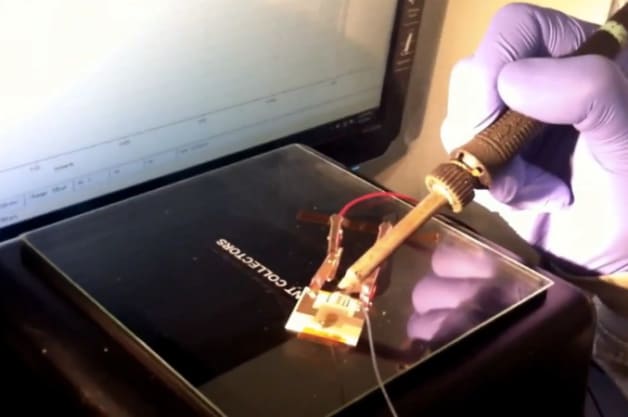
Sakti3 has produced novel, all solid state battery cells that are very safe.
This video shows one of our cells on test in our facility - our engineer
drops hot soldering flux onto the cell, and it continues to operate
normally. The voltage briefly rises due to the heat of the flux, and then
returns to normal. The flux in this movie was heated to approximately 550ºC.
The cell is discharging at approximately 1W (~C/10). Thanks for watching!
]

Every now and then, we hear a little bit more information from the Michigan
battery company Sakti3, which is somewhat secretly working on advanced solid
state lithium batteries. In March, for example, the company was named an
affiliate of the US Department of Energy's Joint Center for Energy Storage
Research (JCESR). This week, according to GigaOM, Sakti3's founder Ann Marie
Sastry announced that its solid state li-ion battery will be able to double
the range of an electric car (or, make things like cell phones last twice as
long between charges). If applied to a vehicle like the Tesla Model S, that
would mean 480 miles on one charge. This should permanently remove the
phrase "range anxiety" from our vocabulary, shouldn't it?

Even more interesting is the claim that Sakti3 believes these batteries
could be had for just $100 per kWh, well under not only today's costs but
also the predictions others have made for the near future. Of course, the
batteries are not here yet, but the company says its test packs were made on
"fully scalable equipment," implying that the time to put up or shut up
should be here soon, don't you think?

Another bit of news, if we can call it that, is a video that is supposed to
show what happens when you drop hot soldering material onto one of the
Sakti3 cells: basically, nothing and the cell continues to work safely.
Note, though, that the title of the video is "Please DO NOT try this with
your own battery!" which is just good advice. Watch the audio-free clip
below.

Despite the relatively low profile, Sakti3 has been able to get investment
attention. The company got $4.2 million from GM Ventures and Itochu in 2010
and $2.5 million from the Michigan Economic Development Corp. in 2008, for
example. In total, Sakti3 has received over $30 million for its
better-battery tech. We're ready for the cars any time now.
[© autoblog.com]
...
http://www.scientificamerican.com/article/secretive-company-claims-battery-breakthrough/
Secretive Company Claims Battery Breakthrough
The Michigan startup Sakti3 says its solid-state cells more than double the
energy density of today’s best li-ion batteries
Aug 20, 2014  By Seth Fletcher


http://cleantechnica.com/2014/08/22/sakti3-battery-startup-aims-hit-100-per-kwh/
Sakti3 — Battery Startup — Aims To Hit $100 Per kWh
August 22nd, 2014  by Zachary Shahan

[video
https://www.youtube.com/watch?v=gTAhdJRkQ0s
SaktiBatteryAdvantage
SaktiInc Jul 29, 2013
Introduction about how battery works and what Sakti3 (Sakti) battery's
advantage is ...
]

Honestly, this one wasn’t planned: last night, I wrote about a new study
concluding that until EV battery costs get down to $100 per kWh, most US
consumers would be better off going with an electric car with less than 100
miles of range rather than splurging for a long-range electric car. Now,
battery startup Sakti3 is saying that its high-performance, sold-state
lithium-ion batteries should be able to get down to $100 per kWh. That would
make 100+ miles of range more logical for more people.

Of course, “could” is the key word right now, and no timeframe has been
estimated, as far as I have seen. However, Sakti3 apparently has a lot going
for it and support from some industry insiders.

What $100 per kWh Could Mean
Tesla’s batteries reportedly cost it $200-300 per kWh, and they are said to
be the best bargain on the market. Of course, Tesla and partner Panasonic
are supposed to be getting their battery costs down on their own, especially
through the scaling up of production at their planned Gigafactory, so let’s
not get into implications for Tesla here. But if Sakti3 was able to get
manufacturing going at $100 kWh within a few years (a big “if” in the world
of battery startups), and Nissan was to use these batteries in its LEAF or
some younger LEAF sibling, that could mean an electric car with over 250
miles of range for under $30,000 (the average new car in the US goes for
over $32,000)… if we assume $300 per kWh for Nissan’s current batteries
(Nissan’s current battery costs may very well be higher).

At such a point, the electric car would be cleaner; for many people,
cheaper; greener; not dependent on foreign oil; more convenient to recharge
(by a landslide — just plug in once in awhile before going to bed); and more
fun to drive.

Of course, another route (and a smarter route according to my eyes) would be
to double the LEAF’s range while also cutting the price by several thousand
dollars (again). That would be killer, imho. Of course, one model alone
wouldn’t bring an EV revolution, but the battery would surely be available
to multiple automakers.

Also, for the record, GM Ventures invested in Sakti3 back in 2010, after
partnering up more than a year earlier, so this is far enough along that it
is a technology that GM is putting some money on ...

Back to Sakti3
With that context out of the way, let’s delve a little further into Sakti3.
From that link to its homepage, we get a listing of some of Sakti3's
accolades:

“Sakti’s battery technology was recognized with IHS CERAWeek’s Energy
Innovation Pioneer Award (2014), by MIT’s Technology Review Magazine as one
of the Top 50 Most Innovative Companies (2012) and World’s Top Ten,
representing the “energy” category (2011). The senior team has over 100
years’ collective experience in research, manufacturing, and leadership. The
company is a spinout of the University of Michigan, where its founding team
created laboratories, published over 80 papers on battery technology, and
demonstrated its first early prototypes. Financed by the world’s top
cleantech fund, Khosla Ventures, and the world’s largest automotive
investor, General Motors Ventures, the company has been recognized for its
innovative approaches in Inc., Time, Automotive Engineering, the New York
Times, Washington Post, NPR and other media.”

You can find out more about Sakti3's technology and team at those links in
the quote, so just head on over there if you want more. But since I can’t
resist, here’s the first paragraph of the “technology” section:

“Sakti’s vacuum deposition technology was invented using advanced numerical
models, coupled with real laboratory data on materials. The team began its
work on computers. We methodically modeled the most promising, low cost
materials, and developed battery compositions and configurations that
offered great cell performance. The team also modeled the scale up of
battery production, right from the start. We developed plant models that
enabled us to create the right processes on the right tools. Our aim was to
create the most scalable, flexible and profitable methods possible.”

Sounds quite promising to me, and aren’t Khosla Ventures and GM Ventures due
for a breakthrough by now?

For Solar Support, Too
Update (Aug 23, 11am CET): One of our readers chimed in below with a note
regarding the help such a battery could be for home solar owners as well.
It’s an important point, so I’m throwing it in here:

    This opens up GREAT opportunity for home PV penetration as well as long
range BEV market penetration. More home solar PV will soon have battery
storage, not just over night but maybe also for the next rainy day. This,
coupled with long-range BEVs with plug-out capability will mean home
coverage for many rainy days in a row. So, many homes may go off grid
completely, assisted by daytime at-work charging. This will boost solar
installation not just at home but also in the workplace leading to workplace
charging and discharging to help balance out the grid to permit even higher
wind and solar penetration. A long-range BEV will be able to get power from
at-work charging to bring it home for home use when goes off grid if there
will a long string of rainy days!

    Soon, long-range BEVs ... will be must-haves for most people, and sales
will skyrocket, just like smart phones of today. This shall complete the EV
Revolution for a complete takeover of the market with this uber chic trend
or fashion in CleanTechnica!
[© cleantechnica.com]
...
https://gigaom.com/2014/08/20/startup-sakti3-says-its-battery-could-double-the-range-of-a-tesla-model-s/
Startup Sakti3 says its battery could double the range of a Tesla Model S
By Katie Fehrenbacher  [2014/08/20]
...
http://sakti3.com/?page_id=47


For all EVLN posts use:
http://electric-vehicle-discussion-list.413529.n4.nabble.com/template/NamlServlet.jtp?macro=search_page&node=413529&query=evln&sort=date

http://www.pv-magazine.com/news/details/beitrag/lithium-batteries-leading-electrochemical-energy-storage-technologies_100016157/
Lithium batteries leading electrochemical energy storage technologies

http://ecomento.com/2014/08/27/german-ev-owners-revolt-against-alarming-tesla-group-test/
German range comparison test findings upset EV owners> deemed harsh

http://www.prnewswire.com/news-releases/telefonix-l1-powerpost-electric-vehicle-charging-station-compatibility-confirmed-by-nissan-271377081.html
Telefonix l1powerpost.com EVSE Compatibility Confirmed by Nissan
+
EVLN: As EV battery prices fall> ?More range or lower 100mi EV cost?


{brucedp.150m.com}


--
View this message in context:
http://electric-vehicle-discussion-list.413529.n4.nabble.com/EVLN-Startup-sakti3-com-sez-480mi-EVs-doable-aims-for-100-kWh-packs-tp4671230.html
Sent from the Electric Vehicle Discussion List mailing list archive at
Nabble.com.
_______________________________________________
UNSUBSCRIBE: http://www.evdl.org/help/index.html#usub
http://lists.evdl.org/listinfo.cgi/ev-evdl.org
For EV drag racing discussion, please use NEDRA
(http://groups.yahoo.com/group/NEDRA)