http://insideevs.com/tesla-model-s-vampire-drain-returns-for-some-owners-with-firmware-6-0/
Vampire Drain Is Reportedly Back With 6.0
[20141112] by Eric Loveday
[image
http://insideevs.com/wp-content/uploads/2014/12/SpeedAssist1LaneDePart.jpg
Some Firmware 6.0 Notes
]

Vampire Drain Is Reportedly Back With 6.0

It’s back…well, sort of.

Several Tesla Model S owners are reporting that the dreaded vampire drain
has returned to the Model S in certain Firmware 6.0 versions.

The problem, it seems, is that some Model S EVs are affected by Firmware 6.0
in a negative way.  Even when selecting “sleep always,” affected vehicles
don’t go to sleep.  This inability to sleep leads to high draw on the
vehicle’s battery pack, resulting in up to 12 miles of range lost overnight.

Some owners are reporting that even the latest Firmware 6.0 version (there
are several 6.0 versions out there already) does not cure this vampire
drain.

If you recall, vampire drain was a big issue for Tesla.  The automaker tried
on several occasions to push out updates to reduce the drain.  Firmware 5.0
largely cured the issue:
Tesla Model S Firmware 5.0 Adds Sleep Mode to Cut Vampire Loss By Up To 75%

However, it now seems that at least some of the vampire drain has returned,
at least for affected Model S sedans.

Oddly, not all or even most Model S owners on 6.0 are reporting this issue,
so we aren’t entirely sure what the cause is.  Therefore, we’ll ask, have
you experienced the return of vampire drain since getting 6.0?  If so, what
firmware version is your Model S on right now and what’s the drain you’re
experiencing?
[© 2014 Inside EVs]


http://www.teslarati.com/charging-tesla-model-s-cost-higher/
Charging a Tesla Model S Might Be Costing More Than You Think
Home »Lifestyle » Charging a Tesla Model S Might Be Costing More Than You
Think
By Rob M.  Jul 25, 2014

[images
http://cdn.teslarati.com/wp-content/uploads/2014/07/IMG_3074.jpg
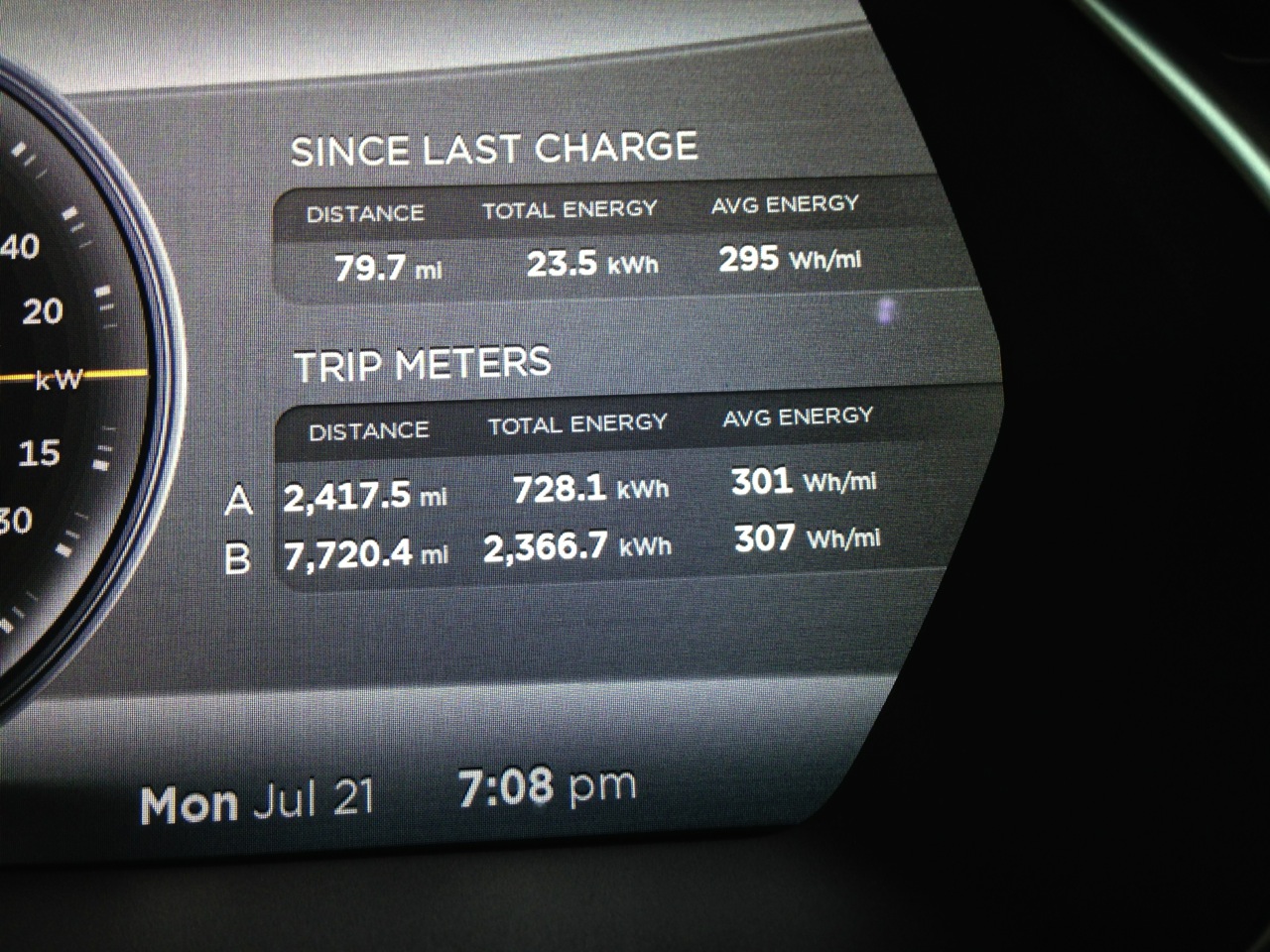
Reported Energy Used

http://cdn.teslarati.com/wp-content/uploads/2014/07/Screen-Shot-2014-07-23-at-10.33.36-AM.jpg
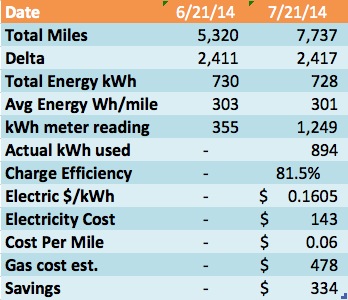
Actual Energy June-Jul
]

When you fill up a normal ICE car you know exactly what your costs are for
the fuel. With an electric vehicle it is not that simple. There is a
charging efficiency factor that comes into play which means that the
reported amount of energy used could be understated and lower than the
actual energy used. In a previous post I wrote about installing an EKM
Digital Submeter on my NEMA 14-50 outlet to measure actual power usage of
the Model S against the reported power displayed on the driver’s digital
dash display. A month later and armed with more data, the energy loss I’m
seeing is larger than I had originally expected.

Test Setup
I charge at home 99% of the time and in the last three months I’ve logged
7,500+ miles driven, one trip to the Supercharger and two visits to the
Tesla store’s High Power Wall Connector. I have a professionally installed
NEMA 14-50 outlet at home. I’m using the factory supplied Universal Mobile
Connector (UMC) as the cable between the outlet and the car. An EKM digital
sub meter measures actual draw from the outlet and is accurate to within 1%
and does not add any measurable load of its own.

Methodology
On the “anniversary date” of taking delivery of my Model S I recorded all of
the pertinent info that was displayed before resetting the Trip A meter.
Before driving the next day I record the reading on the EKM meter. That way
I’ve got the mileage and the Tesla reported power usage over the period
driven. This process will let me see a bunch of information that I plan on
tracking over time, as follows:

    Monthly miles driven
    Monthly kWh used as reported by the Model S
    Monthly kWh used as reported by the EKM meter
    Monthly Average energy used

I plan on using this information to look at how average energy used changes
as the months/temperature changes and perhaps as the Model S gets more miles
on it. While I don’t drive consistently on any given day (test drives,
special trips and the like), the numbers will average out and my driving
style is not likely to change much after 30 years of driving (yeah I’m
getting old but the Model S makes me feel young again!). I also drive pretty
consistent patterns of commuting with a lot of miles to the same places
which helps average out the special trips to locations with different
terrain/conditions. Basically, while the conditions aren’t perfectly stable
over time, the averages and data from this real world testing will be pretty
accurate.

The Data
The last period (6/21 – 7/21) was my first full period with both the car and
the EKM meter. A month of driving and charging, especially with the miles
and kWh’s involved is a decent period over which to look at the results
versus the 2 days from my prior blog post ...

In the above table you can see that the Model S reported 728 kWh used during
the period but the meter reported 894 kWh used. This means my charging
efficiency is only about 82% and electric usage (and cost) is 23% higher
than I may have expected based on the readings the Model S provides. For
that month this is an extra $26 of charging cost which is a small number but
a notable percentage of the total. The good news is that even using this
larger kWh number, the savings versus driving my old ICE car for energy
alone comes in at $334 — I’m saving $334/month in gas driving my Model S!

Summary
Research suggests that an average charging efficiency loss ranges between
10-12%. Over this one month period of over 2,400 miles I’m seeing an 23%
loss using the standard home charging setup that Tesla recommends. Many
people quote an 85% charge efficiency for Tesla, and Tesla’s own charging
calculator appears to assume a 91% charging efficiency which is quite
different than the 82% actual charge efficiency I’ve measured and
significantly worse than the average industry charging efficiency. It would
be great to see another Model S owner do a similar test using the HPWC setup
at home and see if they get results similar to what Tesla is providing. I’d
love to do the test but I’m not quite ready to shell out $1,200 plus
electrician costs to get that data — assuming a cost of about $3,000 all in
it would take me over 20 years to break even assuming the HPWC improves my
efficiency by 10%. From the results above, my conclusion is that the Model S
charging efficiency using the standard home setup is 5-10% worse than other
EVs on the market.
[© teslarati.com]


[dated]
http://www.greencarreports.com/news/1082949_life-with-2013-tesla-model-s-vampire-thirst-for-electricity-at-night
Life With 2013 Tesla Model S: 'Vampire' Thirst For Electricity At Night?
By David Noland  Mar 17, 2013
...
http://www.teslamotors.com/fr_CH/forum/forums/vampire-drain
Vampire drain
stimeygee | 11 Juillet 2013


For EVLN posts use:
http://evdl.org/evln/
http://www.evdl.org/archive/index.html#nabble+template%2FNamlServlet.jtp%3Fmacro%3Dsearch_page%26node%3D413529%26query%3DEVLN%2Bbrucedp2%26days%3D0%26sort%3Ddate

http://www.reviewjournal.com/business/nevada-s-13b-incentive-package-tesla-formally-approved
Nevada’s $1.3B incentive package for Tesla formally approved

http://www.rgj.com/story/money/business/2014/11/20/jobs-posted-tesla-gigafactory/70011762/
More jobs posted for Tesla gigafactory

http://www.northernminer.com/news/nemaska-lithium-and-cree-nation-sign-iba/1003361690/?&er=NA
“Tesla Motors have told me specifically they are looking for hydroxide to
fuel the Gigafactory,” says Moores, referring to the multi-billion
lithium-ion battery plant the electric carmaker is building in NV ...

http://www.daytondailynews.com/news/business/tesla-charging-station-opens-in-englewood/nh8nk/
Tesla charging station opens in Englewood OH
+
EVLN: Tesla manufacturing-robots named after X-Men superheroes


{brucedp.150m.com}


--
View this message in context:
http://electric-vehicle-discussion-list.413529.n4.nabble.com/EVLN-Firmware6-causes-Tesla-S-insomnia-Vampire-12mi-night-Pack-Drain-tp4672728.html
Sent from the Electric Vehicle Discussion List mailing list archive at
Nabble.com.
_______________________________________________
UNSUBSCRIBE: http://www.evdl.org/help/index.html#usub
http://lists.evdl.org/listinfo.cgi/ev-evdl.org
For EV drag racing discussion, please use NEDRA
(http://groups.yahoo.com/group/NEDRA)