http://www.expressnews.com/business/technology/article/Firm-leads-the-charge-for-cars-to-pull-the-plug-6310411.php
Firm leads the charge for cars to pull the plug
By David R. Baker, Houston Chronicle  June 5, 2015
[images  / WiTricity
http://ww1.hdnux.com/photos/36/72/74/8105760/7/920x920.jpg
Honda uses WiTricity’s wireless charging technology with a Fit EV at the
company’s demonstration “Smart Home” in Saitama, Japan

http://ww2.hdnux.com/photos/36/72/74/8105761/7/1024x1024.jpg
WiTricity’s technology uses an oscillating magnetic field to recharge the
batteries of electric cars or plug-in hybrids

http://ww3.hdnux.com/photos/36/72/74/8105762/7/1024x1024.jpg
WiTricity's technology means no plugging is required to recharge electric
and hybrid cars

http://ww4.hdnux.com/photos/36/72/74/8105763/7/1024x1024.jpg
WiTricity CEO Alex Gruzen argues that wireless recharging soon will become
the norm, for personal electronics, medical devices, and yes, cars
]

Someday soon, plug-in cars may no longer need plugging in.

Electric cars and plug-in hybrids won’t recharge their batteries through a
bulky cord. Instead, a small pad placed on the garage floor — or maybe
embedded in it — will transmit energy to a receiver on the car’s
undercarriage, no wires needed. Just drive over the pad, park and forget
about it.

That’s the vision of WiTricity, a Boston-area startup backed by Toyota and
Intel. WiTricity’s technology resembles the cordless charging pads already
available for smartphones and tablets, but it can transmit more power over
greater distance.

Spun out of the Massachusetts Institute of Technology in 2007, WiTricity
isn’t the only company chasing this particular vision, with Qualcomm, Bosch
and Evatran rolling out their own versions. WiTricity CEO Alex Gruzen argues
that wireless recharging soon will become the norm, for personal
electronics, medical devices, and yes, cars. The power cord’s days may be
numbered.

“I’ll have it in my kitchen counter, my bedside table, probably my coffee
table,” Gruzen said. “And throughout my day, I’ll be casually topping off my
devices with this quick ‘energy snacking.’ The same thing will happen in the
automotive space, because when you park, it’ll just charge, and you won’t be
thinking about it.”

Toyota was an early investor in the company, which has raised $45 million to
date. The world’s largest automaker plans to offer WiTricity’s wireless
charging technology as an option on its plug-in hybrid Prius, Gruzen said. A
Toyota spokeswoman declined to confirm any specific plans to outfit the
Prius with WiTricity’s gear. But the automaker announced a licensing
agreement with WiTricity in 2013 and has field-tested the equipment.

Honda uses WiTricity to recharge a Fit EV at one of the auto company’s
showcase “smart homes” near Tokyo. And several of the world’s largest
auto-industry suppliers, including Delphi Corp. and IHI Corp., have licensed
WiTricity’s technology.

Granted, consumers still are getting used to electric cars, with sales
growing slowly at a time of low gasoline prices. Wireless charging would add
another layer of novelty to a type of car that many Americans consider
untested. But the concept’s simplicity could win converts. A study last year
by the Navigant Research consulting firm concluded that annual sales of
wireless electric car charging stations could reach nearly 302,000 by 2022.

“Although some in the industry remain unconvinced that wireless charging
will ever be more than a small niche market, it’s clear that major
automakers have concluded that this technology could be a differentiator in
a crowded EV market,” Richard Martin, Navigant’s editorial director, said at
the time. “Features once considered luxury items, such as power windows and
automatic garage door openers, tend to spread, over time, across all vehicle
segments — and that is likely to apply to wireless charging, as well.”

WiTricity’s technology uses a wire coil in its pad to create an oscillating
magnetic field. That field generates an electric current in a receiving coil
that either sits on the undercarriage of a car or is built into a phone or
other portable device.

“It’s like the opera singer hitting a note and shattering a glass,” Gruzen
said. “When you think about it, she’s moving energy over distance.”

The last generation of electric car — General Motors’ EV1 — used something
similar, with a recharging “paddle” that had to be inserted into a slot
between the headlights. But WiTricity doesn’t need such close, precise
placement between the energy transmitter and receiver. Just parking over the
transmitter will do. While the car is elsewhere, the transmitter remains
off.

Magnetic fields travel through materials, so Gruzen argues the technology
could be better suited to public EV charging than the current crop of
plug-in chargers. WiTricity’s transmitting coil can still function if it’s
covered in concrete — safe from weather, vandalism and copper thieves.

Gruzen says the switch to wireless recharging, for many different devices,
will follow roughly the same path as the adoption of cordless phones — once
a novelty, now ubiquitous.

“I grew up when phones had cords,” he said. “I still to this day think of it
as a cordless phone. But to my kids, it’s just a phone. They’ve never known
phones with cords. So when we’re talking about wireless charging, I think in
five years, it’ll just be charging. It’ll just be what you do.”
[© expressnews.com]


[related]
http://www.greenoptimistic.com/powifi-wireless-power/
PoWiFi Powers Devices Wirelessly, Eliminates Batteries
Mila Luleva  June 5, 2015

[image  / (c) Washington University
http://www.greenoptimistic.com/wp-content/uploads/2015/06/PoWiFi-wirless-power-university-of-washington-1-537x302.jpg


video
https://www.youtube.com/watch?v=gX9cbxLSOkE
Ambient Backscatter
uwsensor Aug 13, 2013
Ambient Backscatter transforms existing wireless signals into both a source
of power and a communication medium. It enables two battery-free devices to
communicate by backscattering existing wireless signals. Backscatter
communication is orders of magnitude more power-efficient than traditional
radio
]

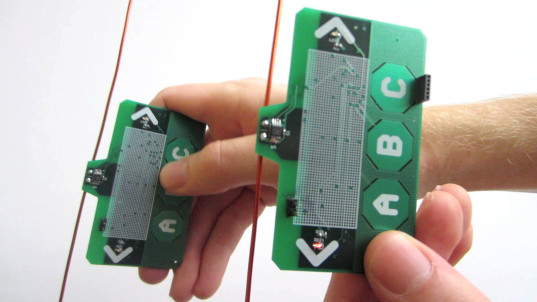
PoWiFi is a system that allows simultaneous wireless transfer of power and
data to electronic devices using existing WiFi infrastructure, giving a
glimpse of hope that batteries might soon be made redundant.

Different technologies that allow wireless charging have been circulating
the news for quite some time now, with gadgets and mats providing that
ever-so-needed power without the need of using a cable and physically
plugging the electronic device. However, the most that these mats do is to
spare you the need to carry a charger, and to feel like a criminal every
time you secretly plug your device in the socket next to your coffee table.

Now, of course this should not sound like criticism, on the contrary, it is
great to see that places like Starbucks for example, are all up for new
slightly geeky and super cool techs that ultimately attract more customers.
But with these techs in place, they do not allow you to walk around, in
fact, you will still have to go to the place, where the wireless powering
technology is available, and spend some time there before you can get going
again. Similarly, wireless charging technology is becoming increasingly
available for EV battrey charging, as it was demonstrated by Busbaar V3
charging station for buses, but again the vehicle has to be at the right
spot, even if it does not require plug in.

Nikola Tesla was the first to start dreaming of getting rid of wires, and
unfortunately he could not live long enough to see his dreams realized.
However, such a brilliant idea is not something that has to be disregarded
as science fiction and just left untouched. Many research teams have been
searching for ways to make this happen. The wireless charging spots are just
the beginning, but the ultimate goal is to be able to charge devices
everywhere, at any point, or why not even get rid of batteries all together?

A team of researchers from University of Washington decided to build on this
idea and conducted an experiment during which they were able to power
devices wirelessly, using only available infrastructure. The technology that
they used is called PoWiFi, and it uses house routers to send RF signals,
which are then received by the antenna of the electronic device. A rectifier
converts the signal into DC power, while a converter boosts the voltage.

Vamsi Talla, a PhD candidate and lead researcher on the project, together
with his team, installed the system in six test homes, where the residents
were advised to keep using their wireless networks as always. Only one of
the users reported problems with internet connection after the installation
of PoWiFi, but all in all, the system allowed wireless transmission of both
power and data simultaneously using RF signal.

This is the first time anyone has managed to get that far. Previous
technologies of this kind by researchers at MIT and the Korea Advanced
Institute of Science and Technology were able to transmit power at a
distance of 2 and 5 meters. These, however, were not able to multitask like
PoWiFi, and most definitely did not imply that we might not need batteries
in the near future.
[© 2015 The Green Optimistic]


For EVLN posts use:
http://evdl.org/evln/


{brucedp.150m.com}


--
View this message in context:
http://electric-vehicle-discussion-list.413529.n4.nabble.com/EVLN-Boston-MA-WiTricity-wireless-EVSE-backed-by-Toyota-Intel-tp4676145.html
Sent from the Electric Vehicle Discussion List mailing list archive at
Nabble.com.
_______________________________________________
UNSUBSCRIBE: http://www.evdl.org/help/index.html#usub
http://lists.evdl.org/listinfo.cgi/ev-evdl.org
For EV drag racing discussion, please use NEDRA
(http://groups.yahoo.com/group/NEDRA)