Ben,

While the current throttle function is in the Elcon manual...... I have never
seen it implemented in the software. I have extracted the code from a dozen or
so of Elcon/TCCH chargers. If someone has one that does this I would like to
get my hands on it to extract the code!
Sent from my iPad

> On Jan 5, 2016, at 10:07 PM, Ben Apollonio via EV <[email protected]> wrote:
>
> Hi Jay,
>
> I think your approach is good.  Some chargers (Elcon, at least) let your BMS
> throttle charge current with an external voltage signal.  If your charger
> supports this, you could try wiring up a comparator and a flip-flop to latch
> the signal at 0A when you hit your target voltage at 30A.
>
> Cheers
> -Ben
>
>> On Jan 3, 2016, at 9:28 PM, Jay Summet via EV <[email protected]> wrote:
>>
>> I want to charge at maximum current to 80%, and then shut off. My thoughts
>> on this subject are listed as text below, or you can follow this link to see
>> the images of my charging profiles:
>>
>> http://www.summet.com/blog/2016/01/03/default-charging-profile-charge-to-80-capacity-quickly/
>>
>> I welcome any comments about issues or tricks I may have overlooked.
>>
>> Thanks,
>> Jay
>>
>>
>>
>> Because I have a relatively short commute, and rarely anticipate needing my
>> full 100% pack capacity, I have chosen to charge my truck to an 80% SOC on a
>> daily basis to maximize battery life. One nice thing about the 80% level is
>> that most batteries can be charged at a relatively high rate of speed up to
>> 80%, and then you need to slow down the charging a bit to prevent them from
>> overheating. (This is why DC Quick Chargers will quickly bring an empty
>> battery up to 80%, but then slow down quite a bit after that.)
>>
>> My first attempt at programming an 80% charging profile was very simple,
>> just set  MaxV to 128.5 and set the TermC (termination current) to 2 amps.
>> This works well, it gets the pack voltage up to 128.5 volts and holds it
>> there until the battery stops accepting much current. The only issue is that
>> it is wasting time, because for a good amount of the charging period the
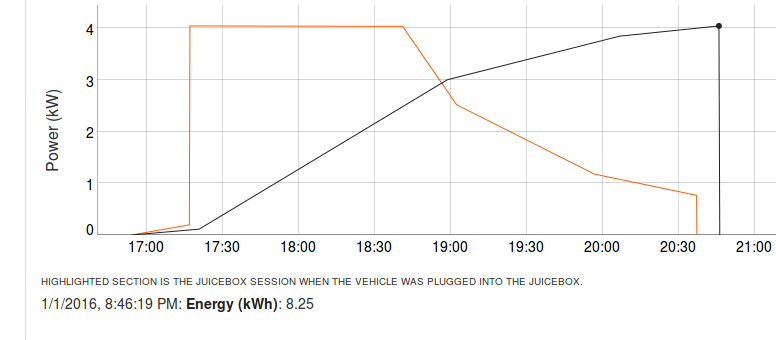
>> current flowing into the battery is less than the maximum 30 amps (4.0 kW)
>> that the chargers can produce. The charging curve looks like this:
>>
>> http://www.summet.com/blog/wp-content/uploads/2015/09/charging_2amp_cutoff.png
>>
>>
>>
>> In an effort to speed up my charging, I set the MaxV to a higher amount (
>> 128.9 volts) so that at the 128 volt level the battery pack would still be
>> accepting a higher current, and then set my TermC to the highest level my
>> EVCC allows (10 amps). This results in a charging curve that looks like the
>> following:
>>
>> http://www.summet.com/blog/wp-content/uploads/2016/01/charging_10amp_cutoff.png
>>
>>
>> As you can see, I spend more time delivering 30 amps before the current draw
>> from the pack starts to drop off, and the curve reaches the cutoff point
>> much quicker. My EVCC currently limits the TermC parameter to 10 amps or
>> less, probably because they have not anticipated somebody trying to charge
>> only to 80% as quickly as possible.
>>
>> If I could set the TermC parameter to 20 or 25 amps it would allow me to set
>> the MaxV up higher (131?). The goal would be to find a voltage setting such
>> that the pack would be drawing 20 or 25 amps right when it hit the 128.5
>> volt level. So my curve would basically be flat, full on charging at 30 amps
>> up until the very end when it would start to taper off and the charging
>> would end at 25 or 20 amps.
>> I’m not worried about setting the MaxV higher than the actual voltage I’m
>> attempting to hit, as it is still much lower than my pack’s actual max
>> voltage, and if something were to change with the pack chemistry making it
>> miss the TermC cutoff, the MaxV would still stop the pack from reaching 100%
>> charged. (and the termination timeout would eventually hit.)
>>
>> This is the end of my main thought, but you can continue reading for…..
>>
>> Extra Info about my pack, charging to the 80% level, etc…
>>
>> The 48 modules from my Nissan Leaf battery pack (LMO/LNO chemistry)  are
>> arranged in a series of sixteen sets of 3 parallel cells. This gives me a
>> 180Ah battery with an absolute maximum voltage of 134.4 (4.2 volts per
>> cell). In actual use the 4.2 VPC level should never be reached, if you
>> charge the cells to 4.1 volts per cell they are around 99% charged. As the
>> extra 0.1 volt difference between 4.1 and 4.2 doesn’t really buy you much
>> extra capacity,  most people use 4.1 volts per cell (131.2 volts) as a safe
>> “full” or 100% capacity on the Leaf Cells.  My Mini-BMS units will start to
>> shunt voltage at 4.1 VPC, and raise an over-voltage alarm at 4.2 VPC.
>>
>> However, if you charge the cells to 4.0-4.01 VPC (128-128.5 volts) that
>> corresponds to about 80% of their maximum possible capacity. To maximize
>> cell and battery pack life, you want to minimize the time the cells are
>> fully charged or fully discharged. If you can keep the cells between a
>> 10%-80% state of charge (SOC) it will maximize their battery life.
>>
>> Keeping them above 10% SOC is easy…don’t drive until they are empty. Keeping
>> them at or below 80% SOC is also easy, simply turn off your charger when
>> they are only 80% charged.   This is why the early Nissan Leafs had the
>> option to only charge the battery to 80%. (Removed in the newer Leafs due to
>> EPA regulations on how maximum range is calculated.)
>>
>> If you want the extra 20% of range that charging to 100% SOC would give you,
>> it is better to charge to 100% and then immediately discharge the pack by
>> driving it (as opposed to leaving it sitting at 100% charge all night).
>> This is one reason why Nissan Leaf’s have a charge timer, so that you can
>> tell the charger to finish just before you start your daily drive. (The
>> other reason is so that you can tell it to start charging only after the low
>> cost nighttime electricity rates start, if you are on a time of use metering
>> rate plan.)
>>
>> My 2nd charging profile will be a 4.1 VPC full 100% capacity charge, for
>> when I feel the need to really go long distances. (or to get the pack ready
>> for a top balancing equalization charge, my future 3rd charging profile.)
>>
>> Jay
>> _______________________________________________
>> UNSUBSCRIBE: http://www.evdl.org/help/index.html#usub
>> http://lists.evdl.org/listinfo.cgi/ev-evdl.org
>> Read EVAngel's EV News at http://evdl.org/evln/
>> Please discuss EV drag racing at NEDRA (http://groups.yahoo.com/group/NEDRA)
>
> _______________________________________________
> UNSUBSCRIBE: http://www.evdl.org/help/index.html#usub
> http://lists.evdl.org/listinfo.cgi/ev-evdl.org
> Read EVAngel's EV News at http://evdl.org/evln/
> Please discuss EV drag racing at NEDRA (http://groups.yahoo.com/group/NEDRA)
>
_______________________________________________
UNSUBSCRIBE: http://www.evdl.org/help/index.html#usub
http://lists.evdl.org/listinfo.cgi/ev-evdl.org
Read EVAngel's EV News at http://evdl.org/evln/
Please discuss EV drag racing at NEDRA (http://groups.yahoo.com/group/NEDRA)