[ref
http://electric-vehicle-discussion-list.413529.n4.nabble.com/Question-L5-30P-vs-L6-30P-tp4679861.html
}
Assumptions:
-You are building the basic 30A kit
http://store.openevse.com/products/openevse-30a-basic-charge-station-combo

-You plan to use the EVSE mostly in L2 5.7kW mode (drawing 24A off a 240VAC
30A circuit), but also want to be able to use the L1 ability (rare).

-You will be using only one 30' length of 10-3 cable repurposed from a
server which will have only one set of power connectors.

I know the type of power cords you are repurposing/using as I have
build/installed/updated many a computer rack in my former 25 year hp CE
career. Many a 10-3 cable I have chased down, pulled and run under many
customers' (and hp's) raised computer room floors. There were so many
changes constantly happening at sites, that perfectly usable cords were
chucked into the huge truck-pulled copper recycling bins (perhaps they were
too short, had the wrong connectors, etc.).

Check the cord's health but taking the existing power connector off. If the
copper strands are dark, the wire has been cooked (over heated = tarnished)
and those wires are not to be used. Usually, I could cut the cable back a
few feet to find health wire again. But if not, that cable is only good for
the recyclers (do not try to still use it, it will cook your connectors).

Having charged at many locations, and in many ways (I had 6 chargers
on-board my former S-10 Blazer EV), I have used-up/cooked my fair share of
cords, hence have learned what lasts longest/the only have to 'make it once'
methods.

>From my own experience of charging for hours using a long 10-3 cord like
this (at 30A powering a pfc-30 charger), it is at the connectors that the
heat will build up. The cord spreads the heat out over its length, but at
the metal to metal connection of the wire of the cord to the power connector
is where the resistance is most. So, ensure you put enough of the wire's
copper around/at the power connector's fastening point.


To answer your question, the difference between a L5-30 and a L6-30 is the
arrangement of the prongs. The design is human-engineered to keep laymen
from connecting power illegally (smoke).

The difference in any 30A rated power connector is not the amount of metal
to metal contact. There is more metal on a 30A connector than a L1 5-15 or
5-20 connector. Thus a those lower L1 rated connectors would heat up and and
cook/burn if used at higher currents than they are rated at.

I carried a small gym bag full of connectors and 1' 10-3 cords in my back
seat so as to have the makings to build up what ever adaptor I needed [

http://www.ebay.com/itm/Foldable-Travel-Luggage-Duffle-Storage-Bag-Sport-Gym-Carry-Suitcase-50L-Black-/281905652195?hash=item41a2e2e1e3:g:4swAAOSwo0JWQVp5

http://www.ebay.com/sch/i.html?_from=R40&_sacat=0&LH_BIN=1&_udhi=13&_sop=16&_nkw=Duffle%20Gym%20Bag&rt=nc&LH_FS=1&_trksid=p2045573.m1684
]. Today, we do not need to do this. But in your case, you will need to make
one adaptor (cheater-cord) from a 5-15 plug to a L6-30 receptacle. That
adaptor will allow your 30A EVSE kit to be powered from a 120VAC 15/20A
circuit for L1 charging.

Here is an example
http://customavrack.com/images/thumbs/0003575_328.jpeg
 of a 5-15 to L5-30 adapter. You would have to use a L6-30 receptacle
instead of the L5-30.

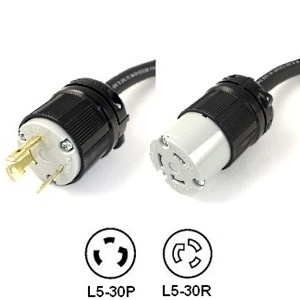
Below I give you three choices with links to an image, and connector pricing
examples. The prices of all three are about the same (~$20), and you will
notice I specified Leviton brand. There are cheaper connectors, but I have
found Leviton to be the best bang for the buck (cheap connectors break when
dropped, overheat/cook, etc.):


http://www.cables.com/Images/l530pl530r.jpg
L5-30
https://www.google.com/search?channel=fs&q=Leviton+L5-30&ie=utf-8&oe=utf-8#q=Leviton+L5-30&channel=fs&tbm=shop

http://www.lockingpowercords.com/images/thumbs/0000382_300.jpeg
L6-30
https://www.google.com/search?channel=fs&q=Leviton+L6-30&ie=utf-8&oe=utf-8#channel=fs&tbs=vw:l,mr:1,price:1,ppr_max:25&tbm=shop&q=Leviton+L6-30

http://www.lockingpowercords.com/images/image/L14-30%20extension%20cords.jpg
L14-30
https://www.google.com/search?channel=fs&q=Leviton+L14-30&ie=utf-8&oe=utf-8#channel=fs&tbs=vw:l,mr:1,price:1,ppr_max:25&tbm=shop&q=Leviton+L14-30


Besure to study the NEMA Wiring Diagrams, see
http://www.automationdirect.com/static/specs/wiringdevicesnemawiring.pdf


I recommend you go with the L6-30 connector. Mainly as you do not have as
many earthquakes as we do in CA, see
http://njmonthly.com/articles/jersey-living/living-on-the-fault-line/
Jersey Living on the Fault Line

In an earthquake, you want the cord to self-disconnect when the EV moves.
But since you do not have that issue, same as in a computer/server room, you
want a twist lock for laymen to use as it makes better metal to metal
connection if you know to twist it tight.

Also, (Gawd forbid) you have a fire, but when the FD look at your connectors
and see you were powering an EVSE off a 240VAC 30A circuit it helps to use
Electrician-code-legal connectors.

At the many in/out-door shows I displayed and charged at, their Electricians
would always check my cabling. I learned what they wanted, changed over, and
had next to no problems after that (aim for legal configurations).


For EVLN EV-newswire posts use:
http://evdl.org/evln/


{brucedp.150m.com}

--
View this message in context:
http://electric-vehicle-discussion-list.413529.n4.nabble.com/Question-L5-30P-vs-L6-30P-tp4679861p4679869.html
Sent from the Electric Vehicle Discussion List mailing list archive at
Nabble.com.
_______________________________________________
UNSUBSCRIBE: http://www.evdl.org/help/index.html#usub
http://lists.evdl.org/listinfo.cgi/ev-evdl.org
Read EVAngel's EV News at http://evdl.org/evln/
Please discuss EV drag racing at NEDRA (http://groups.yahoo.com/group/NEDRA)