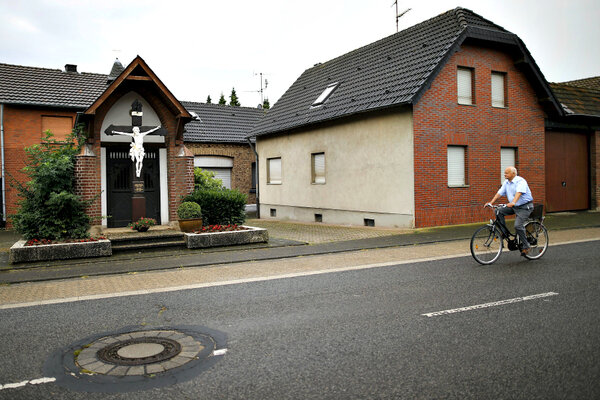
'Germany's new Electric-bicycle highways'
http://www.vancouversun.com/business/cayo+bikes+makes+sense/11758163/story.html?__lsa=66b3-bbf2
Don Cayo: Tax on e-bikes makes no sense
MARCH 2, 2016

[image
http://www.vancouversun.com/business/cms/binary/11758164.jpg
Energy-efficient cars can be eligible for big subsidies. But electric-assist
bikes? Not anymore.
Photograph by: wayne leidenfrost Wayne Leidenfrost , Vancouver Sun
]

The provincial government kindly kicked in $1,500 toward the purchase of my
last car.

The money was my reward for choosing an unusually fuel-efficient vehicle
(even if, as neither the government nor I knew at the time, my Volkswagen
diesel turned out to be not so eco-friendly).

But my last bicycle got not even a sales tax break, despite it being an even
greener way to get around. The timing was wrong — it was purchased during
the HST era (2010 to 2013), so it didn’t get the seven-per-cent PST
exemption that existed previously and that has since been reinstated.

And my newest bicycle? When it is delivered next week, the price will
include 12 per cent tax — five per cent federal plus seven per cent
provincial.

Why won’t this bike get the reinstated exemption? Because I’m adding an
electric assist motor, and this, under the arcane PST rules, makes the whole
shebang taxable.

Which makes no sense. Very little Canadian data on e-bikes exists, but
studies elsewhere suggest each bicycle with electric assist is likely to
take more gas-guzzling traffic off the road than one run solely on pedal
power. European data shows e-bikes typically travel nearly twice as far each
day as other bicycles. As well, travel times are cut by as much as 50 per
cent, riders don’t feel compelled to dress up in Lycra that enhances every
bulge, and they are much less likely to arrive at their destination
sweat-stained and smelling like anything but a rose.

These bikes aren’t merely mini-motorcycles — most must be pedalled for the
motor assist to kick in, and the amount of exertion required ranges from
light on the flat or downhill to quite substantial going up a long, hard
hill. So there are health benefits to e-bikes, too, especially when they are
ridden farther than conventional bikes.

The upshot is they can, and should, appeal to potential riders who won’t
consider a pedal-powered bike for reasons of stamina or time or need to look
presentable.

And, even though it is older riders who most often shell out the extra money
to add a motor, e-bikes aren’t simply for old duffers or people with
mobility challenges.

Indeed, Richard Campbell, the executive director of the B.C. Cycling
Coalition and a guy committed to getting around on two wheels, says he used
to ride one daily between SFU and his home in Kits. Significantly, it cut
his trip time from 1-1/2 hours to just over one.

The finance ministry tells me the PST exemption for conventional bikes goes
back to 1981, but the e-bike exemption was never intended to be permanent.
It was introduced in 2008 as part of the government’s climate action plan,
and had a sunset date in 2011. What would have been its full term expired
during the HST era, and it wasn’t renewed when the PST was reintroduced.

The rationale is sound for some time-limited tax exemptions, although
perhaps not this one. For some such initiatives — for example, the period
when energy-efficient appliances were getting a break — it can be argued
that this sped the process of making energy-efficient choices dominant in
the market. In the case of e-bikes, however, they are so far from
market-dominant — only about five per cent of bikes on the road, according
to Campbell’s estimate — that this argument doesn’t apply.

But reading between the lines of the what the ministry told me, the e-bike
tax policy may not be cast in stone. The amount at stake isn’t much in the
context of a $47-billion operating budget — $100-$200 per buyer, but
totalling well under $1 million a year, by my reckoning. And a ministry
spokesman seemed to take pains to underline that tax policies like this are
reviewed annually and are often responsive to public opinion.

No promise was stated or implied, but it sounded a bit like, “Ask and it
will be given.”

And Campbell and the coalition are about to ask. They are gathering
signatures on an online petition (www.bccc.bc.ca/electric) calling for a tax
break on e-bikes, as well as substantially more investment in infrastructure
to support biking, walking, in-line skating and the like.

More infrastructure spending is a tough call, depending on money available
and other priorities. But the tax break on e-bikes should be an easy
decision.
[© The Vancouver Sun]


http://www.csmonitor.com/World/Making-a-difference/Change-Agent/2016/0302/Beyond-the-Autobahn-Germany-s-new-bike-highways
Beyond the Autobahn: Germany's new bike highways
MARCH 2, 2016 ... He is particularly enthusiastic about the growing
popularity of electric bikes, also called "pedelecs." In Germany, more than
2 million people own pedelecs, which have the added advantage of enabling
older people to move quickly on two wheels ...  charging stations for
electric bicycles will be built along the highway, as will kiosks offering
everything from free air pumps to spare parts, refreshments, or even showers
...
http://images.csmonitor.com/csm/2016/03/967851_1_030216CAGermanbikehighways_standard.jpg?alias=standard_600x400


For EVLN EV-newswire posts use:
http://evdl.org/evln/


{brucedp.150m.com}

--
View this message in context:
http://electric-vehicle-discussion-list.413529.n4.nabble.com/EVLN-Tax-ca-on-e-bicycles-makes-no-sense-tp4680875.html
Sent from the Electric Vehicle Discussion List mailing list archive at
Nabble.com.
_______________________________________________
UNSUBSCRIBE: http://www.evdl.org/help/index.html#usub
http://lists.evdl.org/listinfo.cgi/ev-evdl.org
Read EVAngel's EV News at http://evdl.org/evln/
Please discuss EV drag racing at NEDRA (http://groups.yahoo.com/group/NEDRA)