'UPS converting diesel fleets, mid-life, into EVS'
'UPS drivers not on board using route optimize software'
http://www.edie.net/news/6/UPS-calls-on-UK-Government-to-deliver--level-playing-fuel--for-low-emission-fleets/
UPS calls for 'level playing field' of low-emission fleets
23 March 2016  Matt Mace

[images
http://e2k9ube.cloudimg.io/s/cdn/x/http://edienet.s3.amazonaws.com/news/images/full_29943.jpg?v=23/03/2016%2016:59:00
Currently 35 UPS EVs are in operation in London, with plans to double that
number already in place

http://static.edie.net/images2105/ups.jpg
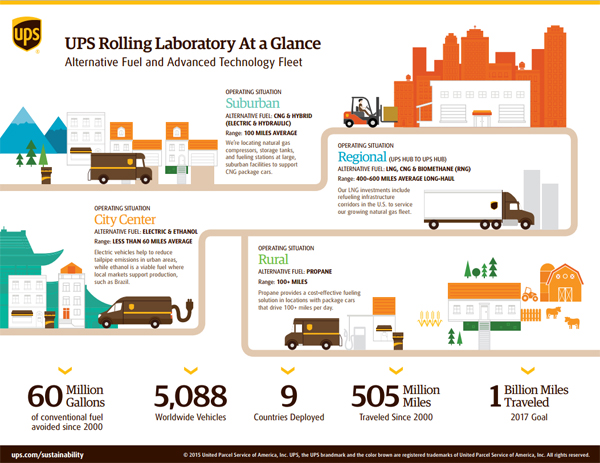
(UPS rolling lab at a glance)


video
https://youtu.be/3FIZuF1LPRY
]

EXCLUSIVE: Packaging and transportation giant UPS has called on the UK
Government to create a 'level playing field' by allowing the transport
sector to create a better support system for vehicle electrification and
enable more investment into biofuels.

Currently 35 UPS EVs are in operation in London, with plans to double that
number already in place

UPS’ director of sustainability for EMEA Peter Harris told edie that the
company is using London as an alternative fuel hub for its operational
fleet, but has hit roadblocks in the transition due to concerns over
electric support assets and the availability of biofuels.

“We started deploying alternative fuel vehicles in the UK just before the
Olympics and used bio-methane vehicles when we were undergoing logistics
work,” Harris said. “Since that point, we’ve been in constant discussion
with Government to create a level playing field so that the transport
industry can have fair access to the fuels that other sectors are able to
use.

“Obviously it’s not a simple debate and we have made steady progress in the
right direction, so we’ll continue to work with Government to find a
solution.”

UPS has been at the forefront of exploration into alternative fuel vehicles
and is using its ‘Rolling Laboratory’ initiative to test which fuels work
best in different regions. While the US has a large, subsidised quantity of
natural gas and Hamburg has the infrastructure in place to use electric
bicycles, the Rolling Laboratory testing revealed the London can act as an
enabler for the EV market, if some hurdles are overcome.

Last year, UPS introduced 125 electric ‘trucks of tomorrow’ into operational
circulation across seven US states and in London in the UK. Since the
trials, UPS has purchased new facilities in the English capital that can
cater for and charge up to 70 EVs.

Harris revealed that 35 UPS EVs are currently in operation in London, with
plans to double that number. However, the costly association of having to
purchase power supply assets from other companies has ramped up costs- a
factor which could drive away investment into EV use in the capital.

“The vehicles are excellent and meet the needs of our duty cycles and are
targeted for routes that are compatible with EV range,” Harris said.
“However there is a lack of supply from manufacturers so we’ve had to make
significant investments into power supply assets and infrastructure which is
a quite a roadblock for the scaling of this technology.”

While UPS has taken this issue up with the Government, it has also turned to
a conversion programme that can transform diesel-guzzling fleets into
zero-emitting delivery vehicles.

UPS currently has a conventional diesel fleet that is designed to last for
15 years. But with the recent Paris Agreement calling for emissions to be
cut, UPS has taken steps to convert these fleets, mid-life, into EVS.

“It gets us around the supply issue and also means we can leverage the long
life span of our vehicles without the added disadvantage of owning an old
diesel truck,” Harris said. “We can actually convert our fleets in a more
cost-effective manner than purchasing a new truck so the ROI has actually
improved.”

Billion-mile journey
The ‘Rolling Laboratory’ project forms part of UPS’ plan to have alternative
fuel vehicles travel one billion miles by 2017 - a feat that chief
sustainability officer Rhonda Clark believes is firmly within reach.

“We’re well on track to hit this goal,” Clark said. “It took us 13 years to
drive the first 350 million miles and now we’re driving that many miles a
year because we’re growing the fleet ...

Driving behaviour
Clark revealed that the biggest challenge in embedding the ORION technology
has been getting the drivers on board. “When we told our drivers, who had
been using their experiences and brains to get them to and from
destinations, that we want them to use this new software optimiser, we had a
little bit of friction,” Clark said.

However, through extensive behaviour change training - which included data
analysts accompanying drivers on their routes to highlight the sheer volume
of data that was being collected - the drivers eventually embraced the
technology.

With work progressing to create the most efficient routes for the most
efficient fleet, UPS remains weary of placing all of its eggs in one basket.
With different countries needing different raw resources and infrastructure,
the company continues to develop and innovate on all fronts.

“One thing is for sure:  the future we’re heading towards is one where there
is no single solution,” Harris said. “We’re moving away from the days where
just petrol and diesel worked for everyone and towards a future that is
multi-polar.”
[© edie.net]


For EVLN EV-newswire posts use:
http://evdl.org/evln/


{brucedp.150m.com}

--
View this message in context:
http://electric-vehicle-discussion-list.413529.n4.nabble.com/EVLN-To-charge-its-delivery-EVs-UPS-uk-has-to-purchase-power-supply-assets-tp4681239.html
Sent from the Electric Vehicle Discussion List mailing list archive at
Nabble.com.
_______________________________________________
UNSUBSCRIBE: http://www.evdl.org/help/index.html#usub
http://lists.evdl.org/listinfo.cgi/ev-evdl.org
Read EVAngel's EV News at http://evdl.org/evln/
Please discuss EV drag racing at NEDRA (http://groups.yahoo.com/group/NEDRA)