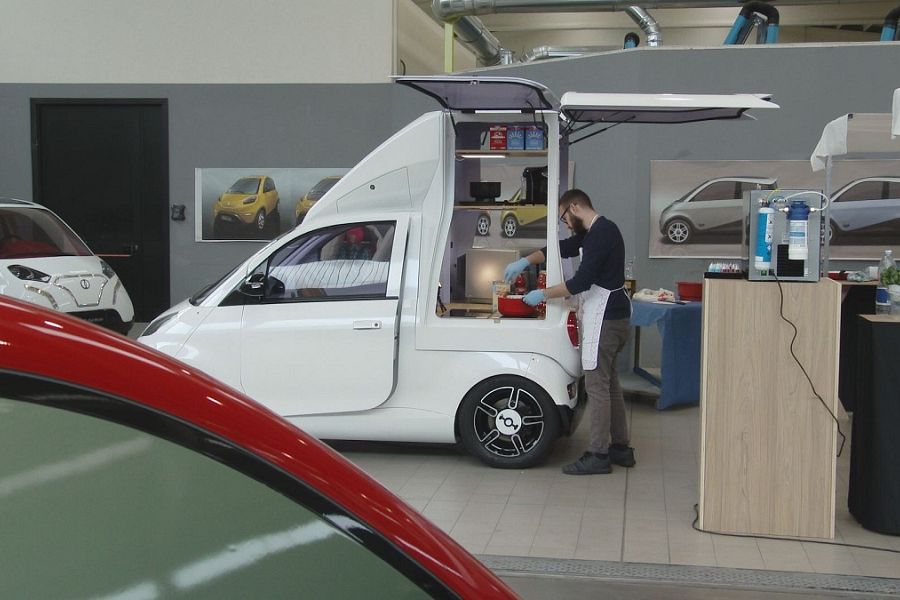
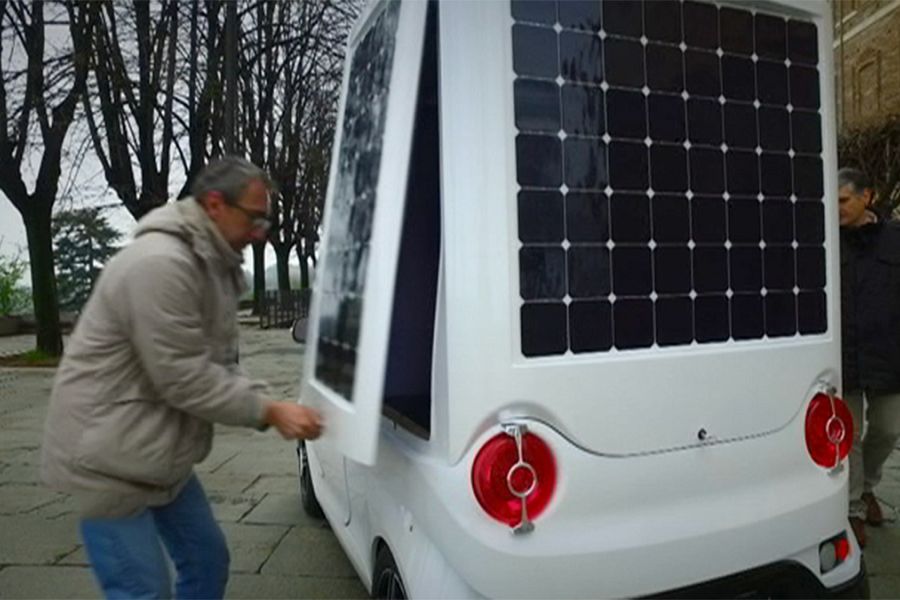
'A PV-EV micro food truck'
http://www.euronews.com/2016/04/11/a-greener-road-ahead/
A greener road ahead?
11/04/2016  Julián López Gómez  Robert Hackwill

[image
http://static.euronews.com/articles/329415/900x600_329415.jpg?1460365598
(EV w/ PVs microwaving rigatoni)


video
http://www.euronews.com/embed/329415/
(A greener road ahead)
]

Electric vehicles are a reality, and scientists are now looking ahead. They
are exploring new frontiers to make them safer, more reliable, more
autonomous and more affordable.

European researchers are not short of ideas to address all those issues.

An electric vehicle has, say its developers, been designed to suit all
tastes. Not only because its solar cells feed its electric batteries. But
also because the vehicle itself is able to provide some food.

Most cars, electric or otherwise, have boots designed to carry luggage. But
one new vehicle has
microwaves and frying pans instead.

This is hardly run-of-the-mill research equipment, but it is integral to a
prototype just developed at one Italian lab.

“This is an electric restaurant car. We wanted to show that by just using
photovoltaic energy you can not only drive the vehicle, but also power a
kitchen and be able to cook in an ecological way,” says IFEVS’s CEO, Pietro
Perlo.

The prototype has been designed by scientists at a European research project
aimed at exploring new innovative ways to design and produce modular urban
light electric vehicles.

The tiny food van is the latest newcomer in a game that also includes small
pick-ups, vans or even taxis.
They all share the same concepts for the chassis, the powertrain and
energy-driven technologies.

“Our car is modular. We always have the same chassis based on a mix of very
high resilient steel. The car has 4 powered wheels. It has two motors, one
in the front, another in the back. Each motor feeds two of the wheels,” says
Perlo.

These modular cars have been designed with simple elements to simplify
assembly and reduce costs.
But they will have to be as safe as any other vehicle in the market. So
researchers had to turn to new
solutions for its conception.

“We are talking about very small cars. So we have much less space to absorb
energy. So we decided to use a special steel. It is a very elastic steel,
really innovative. Its biggest advantage is that this steel absorbs big
quantities of energy,” says Mechanical Engineer at CIDAUT, Javier Romo
García.

The car´s two motors were made with magnets instead of rare earth materials
to reduce costs. Each
motor delivers 9000 rpm to the wheels, according to its developers.

“Requirements for this kind of electrical traction are basically high
efficiency, high power density and constant speed. This is what we tried to
develop. The fact that the car has two motors offers some advantages. Two
motors gives more flexibility to the vehicle, and it improves its
acceleration performance.
These are the main advantages,” says Regulated Environment Protection
Installation Electrical Engineer, Paul Minciunescu.

Researchers are now testing the model’s reliability and ergonomics.

Details like visibility, handling, on-board sensing or computational power
are closely studied at these European labs.

“Our aim was to develop a really hi-tech vehicle, with state of the art
technology, that has the safety of a plane for the cost of a washing
machine. In the 90s the big challenge for technology developers was bringing
a cell phone into every home. Our challenge now is to bring one of these
cars to the garage of every European,” says Bitron/Plus-Moby project
coordinator Marco Ottella.

While continuing to work on sometimes tasty validation tests, researchers
say they are now getting ready for the next big step, full-scale
manufacturing.

“Our idea is that manufacturing should be tailor-made. Tell us where you
want to produce the cars. We come with our trucks with containers. Inside
the containers you have robots ready to assemble the car. So in just a few
days you are able to produce electrical cars that we consider safe, reliable
and efficient, vehicles that are only powered with renewable energies,” says
Pietro Perlo.

Researchers hope their modular vehicles could be ready for industrial
manufacturing in less than 2 years.

Guaranteeing the safety and technical reliability of these existing and
future electric cars, and also their charging points are the questions that
European scientists are addressing from one sophisticated lab in Northern
Italy.

The lab includes a novel electric and hybrid vehicle testing facility; a
climatic chamber with temperatures ranging from -30ºC to +50ºC under
controlled humidity.

Researchers are able to get information about the car’s performance and
efficiencies under different drive-cycles and climatic conditions, including
the impact of heating, ventilation or air-conditioning.

And there is more…

“We measure information on electrical data, information on the ratio between
the car’s emissions and its consumption. We also obtain information about
the car’s own consumption of electricity, and how its battery behaves,” says
Telecommunications Engineer at the EU’s Joint Research Centre Germana
Trentadue.

The lab also includes a new chamber designed to analyse electromagnetic
emissions generated by electric cars during acceleration, driving and
braking.

Researchers use reception antennas and receivers to measure e-mobility’s
potential interference with communications frequencies.

They can also test the immunity of electric vehicles against external
electric and magnetic fields.

But why is it important to measure the electromagnetic fields around the
vehicle?

“Electro-mobility is a very young field of research. And it involves
technical equipment where certain fears need to be addressed, and methods
need to be developed to rule out problems in the future with certainty.
These include for instance very low-frequency magnetic fields in the fast
charging area, which could, under certain circumstances, pose a risk for
pacemaker patients, and of course we want to exclude such issues from the
very beginning,” says the JRC’s Coordinating Research Engineer for
Electro-mobility, Harald Scholz.

Research is complemented by testing the interoperability all supply devices
and communications systems involved in electric car recharging.

Researchers study the behavior of evolving smart power grids integrating
renewable sources of energy, electric vehicles, storage and other features.

“Take for instance a future mobile app that will allow us to book a charging
point for our electrical car. So you book it, you drive there, you recharge
your car and you leave with your battery totally full. This may look like a
very simple process; it takes just around 30 minutes to do all that. But it
needs between 10 and 15 different agents, systems and components that must
all work together in real time. This is very complex, and this is what we
are trying to ensure in our labs; that all these different technical
components work well together,” says Telecommunications Engineer at the JRC,
Miguel Olariaga Guardiola.

Information acquired at these facilities should make the establishment of
standards and harmonized criteria easier, to guarantee safety and
reliability in future electric vehicle and recharging markets.

Ecological and more and more sophisticated, electrical vehicles are a dream
for some people, but their limited range is a huge challenge. Most existing
vehicles on the market still cannot go very far on one charge. It is a
challenge that some European scientists say they are addressing with the
help of a trailer.

Researchers have developed a portable generator housed in a little
two-wheeled trailer. It can be
programmed with a mobile app.

The generator produces energy to “bolt on” to the electric cars to increase
their range. The energy is
provided by petrol.

“If you are driving at 100 kph on a highway, an average electric car offers
you around 100 kilometres of autonomy. With our prototype you can drive 500
kilometres. Then you fill up with petrol and you can keep on driving,” says
EP-Tender’s CEO, Jean-Baptiste Segard.

Is it not a curious paradox that at the end of the day you need gasoline to
produce energy for an electric car?

“Yes it is a true paradox. But during the year, with an electric vehicle you
are going to drive short distances almost all the time, so those 20 or 30
kilometre trips you drive with your batteries. But if you ever want to drive
500 kilometers, you use our product, powered with petrol. But how often do
you drive 500 kilometers? 3, 5, 10 times per year?” asks Segard.

The trailer is around 1.2 meters long. It weighs some 250 kilos and provides
a peak power of 20kW.

Scientists say it has some sophisticated electronics onboard.

“We had to find the right processor and the right systems. And then we had
to make sure that the algorithms that we had imagined on paper worked in the
real product,” says EP-Tender’s Embedded Systems Engineer, Fabrice Viot.

Production of the first units was done at this small French company.

Researchers here say the product is fully ready for industrial assembly
lines, after multiple manufacturing challenges were sorted out.

“This is a complex product with a combustion engine and power electronics in
a very small, closed environment. There are very different components with
really complex functions. And this reality imposes important constraints for
the mechanical integration of the product,” says Adaccess’s CEO, Damien
Alfano.

Back on the road, the trailer’s developers are already working on a business
model, based on a rental basis, they say.

“We are not planning to produce one of these trailers for every electric
vehicle. We don´t want to add a motor to each electric vehicle. Maybe there
will be one trailer for every 10 or 20 electric cars. And each driver will
just rent it when he or she needs more range,” says Segard.

The key question is how much this will cost.

“If the driver wants to drive just for one day and the motor works for one
hour, the rental price would be 17 euros,” says Segard. “Each other extra
hour you pay seven euros. So if you are renting the trailer for one day and
the motor works for three extra hours, you pay 17 euros plus 21 euros;
that´s a total of 38 euros.”

Researchers say they expect the product to hit European roads in less than 3
years.
[© European Commission 2016]


http://www.euronews.com/2016/04/11/takeaway-the-electric-restaurant-car/
Takeaway: the electric restaurant car
11/04/2016

[image
http://static.euronews.com/articles/329421/900x600_329421.jpg?1460365527
(A PV-EV micro food truck)


video
http://www.euronews.com/embed/329421/
]

Its solar cells not only feed its two electric motors…

… but also its kitchen.

This prototype has been designed by Italian engineers.

They say they want to change the way we move around.

Their cars are modular.

They can be a food truck, a pick up, a van. Or a taxi.

The assembly line has been designed to be low cost and portable.

Researchers hope to launch production by late 2017…

… with prices not exceeding 10.000 euros.

So in case you are interested…

… get ready to enjoy your all electric meal!
[© European Commission 2016]


For EVLN EV-newswire posts use:
http://evdl.org/evln/


{brucedp.150m.com}

--
View this message in context:
http://electric-vehicle-discussion-list.413529.n4.nabble.com/EVLN-Euro-EV-report-PV-EV-cooking-pasta-EV-rfi-testing-ice-trailer-tp4681570.html
Sent from the Electric Vehicle Discussion List mailing list archive at
Nabble.com.
_______________________________________________
UNSUBSCRIBE: http://www.evdl.org/help/index.html#usub
http://lists.evdl.org/listinfo.cgi/ev-evdl.org
Read EVAngel's EV News at http://evdl.org/evln/
Please discuss EV drag racing at NEDRA (http://groups.yahoo.com/group/NEDRA)