http://www.nanowerk.com/spotlight/spotid=43172.php
Dendrite-free lithium metal batteries through evenly distributed lithium
ions
Apr 19, 2016  Michael Berger
[images
http://www.nanowerk.com/spotlight/id43172_1.jpg
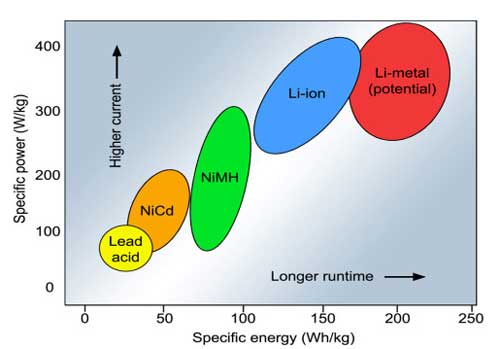
Specific energy and specific power of rechargeable batteries. Specific
energy is the capacity a battery can hold in watt-hours per kilogram
(Wh/kg); specific power is the battery’s ability to deliver power in watts
per kilogram (W/kg). (Source: Battery University)

http://www.nanowerk.com/spotlight/id43172.jpg
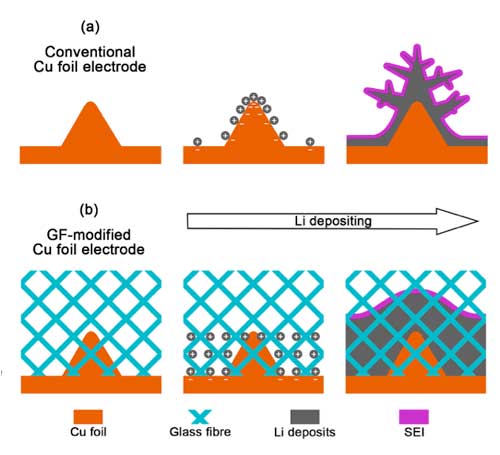
Schematic diagrams of Li deposition. a) The routine 2D Cu foil electrode is
always with an uneven surface that induces inhomogeneous electron
distribution. Li ions aggregate near the protuberance on the 2D surface with
a stronger field strength than the flat during continuous Li depositing. The
agminated Li ions can trigger Li dendrite growth. b) GF cloth is with large
quantities of polar functional groups (Si O, O H, O B), resulting in a
strong interaction with Li ions. The concentrated Li ions by the
protuberances on the Cu foil electrode are evenly redistributed, therefore
rendering the dendrite-free Li deposits. (Reprinted with permission by
Wiley-VCH Verlag)
]

(Nanowerk Spotlight) Battery technology is advancing on two fronts,
reflecting in increased specific energy for longer runtimes and improved
specific power for high-current load requirements. Improving one
characteristic of a battery may not automatically strengthen the other and
there is often a compromise.

Lithium is regarded as a vastly superior electrode material due to its
capacity (3860 mA•h•g-1) and the lowest negative electrochemical potential
(-3.040 V vs. the standard hydrogen electrode).

Today, the best performing battery in terms of specific energy and specific
power is the secondary lithium-metal (Li-metal). However, uncontrolled
dendrite growth during Li depositing/stripping in rechargeable Li metal
based batteries has prevented their practical applications over the past 40
years.

In our Nanowerk Spotlight from a couple of weeks ago, we addressed the issue
of growth of lithium dendrites and its negative impact on the performance of
lithium metal-based batteries ("Graphene renders low local current density
to inhibit growth of lithium dendrites").
The above-mentioned approach, introduced by the research group of Dr. Qiang
Zhang at Tsinghua University in Beijing, is based on graphene.

In new work, Zhang's team has now proposed a novel method of modulating the
lithium ion adsorption to suppress lithium dendrite growth by employing
glass fiber (GFs) as solid electrolytes with plenty of polar functional
groups as the interlayer between Li metal anode and routine polymer
separator.

"Polar functional groups of glass fibers strongly adsorb lithium ions to
compensate the electrostatic interactions and the concentration diffusion
between lithium ions and protuberances of routine anode," Zhang explains to
Nanowerk. "This effectively prevents the accumulation of lithium ions around
protuberances."
The results have been published in Advanced Materials on April 20, 2016
("Dendrite-Free Lithium Deposition Induced by Uniformly Distributed Lithium
Ions for Efficient Lithium Metal Batteries").

The molecular simulations carried out by the team indicate that an elevated
binding energy of 3.99 eV is generated between SiO2 and Li relative to 2.85
eV for Cu and Li. The finite element method confirmed the evenly distributed
Li ions caused by extra 1.14 eV.
"After the electrochemical tests, large dendrites with a diameter of 5.0 µm
and lengths of 20~40 µm formed on the conventional Cu foil current
collector," notes Xin-Bing Cheng, the paper's first author. "In contrast, we
obtained a dendrite-free morphology on anodes that were modified with glass
fibers."

The team showed that the dendrite-free morphology led to an enhancement in
Coulombic efficiency. Under the current density of 0.5, 1.0, 2.0, 5.0, and
10.0 mA cm-2, GF-modified cells deliver enhanced Coulombic efficiencies of
98, 97, 96, 93, and 91%, respectively.

"The surface polarity modification affords a creative method to inhibit
dendrite growth by molecular interactions," Zhang says. "However, we still
don't know the exact dynamics of Li ion adsorption and Li ion diffusion
before and after Li ion adsorption are still unknown."

In conclusion, this work shows that the use of polar solid electrolyte
efficiently and effectively tunes the Li ion distribution and achieves
evenly distributed Li ions to inhibit dendrite growth. These results shed
new light not only on Li metal-based batteries, but also on Na, Mg, and Zn
based batteries for advanced energy storage.
[© 2016 Nanowerk]


http://ngtnews.com/stainless-steel-could-make-ev-batteries-up-to-20-lighter/
Stainless Steel Could Make EV Batteries Up To 20% Lighter
Apr 19, 2016  Finnish material experts from Outokumpu, along with scientists
from Germany's Fraunhofer Institute for Laser Technology, are working on
lightweight, ...


For EVLN EV-newswire posts use:
http://evdl.org/evln/


{brucedp.150m.com}

--
View this message in context:
http://electric-vehicle-discussion-list.413529.n4.nabble.com/EVLN-Evenly-distributed-ions-for-dendrite-free-lithium-batteries-tp4681673.html
Sent from the Electric Vehicle Discussion List mailing list archive at
Nabble.com.
_______________________________________________
UNSUBSCRIBE: http://www.evdl.org/help/index.html#usub
http://lists.evdl.org/listinfo.cgi/ev-evdl.org
Read EVAngel's EV News at http://evdl.org/evln/
Please discuss EV drag racing at NEDRA (http://groups.yahoo.com/group/NEDRA)