https://www.digitaltrends.com/cars/workhorse-ceo-drone-delivery-electric-trucks/
From drones to pickup trucks, Workhorse CEO believes the future is electric
2018-08-20  Stephen Edelstein
[images  / Steve Burns
https://icdn6.digitaltrends.com/image/workhorse-surefly-29221-720x720.jpg
Workhorse SureFly

https://icdn3.digitaltrends.com/image/workhorse-surefly-29227-1200x9999.jpg

https://icdn2.digitaltrends.com/image/workhorse-surefly-29225-720x720.jpg

https://icdn3.digitaltrends.com/image/workhorse-surefly-29224-720x720.jpg

https://icdn4.digitaltrends.com/image/workhorse-surefly-29223-720x720.jpg

https://icdn5.digitaltrends.com/image/workhorse-surefly-29222-720x720.jpg

https://icdn3.digitaltrends.com/image/workhorse-surefly-29226-1200x9999.jpg


video  flash
https://players.brightcove.net/5340004208001/Hkov7xwff_default/index.html?videoId=5823085858001
]

From drones to pickup trucks, Workhorse CEO believes the future is electric

Tesla isn’t the only company focusing on electric vehicles. But instead of
luxury cars, Ohio-based Workhorse builds electric delivery vans, and it’s
developing an extended-range electric pickup truck called the W-15. The
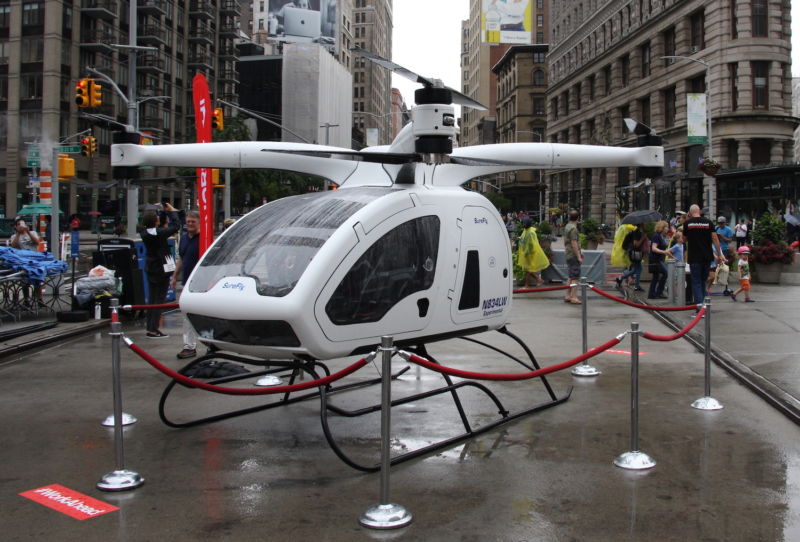
company is also working on drone delivery, and a human-piloted aircraft
called the SureFly that looks like a cross between a drone and a
conventional helicopter.

Workhorse recently brought the W-15 and SureFly to New York City, where
Digital Trends chatted with CEO Steve Burns about the company’s many
projects.

DT: We have the SureFly octocopter and W-15 pickup truck here. Workhorse
also builds electric vans and is developing delivery drones. How did you get
into so many different projects?

Steve Burns: It all started innocently enough. We first went into
electrification. We didn’t have the wherewithal to put fast-charging
networks all across the planet. They (electric delivery vans) go a defined
range, and they come back to the barn at night. That’s how we got into
delivery vans.

“(The SureFly) can probably get there faster than any ambulance. It doesn’t
have the long wind-up of a helicopter.”

Since we cater to people that deliver things, we said, “we’re essentially
making a more efficient truck, but a person going door to door in a truck is
as old as the hills,” right? We thought, “how can we refine that?” And then
we thought a drone could help the driver be more efficient. If you have
three deliveries to the right, and one to the left, give the one on the left
to the drone.

The FAA has let us start doing some testing, and it’s clearly going to be
dramatically more economical. We let the customer opt in. They download the
app, say “I want drone delivery.” They touch on the screen where they want
(the package) to be delivered, and it winches it down.

That’s where we learned to fly. Then, as we wanted to do more and more
cargo, we got to the point where we said we might as well build a manned
(aircraft). The FAA has a limit of 55 pounds (of cargo) on a drone.

So that FAA limit was the impetus for the SureFly?

Right. If you put a pilot in it, a person in it, suddenly it’s not a drone
and, if you can get the FAA to certify it, you can fly it anywhere just like
a helicopter.

We’ve been flying under experimental certification for about six months. Now
they’ve accepted our application for full-type certification. We’re going to
go through that very rigorous thing to allow us to sell that in the United
States.

How many more steps do you have to go through before being able to sell it?

There are a lot of steps. But time-wise, we’re hoping to get it done in two
years. It could take longer. It’s difficult to know. It’s the first of its
kind to go through the process.

You mentioned cargo as one application. What other applications are you
looking at?

Since we’re kind of fleet-centric, we want to sell to fleets first. So, like
a paramedic; it can probably get there faster than any ambulance. It doesn’t
have the long wind-up of a helicopter; it can be running instantly.

“When we went to make something, we thought, “why doesn’t everybody have a
helicopter in their garage?”

What kind of other applications are we looking at? It could be a farmer
doing precision agriculture. It could be a rancher checking on the cows. It
could be military. But really, the number of calls we get, the biggest thing
is people wanting to avoid traffic. So, in the end I think that’s going to
be its biggest use, but we’ll start with fleets.

Why an octocopter, instead of a regular helicopter?

Our drones are octocopters. When we went to make something, we thought, “why
doesn’t everybody have a helicopter in their garage?” It takes a long time
to learn to fly a helicopter and be certified, they’re pretty costly to buy
and maintain, and most people feel they’re not safe.

The first thought is, “is it safe?” It’s got eight propellers because if one
should get hit with a bird, you can still get down. It’s got a generator
that keeps the battery charged, but if the generator fails you’ve got enough
battery to get down. And it’s got a parachute right in the middle of it. So
(it has) a lot of redundancies.

You said you’re a fleet-centric company, so is the W-15 pickup going to be a
fleet vehicle as well?

We made fleet delivery trucks, and then we thought, “what’s the number one
fleet vehicle in the United States?” It’s a pickup truck. It’s the number
one consumer vehicle, but it’s also the number one fleet vehicle.

“We’re coming out with two versions: an all-electric version, and a
range-extended.”

Then we thought, “how could the number one vehicle not even have a mild
hybrid?” They’re all just gas or diesel. Almost every SUV or sedan has at
least a hybrid in the books, or maybe a full electric, but not pickup
trucks. We started looking at it; we thought we had the chops to do it.

We thought, “well, let’s not make it just electric; let’s just try to make
it the best pickup truck for fleets.”

For example, the hood is tapered downward. As opposed to normal pickup
trucks, where grilles are getting larger and larger. That makes it difficult
to see over; a lot of mayors are worried about hitting pedestrians with
municipal vehicles. It also cuts through the wind better. But we didn’t take
it down to a point, because we still wanted it to look like a pickup truck.

What was the thinking behind offering an extended-range electric powertrain?

Unlike a passenger car, a pickup truck can just double its weight. You just
throw 3,000 pounds in the bed, or haul 6,000 pounds (on a trailer). Whatever
battery range you advertise, let’s say it’s 200 miles, it could go down to
100 miles if you’re towing something.

We’re coming out with two versions: an all-electric version, and a
range-extended. All of the 6,000 preorders (we have) are for the
range-extended.

If it’s really going to be successful, we didn’t want to say “okay, this
gets 75 MPGe (miles per gallon equivalent)” but have an asterisk say it
can’t do certain things. We wanted too take away the asterisk. Let’s try to
make a vehicle that can do anything a diesel truck can do, but get 75 MPGe.

When will the W-15 go into production?

“We kind of took a page out of Tesla’s book there, to test the market. And
it’s pretty robust.”

We’re trying to get people like Duke Energy, who bought the first 500
trucks, what’s called a manufacturer’s test vehicle late this year so they
can start to test it. We want to get it into production in the first quarter
of 2019.

As you said, pickup trucks are the biggest segment not just for fleet
vehicles, but consumer vehicles. Is there any chance that the W-15 will be
available to non-fleet buyers?

We’ve started to get a lot of calls for that. To test the market, we started
taking preorders, (customers) put $1,000 down. We kind of took a page out of
Tesla’s book there, to test the market. And it’s pretty robust.

What we’ve told all of them is, if you’re going to put your money down,
first we’ve got to get through the initial wave of fleet orders. We really
want to cut our teeth there before we go into full-blown consumer sales.
[© digitaltrends.com]


https://arstechnica.com/cars/2018/08/workhorse-brings-an-electric-pickup-truck-helicopter-to-manhattan/
Workhorse brings an electric pickup truck, helicopter to Manhattan
8/19/2018  Workhorse, with its 120 employees, hopes to beat larger players
to market. I wasn't sure entirely what I expected an electric helicopter to
look like, but .... Burns pointed out that pickup trucks are the number-one
selling vehicle type in the ...
https://cdn.arstechnica.net/wp-content/uploads/2018/08/IMG_5180-800x542.jpg


For EVLN EV-newswire posts use:
 http://evdl.org/archive/


{brucedp.neocities.org}

--
Sent from: http://electric-vehicle-discussion-list.413529.n4.nabble.com/
_______________________________________________
UNSUBSCRIBE: http://www.evdl.org/help/index.html#usub
http://lists.evdl.org/listinfo.cgi/ev-evdl.org
Please discuss EV drag racing at NEDRA (http://groups.yahoo.com/group/NEDRA)