https://jalopnik.com/the-2018-tesla-model-3-long-range-is-the-perfect-mix-of-1828853186
The 2018 Tesla Model 3 Long Range Is The Perfect Mix Of Ordinary And
Revolutionary
Sep 11, 2018  Kristen Lee, Jalopnik
[images
https://i.kinja-img.com/gawker-media/image/upload/s--zSb3VTc9--/c_scale,f_auto,fl_progressive,q_80,w_1600/p9o8hnjwn0zx8fnb56yq.jpg
2018 tesla model 3

https://i.kinja-img.com/gawker-media/image/upload/c_lfill,w_768/nzz7nyiehpgnkgvcnqmy.jpg

https://i.kinja-img.com/gawker-media/image/upload/c_lfill,w_768/yhixrnxsefhqli0wibu4.jpg

https://i.kinja-img.com/gawker-media/image/upload/c_lfill,w_768/fan6zksjo9qtgon5vfpx.jpg

https://i.kinja-img.com/gawker-media/image/upload/c_lfill,w_768/eissstt5fxakhfihyfy2.jpg

https://i.kinja-img.com/gawker-media/image/upload/c_lfill,w_768/lifpabemqhe42cvpiyn5.jpg

https://i.kinja-img.com/gawker-media/image/upload/c_lfill,w_768/tws62atcolkkx8xofcnf.jpg

https://i.kinja-img.com/gawker-media/image/upload/c_lfill,w_768/unltkhq7ts4cjas3eih6.jpg

https://i.kinja-img.com/gawker-media/image/upload/c_lfill,w_768/wcpyjq7qv6l6dmmwvy4l.jpg

https://i.kinja-img.com/gawker-media/image/upload/c_lfill,w_768/i3d8pu6chqlnvjgbcoo0.jpg

https://i.kinja-img.com/gawker-media/image/upload/c_lfill,w_768/cbfxfuq6xzr3rzapjrbt.jpg

https://i.kinja-img.com/gawker-media/image/upload/c_lfill,w_768/u7p1x6hc9y6fu2v6qfsy.jpg

https://i.kinja-img.com/gawker-media/image/upload/c_lfill,w_768/cn6ymeqgeo8uap4jgvxm.jpg

https://i.kinja-img.com/gawker-media/image/upload/c_lfill,w_768/oelegj2ol74bksm47ahh.jpg

https://i.kinja-img.com/gawker-media/image/upload/t_original/hvxuxfnoojkoxncnc1gq.jpg

https://i.kinja-img.com/gawker-media/image/upload/c_lfill,w_768/unym6qybghufxoyc9q1w.jpg

https://i.kinja-img.com/gawker-media/image/upload/c_lfill,w_768/i8x9bkd7tms2qwft8z5n.jpg

https://i.kinja-img.com/gawker-media/image/upload/c_lfill,w_768/i3hj6kkixpxpfyhxnlgn.jpg

https://i.kinja-img.com/gawker-media/image/upload/c_lfill,w_768/h9ijnyoyevqtdmhcpbbk.jpg
]

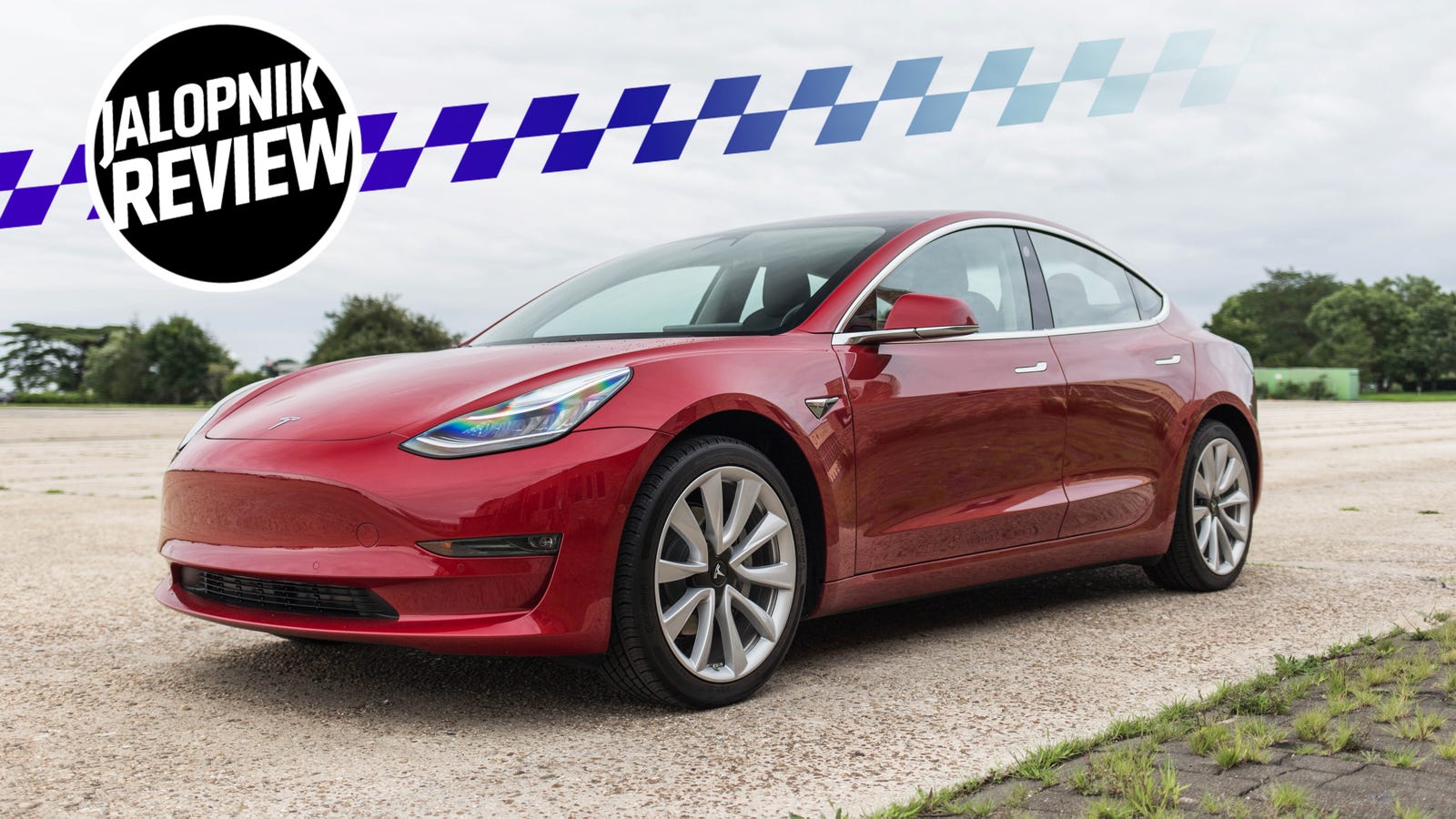
There is no denying the 2018 Tesla Model 3's importance. It is intended to
be Tesla’s volume-seller, the car that will hopefully make luxury electric
cars more accessible to more people, especially when the long-promised
$US35,000 version hits the market. It is the key to Tesla’s future, the
source of many of its struggles this year, and an EV—hell, a car,
period—truly unlike any other.

Equipped as you see here with distance driving in mind, the Model 3 Long
Range further normalizes electric cars by offering a truly capable machine
with a mix of power, performance, price, range and convenience no other
electric cars currently match. For right now, anyway.

(Full Disclosure: We asked Tesla if we could borrow a 2018 Model 3 and it
obliged, loaning us a fully charged car for about a week.)

Editor's note: as this is a U.S. review some specs and pricing may differ in
Australia.

What Is It?

Jalopnik’s previous time with the Model 3 has only been in short bursts. We
spent a few hours with one back in January, right after it first went on
sale, and then delighted in the blistering acceleration of the Performance
version for a couple hours last month.

The ultimate test would be to find out what it was like to live with,
especially in a city that provides little to zero access to home charging
stations.

So Tesla loaned us the Long Range version Model 3, which meant that it had
the $US9,000 long range battery, good for a claimed 499km. This also had the
rear-wheel drive setup, not the dual motor that offers all-wheel drive. Zero
to 60 mph happens in a highly respectable 5.1 seconds, making it slightly
quicker than a four-cylinder turbo BMW 330i, and it has a top speed of
225km/h.

Beyond the car’s obvious noteworthiness, I was eager to give it a try,
because in a lot of ways it’s the kind of car that suits me personally. Out
of Tesla’s three current offerings, the Model 3 is the smallest and most
compact. It’s not the hulking behemoth of the Model X, nor is it the lengthy
Model S, which can seat seven in a pinch if you get it with the third row of
seats.

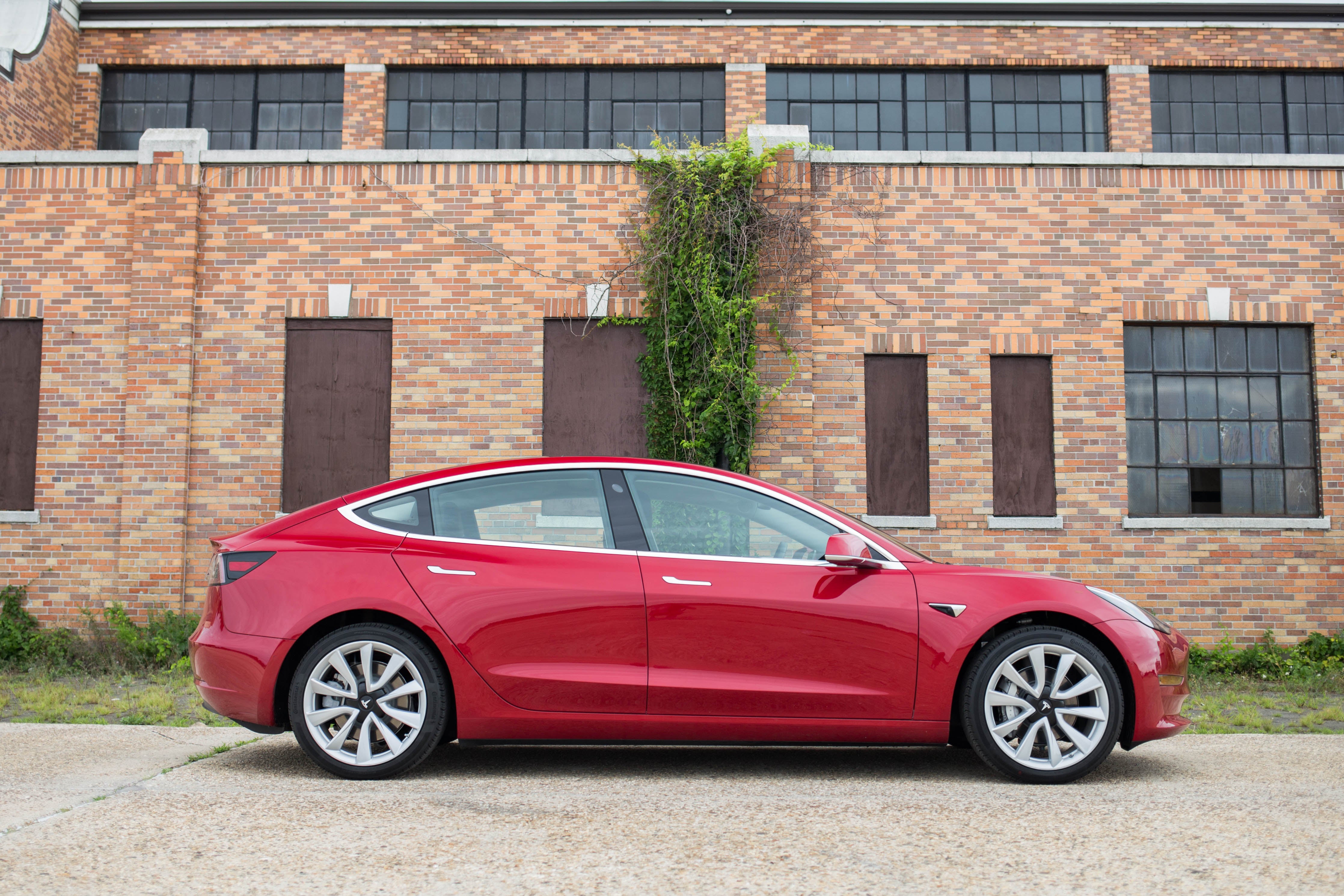
The Model 3 seats five and its proportioned similarly to a Mercedes C-Class
or a BMW 3 Series—a size that I much prefer over the Model S. I mostly only
ever need to drive myself and my boyfriend around, and just occasionally
I’ll add some friends or family. I don’t need the truckloads of space that
the other two models offer. It’s so much less car to have to be responsible
for.

That, and it’s pretty quick, and a sharp handler. I’ll never say no to that.

What’s Good

More and more EVs hit the market every year and 2018 has been a banner year
for them in general, but we’re still mostly used to testing internal
combustion-powered cars. As such, there were some things that I needed to
get readjusted to, like the regenerative braking.

The first hour or so I had the car, I’d release the accelerator pedal as
soon as I needed to step on the brake and the entire car would lurch forward
unpleasantly.

But as soon as I’d trained myself to modulate the pedal, stopping smoothly
became second nature. You can apparently drive electric cars with one pedal
only. I wouldn’t recommend doing it all the time, because safety and
everything, but it’s possible.

It’s extremely well insulated from things like road noise. Of course, it’s
not completely silent, you can still hear other cars driving around you and
the sound of your own tires on the road. But even knowing I’d be living with
the absence of engine noise, it was a lot quieter than I expected.

Ride quality is a tad harsher that I would’ve figured, too. This isn’t a bad
thing, as pillowy soft suspension tends to lull you to sleep. The Model 3's
suspension absorbs bumps but never lets you forget that they are there.
Being that it’s meant to compete with sport sedans from BMW and Mercedes and
more, it feels like this suspension is tuned more for agility in cornering
than cruising, something I appreciated.

And you can see everything from it! As we’ve mentioned before, forward
visibility is incredible. The car’s low, short hood—you can do a lot with
packaging when you don’t have to accommodate an engine—doesn’t impede your
vision at all, which has historically been a problem for me. I’ve always
needed to peer over the hoods of most cars, but not the Model 3. My seating
position allowed me see clear over the hood perfectly.

And because my driver profile had been saved to the car, I could move the
seat, steering wheel and wing mirrors back into my position with a simple
tap on the touch screen.

But perhaps the best thing about the interior is how many compartments there
are to store your stuff. The piano-black (ugh) center console splits open to
reveal a place to put your phone and then another, deeper cubby beneath
that, good for a wallet or a bag or chips or a camera. Behind the
cupholders, the armrest also opens up to reveal another medium-sized storage
compartment. Those, added with the door compartments, make for an extremely
utilitarian interior.
Deliberately Contrarian

As you all know by now, the Model 3 has a controversial interior. It has no
dials, switches, levers or gauges, which make it look more like a trendy and
minimalist workspace instead of a car. There’s the big square-shaped touch
screen, two buttons on the steering wheel, two stalks for wipers and gear
selection, and... not much else.

The air vents are seamlessly integrated into the dashboard, almost
invisibly, because Elon Musk didn’t want holes in said dashboard. One of the
big draws for Tesla is that it’s a company that thinks differently from the
competition, and nowhere else is this more readily apparent than inside the
Model 3 itself.

And in lieu of traditional controls, the car has a giant touchscreen mounted
smack in the middle of the dashboard, which is where you control most of its
functions.

Even the glovebox doesn’t have a physical latch. You have to use the screen
to open it up, an annoying and unnecessary extra step. I didn’t know how
much I would miss a glovebox latch until it was taken away from me.

The two little scroller buttons on the wheel itself help you navigate
certain menu items in on the screen. These scrollers are unmarked, as their
functions can vary. It’s almost like a video game controller. The button
layout never changes, but depending on which game you’re playing, the
buttons and joysticks do different things. If the company decides to send
any over-the-air updates, it can just assign new tasks for those buttons.
Those buttons were easy enough to figure out because I could use them
without looking at them.

But I’m still not sold on the screen. I’m not used to glancing down and to
the right to see my speed. I still needed to take my eyes off the road to
adjust the climate control instead of just hitting a button or turning a
dial. And it was slightly frustrating that while using the car’s navigation
system, the pop-up window of instructions on the rightmost side of the
screen couldn’t be moved closer so I could read it better. I asked Tesla if
it was possible to move that window and the spokesperson said that it
wasn’t. However, it was a piece of feedback that they’ve been getting from
other owners.

My other main gripe with the car was its lack of a key or key fob. I
downloaded the Tesla app, connected my phone to the car via Bluextooth and
could access information like where the car was parked and unlock it
remotely. That was neat, but I still just wanted a damn key, or a fob like
pretty much all other new cars have these days.

I’m already uncomfortable with our over-reliance upon smartphones and now
having it be responsible for my car as well was just pushing it too far.
Phones can be compromised, lost or stolen. And not everyone has a
smartphone. What then?

Well, Tesla will also give you two key cards that you can use to lock and
unlock the car. You just tap them on the car’s B-pillar to do so. Explaining
how all of that worked to a valet attendant was not always easy. I’d leave
the car overnight for charging, and them come back the next morning to a
different person working the morning shift and they wouldn’t know to look
for a little black card instead of a car key. And then I’d have to explain
the whole thing over again. It’s needlessly complicated.

I also noticed a concerning detail about the car’s door release mechanisms.
To open any of the Model 3's four doors, you hit a button and the door
mechanism releases electronically. On the two front doors, there is also an
alternative latch beneath the armrest that acts as a manual release. There
is no such option for the two back doors.

I asked Tesla why it chose to omit the latches there. A spokesperson
explained that in the case of a crash, the 12-volt battery that powers the
doors will stay active and occupants can still use the electric door
switches to open their doors. They also linked to this Reddit post about a
crash where the Model 3 rolled but the woman was luckily still able to
operate the doors without the manual release to escape.

It’s hard to account for every single scenario when designing any car’s
safety features. I’d think the logic would be to try and plan for any and
all imaginable situations in order to maximise passenger protection. Tesla
says that the Model 3's glass roof is extremely safe; I have little doubt it
went to some lengths to make it so. Yet, if it took the extra effort to make
the roof safe, why not also just put in the manual latches in the back doors
for emergency situations? I don’t see a downside to doing this.

Small details like these make me think the Model 3 is just being
deliberately contrarian, to a fault. There’s some stuff that makes a ton of
sense, and other stuff that leaves you scratching your head. There are
endless conversations to be had about form over function and the Model 3
definitely has form locked down because the interior is extremely pretty.
But in doing so, it’s sacrificed some of the functionality.

Doing That Driving Thing

Once I suppressed my gripes with the interior and got to what the car is
actually for—driving—I found it to be a wonderful daily. I took it all over
Brooklyn, Manhattan and outside the city during the weekend I had it out in
traffic, bumpy city roads and highways.

The steering is weighted perfectly—not too heavy and not too light.
Surprisingly better than a lot of competitors who have been making cars a
lot longer, to be honest. It doesn’t feel artificial at all and gives the
car an energetic, peppy feel. And it really was a very nice feeling to be
sitting in gridlock and knowing that your car isn’t producing pointless
exhaust fumes.

I must admit this was also my first time trying out Autopilot, Tesla’s
semi-autonomous driver assistance system. On stretches of highways, I found
it to be extremely convenient. The system “sees” far more cars than other
systems I’ve tested, so whenever someone cut me off, the car didn’t brake at
the very last moment.

It still doesn’t completely mimic human driving, though. Normally, when
approaching a bend in a road, you’d naturally ease off the accelerator a
little bit. The system didn’t do that; it pushed into the turn at full
speed, something I wasn’t comfortable with the car doing. I took over.

Don’t get me wrong, the system is very good, but not so good that I’ve give
myself over to it completely. We’re not there yet, and Tesla admits as much,
which is why there’s so many warnings and such to keep your hands on the
steering wheel, your eyes on the road and your brain on how Autopilot is
behaving.

Lean into that accelerator, though, and how quickly the car picks up speed
will surely put a smile on your face. It’s not face-meltingly fast like the
last BMW M5 I drove, but it’ll close gaps between cars with ease and let you
merge with full confidence. Though, on curvier roads, you can definitely
feel the car’s 1,726kg heft. It’s certainly not top-heavy thanks to the
battery pack laid into the floor, but you can still feel some body roll.

For comparative purposes, Tesla was kind enough to let me have a go in a
Model 3 Performance after testing the Long Range. It’s a lot faster. Like a
lot, a lot. It had the acceleration that I can only describe as
mind-numbing. Previously, I had thought that the RWD Long Range car was
quick. Driving the Performance right after completely redefined what exactly
it is to be quick. The acceleration was so instant and furious that I felt
like I was outrunning my own thoughts. It’s nearly two seconds quicker to 60
mph.

Normally, when I accelerate that fast, I’m used to some kind of accompanying
engine or turbine noise. All I got from the Model 3 was an increased,
high-pitched whining. It’s spooky and cool.

The steering was noticeably heavier on the faster car, too, probably because
there’s an extra motor sitting in the car’s nose. Tesla told me that the
dual motor Performance weighs 121kg more than the RWD Long Range. Also,
weirdly, the Performance let in a greater amount of wind noise. I couldn’t
figure out why that would be.

And because it was sunny when I took out the Performance, I noticed that the
glass roof actually does trap a significant amount of heat. I needed to keep
the cabin air conditioned even though the day itself wasn’t terribly hot.

But hottest version or not, the Model 3 is an incredibly fun car to stomp
on. Maybe the acceleration gets old for some after a while, but it didn’t
for me. Having said that, I also cannot deny that its silence and
single-gear transmission give it more of an appliance-like feel at times,
like it was a dish that was missing a crucial spice that would have given it
that final kick.

Adventures in Charging

The last gauntlet to put the Model 3 through was the charge test. With the
car’s screen, you can locate registered charging stations, as well as where
Tesla’s Supercharging stations are.

The biggest difficulty of having a car in New York City is figuring out
where to put it when you aren’t driving it. Your two options, really, are
street parking it or finding a public garage. A private garage is an
extravagant luxury. This makes it especially difficult to own an electric
car, as you can’t just park your car in your own garage and charge it
overnight, and running a 30.48m extension cord out your window at night
seems to be frowned upon.

Currently in New York, there are only a handful of Tesla Superchargers.
There’s one in Manhattan, one at JFK Airport and one in Brooklyn, at the
William Vale hotel in Williamsburg, which is not anywhere near where I live.
I had whittled the car’s available range down to about 130-something miles
by the time I pulled up to the hotel’s valet parking.

(Oh, and that’s the other thing with electric car ownership in this city:
since most of the charging stations are located in public lots, you may or
may not get charged for electricity while charging the car, but you’re
always at least paying for the space.)

We made sure the car was plugged in and charging before heading upstairs for
a bite to eat. From there, I monitored the car’s charging progress with the
app.

I would think a typical Model 3 owner charging at a place that is not their
house wouldn’t need to fully charge their car, since they’d have a place to
charge at home. They would only need to charge it enough to get there. I
didn’t have such a luxury, so I settled down to wait for the car to fully
charge because I didn’t know when I’d get another opportunity.

From about 209km remaining, it took about 45 minutes to charge back to the
full 499km. Not bad for a dinner break. It’s hard for me to say how these
charge times would affect the length of a long road trip, so you can expect
a road trip test from us soon.

Range Anxiety?

While I had the Model 3, I found myself thinking a lot about range. I didn’t
get anxious, exactly, but I watched the range indicator much more closely
than I would a gas tank needle. It was a little off-putting to park
overnight and come out to see the range fall by a couple of miles the next
morning. But that might have only been because it was written there in the
first place.

I’m also not altogether too convinced that range anxiety is about range at
all. I think, at its core, it is us acknowledging that charging
infrastructure isn’t where it needs to be yet. The golden 483km of range has
become something of a benchmark, but it’s an arbitrary figure, when you
really thinking about it—a psychologically sound benchmark but not a
realistic one.

Truth be told, most of us rarely drive 483km in a day. But electric cars are
still married to charging stations in ways that gasoline cars really aren’t.
If you run out of gas somewhere, you can get to the closest gas station,
fill up a jerrycan with a gallon of gas and get your car running again. You
can even carry a can of fuel with you in your car if you’re going somewhere
remote. You can’t do that with an electric car.

It’s true that charging infrastructure is growing, and Tesla deserves a lot
of credit for actually bothering to invest in one for its vehicles, but the
EV network in general has so much more ground to cover before it can be
truly considered an alternative for all. When you get into your car, you can
confidently drive to virtually any place where there’s civilisation, because
chances are extremely high that there will also be a gas station there. You
can’t make such assumptions with charging stations. Furthermore, it takes
much longer to charge a battery back to usable levels than it does to simply
fill up a tank with gas.

I suspect that range anxiety will go away when two things happen: Charging
stations become as prevalent as gas stations and batteries take on the
ability to charge just as quickly as it is takes to pump some gas.

Value

At $US57,500 — because of options like the enhanced Autopilot, the long
range battery and other various upgrades—the Model 3 is not a cheap car. As
noted above, the $US35,000 price tag was the car’s big selling point for a
while, and it has yet to materialise.

Still, it certainly does feel luxurious. The materials used on the inside
have a quality feel to them and it drives smoothly. I didn’t spot any
obvious build quality issues on the two Model 3s that I drove, but as these
were press cars, extra effort probably went into making sure that they were
perfect.

Verdict

It’s difficult to judge the Model 3 against other cars because there simply
aren’t comparable, direct competitors currently being offered in the U.S.
(and Australian) market. The Jaguar I-Pace is more expensive, and it’s a
small crossover-hatch thing, not a sport sedan. The Nissan Leaf and
Chevrolet Bolt don’t have the Model 3's sporting qualities. I suppose you
could judge it against a BMW 3 Series or a Mercedes C-Class and the like,
but even that comparison feels incongruous because those are not electric
vehicles.

Tesla has been enjoying a massive lead ahead of the legacy automakers in
terms of introducing EVs to buyers. In that time, it’s managed to secure a
terrifyingly loyal fanbase, something that isn’t so easily broken by the
simple introduction of a competitor car. But because Tesla’s cars were so
good at just being electric cars, it’s managed to inject the idea of usable
electric cars into the mainstream. No amount of production setbacks or bad
tweets can change this fact.

Of course, because the public is now more open to the idea of an electric
car, competitors won’t have as hard a time selling that idea. With Porsche,
Audi, Volkswagen, Mercedes and more dumping tons of money into EVs, Tesla
will soon face a hard fight to maintain its lead.

I’m not sure I’d have the Model 3 as my only car. I think I’d come to miss
things like engine sounds and gears too much. But for a car to commute in,
run errands with and take on occasional trips, it’s pretty ace. It’s an
electric car that you can, for the most part, use like a normal car, if you
live in the right place.

And for some people, that big, conditional if—which determines whether they
can they confidently take it on road trips and conveniently charge it—will
make all the difference. Nothing’s ever easy in New York City, and that goes
double for owning an electric car ...
[© techengage.com]


+
https://www.forbes.com/sites/sebastianblanco/2018/09/10/tesla-battery-liquid-cooling-patent-application/#89a7f8c127a2
Tesla Battery Patent Application Refines Liquid Cooled Batteries
Sep 10, 2018  EV drivers certainly don't want an "excessive thermal
condition," also known as a fire. ... I have been writing about electric
vehicles, hybrids, and hydrogen since 2006. My articles and reviews have
appeared on most of the big green car blogs ...
https://thumbor.forbes.com/thumbor/960x0/https%3A%2F%2Fblogs-images.forbes.com%2Fsebastianblanco%2Ffiles%2F2018%2F09%2Ftesla-battery-cooling-patent.jpg


For EVLN EV-newswire posts use:
 http://evdl.org/archive/


{brucedp.neocities.org}

--
Sent from: http://electric-vehicle-discussion-list.413529.n4.nabble.com/
_______________________________________________
UNSUBSCRIBE: http://www.evdl.org/help/index.html#usub
http://lists.evdl.org/listinfo.cgi/ev-evdl.org
Please discuss EV drag racing at NEDRA (http://groups.yahoo.com/group/NEDRA)