... sends information about the precise location of his car to the Chinese
government ... surveillance tools available to the Chinese government as
President Xi Jinping steps up the use of technology to track Chinese
citizens ... 200+ manufacturers ... transmit position information and ...
other data points to government-backed monitoring centers, The Associated
Press has found. Generally, it happens without car owners' knowledge ... "If
you're concerned about it, then there's no way to live in this country." ...
https://cdn.mainichi.jp/vol1/2018/11/29/20181129p2g00m0fe109000p/9.jpg
"It's useless to be concerned about it,"  "If you're concerned about it,
then there's no way to live in this country."

https://mainichi.jp/english/articles/20181129/p2g/00m/0fe/110000c
Electric vehicles send real-time data to Chinese government
November 29, 2018  (Mainichi Japan)  AP

[images  / AP Photo/Ng Han Guan
https://cdn.mainichi.jp/vol1/2018/11/29/20181129p2g00m0fe109000p/9.jpg
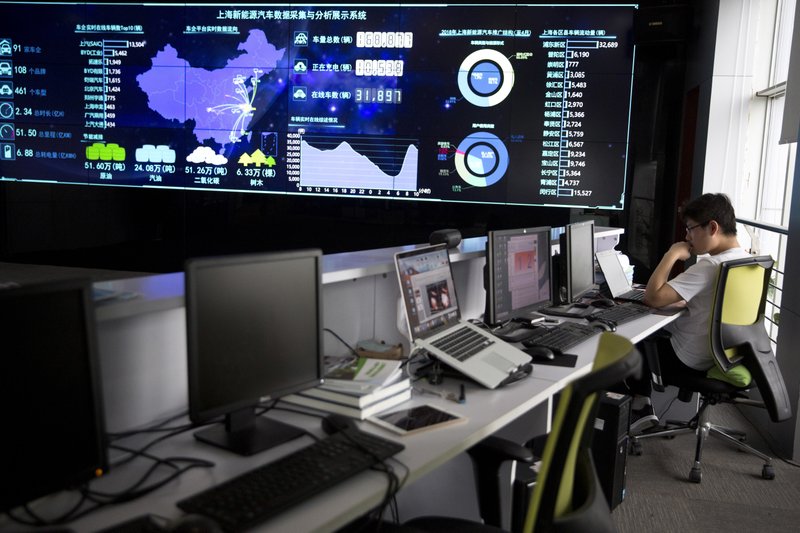
In this June 22, 2018 photo, Ding Xiaohua, deputy director of the Shanghai
Electric Vehicle Public Data Collecting, Monitoring and Research Center
speaks near a data display screen in Shanghai

https://cdn.mainichi.jp/vol1/2018/11/29/20181129p2g00m0fe108000p/6.jpg
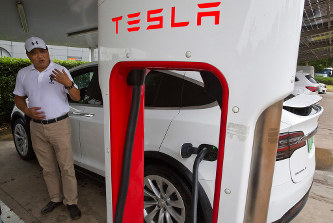
In this June 22, 2018 photo, Shan Junhua chats about privacy near his white
Tesla while charging it in Shanghai
]

SHANGHAI (AP) -- When Shan Junhua bought his white Tesla Model X, he knew it
was a fast, beautiful car. What he didn't know is that Tesla constantly
sends information about the precise location of his car to the Chinese
government.

    Related - Chinese 'gait recognition' tech IDs people by how they walk [
https://mainichi.jp/english/articles/20181106/p2g/00m/0dm/050000c
] ...

Tesla is not alone. China has called upon all electric vehicle manufacturers
in China to make the same kind of reports -- potentially adding to the rich
kit of surveillance tools available to the Chinese government as President
Xi Jinping steps up the use of technology to track Chinese citizens.

"I didn't know this," said Shan. "Tesla could have it, but why do they
transmit it to the government? Because this is about privacy."

More than 200 manufacturers, including Tesla, Volkswagen, BMW, Daimler,
Ford, General Motors, Nissan, Mitsubishi and U.S.-listed electric vehicle
start-up NIO, transmit position information and dozens of other data points
to government-backed monitoring centers, The Associated Press has found.
Generally, it happens without car owners' knowledge.

The automakers say they are merely complying with local laws, which apply
only to alternative energy vehicles. Chinese officials say the data is used
for analytics to improve public safety, facilitate industrial development
and infrastructure planning, and to prevent fraud in subsidy programs.

But other countries that are major markets for electronic vehicles -- the
United States, Japan, across Europe -- do not collect this kind of real-time
data.

And critics say the information collected in China is beyond what is needed
to meet the country's stated goals. It could be used not only to undermine
foreign carmakers' competitive position, but also for surveillance --
particularly in China, where there are few protections on personal privacy.
Under the leadership of Xi Jinping, China has unleashed a war on dissent,
marshalling big data and artificial intelligence to create a more perfect
kind of policing, capable of predicting and eliminating perceived threats to
the stability of the ruling Communist Party.

There is also concern about the precedent these rules set for sharing data
from next-generation connected cars, which may soon transmit even more
personal information.

"You're learning a lot about people's day-to-day activities and that becomes
part of what I call ubiquitous surveillance, where pretty much everything
that you do is being recorded and saved and potentially can be used in order
to affect your life and your freedom," said Michael Chertoff, who served as
Secretary of the U.S. Department of Homeland Security under President George
W. Bush and recently wrote a book called "Exploding Data."

Chertoff said global automakers should be asking themselves tough questions.
"If what you're doing is giving a government of a more authoritarian country
the tools to have massive surveillance, I think then companies have to ask
themselves, 'Is this really something we want to do in terms of our
corporate values, even if it means otherwise forgoing that market?'"

___

A BIGGER BROTHER?

The Shanghai Electric Vehicle Public Data Collecting, Monitoring and
Research Center sits in a grey tower in suburban Jiading district. One floor
up from the cafeteria, a wall-sized screen glows with dots, each
representing a single vehicle coursing along Shanghai's roads to create a
massive real-time map that could reveal where people live, shop, work, and
worship.

Click a dot at random, and up pops a window with a number that identifies
each individual vehicle, along with its make and model, mileage and battery
charge.

All told, the screen exhibits data from over 222,000 vehicles in Shanghai,
the vast majority of them passenger cars.

"We can provide a lot of data from consumers to the government to help them
improve policy and planning," said Ding Xiaohua, deputy director of the
center, a non-profit that is tightly aligned with and funded by the
government.

According to national specifications published in 2016, electric vehicles in
China transmit data from the car's sensors back to the manufacturer. From
there, automakers send at least 61 data points, including location and
details about battery and engine function to local centers like the one Ding
oversees in Shanghai.

Data also flows to a national monitoring center for new energy vehicles run
by the Beijing Institute of Technology, which pulls information from more
than 1.1 million vehicles across the country, according to the National Big
Data Alliance of New Energy Vehicles. The national monitoring center
declined to respond to questions.

Those numbers are about to get much bigger. Though electric vehicle sales
accounted for just 2.6 percent of the total last year, policymakers have
said they'd like new energy vehicles to account for 20 percent of total
sales by 2025. Starting next year, all automakers in China must meet
production minimums for new energy vehicles, part of Beijing's aggressive
effort to reduce dependence on foreign energy sources and place itself at
the forefront of a growing global industry.

The Chinese government has shown its interest in tracking vehicles.

"The government wants to know what people are up to at all times and react
in the quickest way possible," said Maya Wang, a senior China researcher for
Human Rights Watch. "There is zero protection against state surveillance."

"Tracking vehicles is one of the main focuses of their mass surveillance,"
she added.

Last year, authorities in Xinjiang, a restive region in western China that
has become a laboratory for China's surveillance state, ordered residents to
install GPS devices so their vehicles could be tracked, according to
official media. This summer the Ministry of Public Security, a police
agency, began to roll out a system to track vehicles using windshield radio
frequency chips that can identify cars as they pass roadside reading
devices.

Ding insisted that the electric vehicle monitoring program is not designed
to facilitate state surveillance, though he said data could be shared with
government public security organs, if a formal request is made. The center
said it has not shared information with police, prosecutors or courts, but
has used the data to assist a government investigation of a vehicle fire.

There is a privacy firewall built into the system. The monitoring center has
each car's unique vehicle identification number, but to link that number
with the personal details of the car owner, it must go through the automaker
-- a step it has taken in the past. Chinese law enforcement can also
independently link the vehicle identification number with the car owner's
personal information.

"To speak bluntly, the government doesn't need to surveil through a platform
like ours," Ding said. He said he believed the security forces "must have
their own ways to monitor suspects," as other governments do.

___

DATA ON WHEELS

Many vehicles in the U.S., Europe and Japan transmit position information
back to automakers, who feed it to car-tracking apps, maps that pinpoint
nearby amenities and emergency services providers. But the data stops there.
Government or law enforcement agencies would generally only be able to
access personal vehicle data in the context of a specific criminal
investigation and in the U.S. would typically need a court order, lawyers
said.

Automakers initially resisted sharing information with the Shanghai
monitoring center; then the government made transmitting data a prerequisite
for getting incentives.

"The automakers consider the data a precious resource," said a government
consultant who helped evaluate the policy and spoke on condition of
anonymity to discuss sensitive issues. "They gave you dozens of reasons why
they can't give you the data. They give you dozens of excuses. Then we offer
the incentives. Then they want to give us the data because it's part of
their profit."

There was concern that data pulled from electric vehicles might reveal
proprietary information about, for example, how hybrids switch between gas
and battery power, and eventually set automakers up for commercial
competition with a Chinese government entity. As cars become more connected,
carmakers are looking to tap new revenue streams built on data -- a market
McKinsey estimated could be worth $750 billion by 2030.

Ding said a Tesla executive came to Shanghai and grilled him about the
rules. "The first question is who are you, the second question is why you
collect this data, and the third question is how to protect the privacy of
the users," Ding said.

Tesla declined to comment.

Ding said confidentiality agreements bar the data center from sharing
proprietary information.

Still, he is open about his commercial ambition. He'd like to wean the
center from government funding and make money from the data, without
infringing on anyone's privacy or intellectual property. "We have done some
explorations," he said. "But there is still a distance from truly monetizing
it."

___

CHINA'S EDGE

The Chinese government's ability to grab data as it flows from cars gives
its academics and policymakers an edge over competing nations. China tends
to view technology development as a key competitive resource. Though global
automakers have received billions in incentives and subsidies from U.S.,
European and Japanese governments, they are contributing data to the Chinese
government that ultimately serves Beijing's strategic interests.

In 2011, the U.S. Department of Energy's Idaho National Laboratory began a
nationwide study of how electric vehicle owners drive and charge their cars.
Participants gave explicit written consent to allow the government
laboratory to collect their data, and even then it wasn't delivered in real
time, said John Smart, who leads the center's advanced vehicles group.
Instead, the team got historical data on a weekly basis. Cars were assigned
random numbers for the study, so owners remained anonymous.

Nothing of its kind has been done since in the U.S., Smart said.

"The cost is very high to collect data," he explained. "The government
hasn't felt the need to provide that money and the manufacturers making
their own investments are choosing to keep the findings to themselves for
proprietary reasons."

When it was published, in 2015, the Idaho National Laboratory's study was
the largest ever done. All told, bundled with some additional data, the
study helped Idaho researchers analyze 21,600 electric vehicles over 158
million driving miles (254 million kilometers).

In the same amount of time it took Idaho researchers to publish their study,
the Shanghai Electric Vehicle Public Data Collecting, Monitoring and
Research Center began gathering real-time information from more than 222,000
vehicles and amassed over 4.7 billion miles (7.6 billion kilometers) of
driving history.

"As a researcher, I think that data set could be used to answer hundreds of
questions," Smart said. "I have a notebook a half an inch thick full of
questions."

Global automakers stressed that they share data to comply with Chinese
regulations. Nearly all have announced plans to aggressively expand their
electric vehicle offerings in China, the world's largest car market.

"There are real-time monitoring systems in China where we have to deliver
car data to a government system," Volkswagen Group China chief executive
Jochem Heizmann said in an interview. He acknowledged that he could not
guarantee the data would not be used for government surveillance, but
stressed that Volkswagen keeps personal data, like the driver's identity,
secure within its own systems.

"It includes the location of the car, yes, but not who is sitting in it," he
said, adding that cars won't reveal any more information than smart phones
already do. "There is not a principle difference between sitting in a car
and being in a shopping mall and having a smart phone with you."

Jose Munoz, the head of Nissan's China operations, said he was unaware of
the monitoring system until the AP told him, but he stressed that the
automaker operated according to the law. Asked by the AP about the potential
for human rights abuses and commercial conflicts posed by the data sharing,
Munoz smiled and shrugged.

"At Nissan, we are extremely committed to the Chinese market," he said. "We
see it as the market that has the greatest opportunity to grow."

Ford, BMW and NIO declined to comment. Mitsubishi did not respond to
multiple requests for comment.

General Motors and Daimler said they transmit data in compliance with
industry regulations and get consent from car buyers on how their vehicle
data is collected and used.

Tesla declined to answer specific questions and instead pointed to a privacy
policy buyers sign at the time of purchase, which stipulates that vehicle
data can be shared "with other third parties when required by law," though
there was no specific mention of the government monitoring centers in the
Chinese version of the policy.

Interviews with car owners suggest such disclosures aren't effective. Only
one of nine electric vehicle owners was aware data from his car is fed to
the government -- and he said he only knew because he is an electric vehicle
engineer.

"It's useless to be concerned about it," said Min Zeren, who owns a Tesla
Model S. "If you're concerned about it, then there's no way to live in this
country."
[© mainichi.jp]


https://www.apnews.com/4a749a4211904784826b45e812cff4ca
If your Tesla knows where you are, China may too
 ... vehicles in the U.S., Europe and Japan transmit position information
back to automakers, who feed it to car-tracking apps, maps that pinpoint
nearby amenities and emergency services providers. But the data stops there.
Government or law enforcement agencies would generally only be able to
access personal vehicle data in the context of a specific criminal
investigation and in the U.S. would typically need a court order ...
https://storage.googleapis.com/afs-prod/media/media:e6516982e56f495bad68a44949667227/800.jpeg


https://wccftech.com/china-us-electric-vehicle-makers-tesla-data/
Beijing’s Censorship Regime Now Apparently Demands US Electric Vehicle
Makers to Share User Data
Wccftech-40 minutes ago
 ... how these companies are revealing consumer data without even informing
their userbase ... automakers simply use the tried and tested excuse of
having to “comply with local laws.” As for the Chinese government, the
officials say they are only asking for this data to “improve public safety,
facilitate industrial development and infrastructure planning, and to
prevent fraud in subsidy programs ...


https://www.nytimes.com/2002/11/10/automobiles/the-spy-who-drove-me.html
...
https://www.google.com/search?q=the+spy+who+tracked+me
...
https://www.google.com/search?q=the+spy+who+stalked+me


For EVLN EV-newswire posts use:
 http://evdl.org/archive/


{brucedp.neocities.org}

--
Sent from: http://electric-vehicle-discussion-list.413529.n4.nabble.com/
_______________________________________________
UNSUBSCRIBE: http://www.evdl.org/help/index.html#usub
http://lists.evdl.org/listinfo.cgi/ev-evdl.org
Please discuss EV drag racing at NEDRA (http://groups.yahoo.com/group/NEDRA)