[ref
http://electric-vehicle-discussion-list.413529.n4.nabble.com/EVLN-Lost-Wages-auton-e-shuttles-2use-Boring-s-55M-tunnels-tp4693072.html
]
https://www.reviewjournal.com/business/business-columns/inside-gaming/questions-surround-las-vegas-underground-transit-system-1619807/
Questions surround Las Vegas underground transit system
March 16, 2019  Richard N. Velotta

[image
https://www.reviewjournal.com/wp-content/uploads/2019/03/11906515_web1_boring_co_aev.jpg
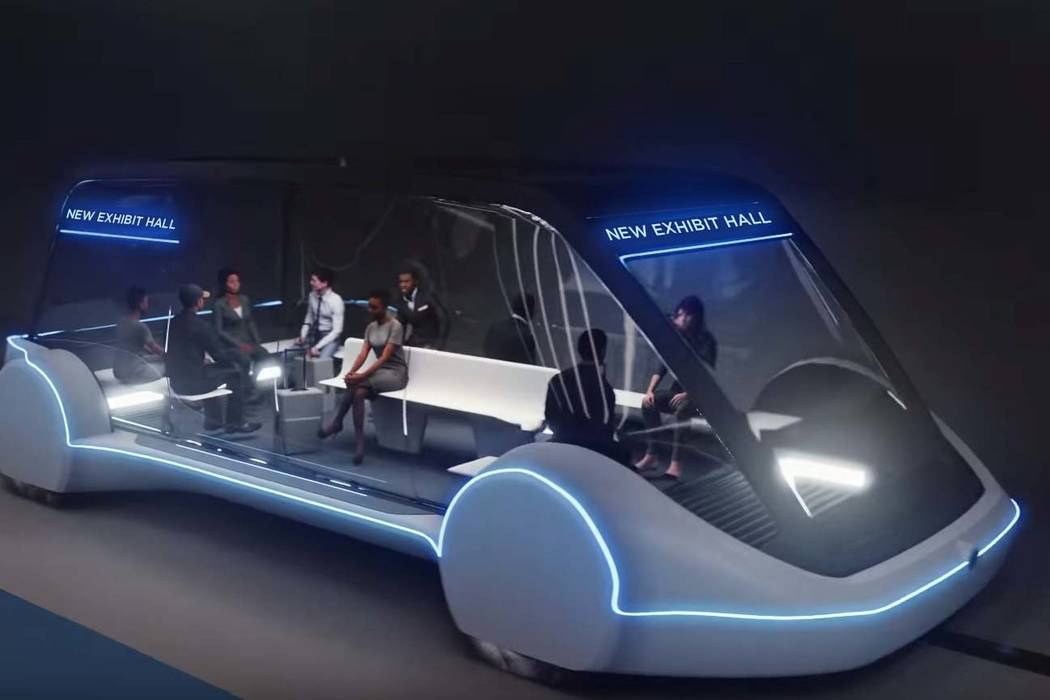
High-occupancy autonomous electric vehicles would run between exhibit halls
at the Las Vegas Convention Center. (The Boring Company)
]

Three members of the Las Vegas Convention and Visitors Authority’s board of
directors brought some healthy skepticism to last week’s meeting at which
the board gave the go-ahead for an underground transit system.

While Las Vegas Mayor Carolyn Goodman, Councilwoman Michele Fiore and
Caesars Entertainment executive Tom Jenkin were unsuccessful in their bid to
get more time to study a proposal by The Boring Co., they raise plenty of
questions, some of which remain unanswered.

The Boring Co., an Elon Musk subsidiary grown out of his SpaceX operation,
proposes using Musk-developed electric Tesla vehicles to run within paired
precast concrete tunnels that would be built about 30 feet below grade
level.

But this system isn’t like a traditional subway that runs from one end of
the line to the other with a series of stops in between.

Think of it as a combination of subway, ride hailing and theme park ride
blended into one. It’s all underground — that’s the subway part. Riders
would use an app to select a destination, presumably from between two and
four choices — that’s the ride-hailing part. And,the vehicles would cruise
on rubber tires just like those minicar rides at amusement parks.

LVCVA President and CEO Steve Hill described it as riding along a freeway
and then taking an exit off the main highway to the destination.

Hill likes the idea that all construction would occur underground, so no
streets would be blocked during trade shows. No parking disruptions. No
traffic issues.

Still, questions abound.

The Boring Co. says it can tunnel at roughly $10 million a mile. By today’s
engineering standards, that’s extraordinary, since subway tunnels in other
cities have cost between $750 million and $1 billion per mile. Those kinds
of numbers will evoke the sentiment of, if it sounds too good to be true, it
probably is.

The high cost of tunneling scratched the idea of a subway system beneath the
Strip in the 1970s. Bill Flangas, a tunnel superintendent and manager for a
team that moved atmospheric nuclear weapons testing underground at the
Nevada Test Site, now known as the Nevada National Security Site, suggested
an underground transit system between McCarran International Airport and the
Strip in 1974.

One of the fears tunneling experts always have is encountering caliche, a
hard substance that is found in our local soils and is challenging to drill
through. But Boring has said a more challenging substance would be soft,
sandy soil to which the tunnel lining can’t be affixed. For the Las Vegas
Convention Center expansion project, tunnelers must also be wary of utility
lines that may exist but are unaccounted for in old records, as well as the
aquifer.

The LVCVA should have a good guide with the deep drilling that contractors
did in the current construction of the West Hall expansion.

The board’s 10-3 vote gives Hill and LVCVA executives permission to
negotiate the terms of a final contract with Boring with a wide range of
projected costs, between $35 million and $55 million.

The cost will depend on the length of the tunnels and the number of stations
— the biggest cost. At a minimum, plans call for three stations and a little
over 1¼ miles of tunneling. At a maximum, plans call for five stations and
about 1½ miles of tunneling.

It’s a little scary that one of the short routes would burrow directly
beneath the convention center’s South and Central halls.

If anything were to happen to the stability of those exhibition halls, as
one engineer I spoke with last week suggested, some of the city’s key
meeting venues would be compromised. That would be a devastating blow to the
city’s convention business.


There’s also been some concern shown about the capacity of the Tesla
vehicles that would be transporting people. The largest vehicle could carry
16 passengers, and it would take several minutes for it to be loaded and
unloaded and be replaced with another vehicle for the next ride.

Anyone who has ever witnessed the crush of people moving around CES knows a
maximum capacity of 16 passengers per vehicle could be an issue.


Some have asked how such a transit system, if extended into the community as
some have suggested, would affect bus, monorail, taxi and ride-hailing
operations. All fair questions.

I’m sure those are some of the questions Goodman, Fiore and Jenkin wanted to
have answered before entering negotiations.
Presumably, they and we will get answers before a final contract is
authorized.
[© reviewjournal.com]


https://www.google.com/search?q=nevada+caliche
...
Caliche: Also known as calcrete, hardpan, and duricrust
https://geology.com/rocks/caliche.shtml
In the United States, caliche is a familiar deposit in many parts of the
Southwest, especially in Arizona, California, Nevada, New Mexico, and Texas.
There ...


For EVLN EV-newswire posts use:
 http://evdl.org/archive/


{brucedp.neocities.org}

--
Sent from: http://electric-vehicle-discussion-list.413529.n4.nabble.com/
_______________________________________________
UNSUBSCRIBE: http://www.evdl.org/help/index.html#usub
http://lists.evdl.org/listinfo.cgi/ev-evdl.org
Please discuss EV drag racing at NEDRA (http://groups.yahoo.com/group/NEDRA)