https://www.abacusnews.com/digital-life/thousands-shared-electric-cars-seen-discarded-hangzhou/article/3003170
Thousands of shared electric cars seen discarded in Hangzhou
March 25, 2019  Xinmei Shen
[image
https://cdn.i-scmp.com/sites/default/files/styles/1320w/public/d8/images/2019/03/25/screenshot_2019-03-25_at_4.04.24_pm.png?itok=fxMDCHZb
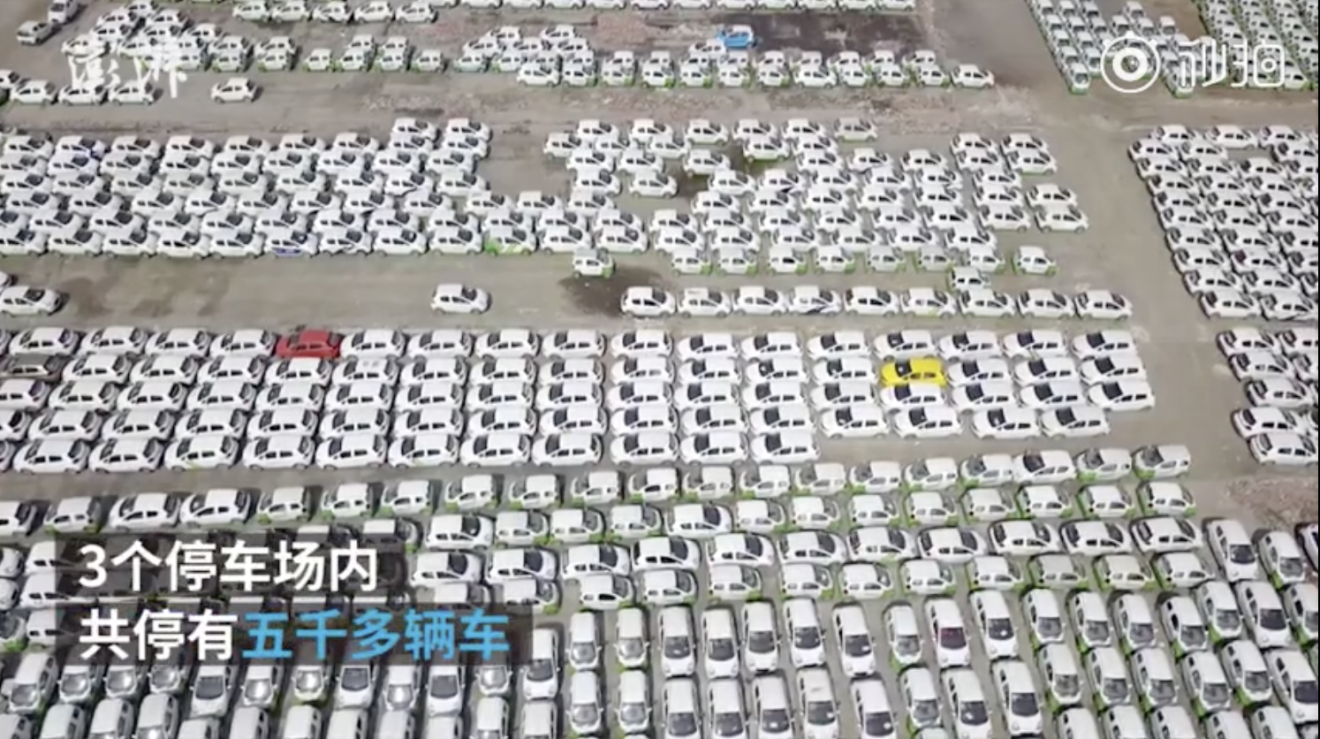
Thousands of electric cars are seen unattended on the outskirts of Hangzhou.
(Picture: The Paper)
]

Is “car-sharing” going down like “bike-sharing”?

Remember those “bike graveyards” that appeared last year after China’s bike
sharing bubble burst? It could be happening again — but this time, it’s a
“graveyard” for shared cars.

Thousands of unused electric cars were seen parked alongside a river on the
outskirts of Hangzhou, according to Chinese media reports. They belong to an
electric car rental company named Microcity, who describes itself as a
leader in “car sharing”.

(Like “bike sharing”, this is more like rental than actual sharing -- all of
the cars are owned by Microcity.)

The company reportedly responded by saying that the cars are still in use,
but the Chinese report claimed that when using the app, they couldn’t locate
any available cars nearby.

A villager interviewed in a video report said that the company has been
paying him more than 30,000 yuan (US$4,469) a year since last July to park
the cars on his land. Another villager said to a local newspaper that she
has never seen so many cars in her whole life and wanted to get closer, but
was stopped from approaching.

Microcity is among the hundreds of “car-sharing” companies that appeared in
the past few years, with the most popular ones deploying tens of thousands
of vehicles across China. Their growth was sparked partially by attempting
to cash in on the sharing economy (even though, again, this is closer to
rental than sharing) and the abundance of EVs in China, thanks to heavy
government subsidies for new energy car makers.

But it appears to have been a bumpy ride so far, as several car-sharing
startups have gone bust last year. In January, state broadcaster CCTV
questioned the business model of “car-sharing” and whether the companies are
really improving city traffic, since they’re putting more cars on the road.

On Zhihu, China’s Q&A platform, users have complained about the poor
experiences of shared electric cars, with many users saying that they
couldn’t start their car again after stopping it on the road.

And it’s starting to look familiar: Togo, one of the most high-profile
“car-sharing” startups, has been struggling to survive since the end of
2018. Users flocked to Togo’s office to ask for their deposit money, just
like they did with Ofo.
[© abacusnews.com]


+
https://news.metal.com/newscontent/100884741/China-halves-subsidies-for-pure-electric-passenger-cars/
China halves subsidies for pure electric passenger cars
SHANGHAI, Mar 27 2019 (SMM) – China announced its long-awaited plan on
Tuesday March 26 to cut subsidies for new energy vehicles (NEVs), to
encourage innovation and promote high-quality development of NEVs ...


For EVLN EV-newswire posts use:
 http://evdl.org/archive/


{brucedp.neocities.org}

--
Sent from: http://electric-vehicle-discussion-list.413529.n4.nabble.com/
_______________________________________________
UNSUBSCRIBE: http://www.evdl.org/help/index.html#usub
http://lists.evdl.org/listinfo.cgi/ev-evdl.org
Please discuss EV drag racing at NEDRA (http://groups.yahoo.com/group/NEDRA)