https://www.teslarati.com/tesla-battery-advantage-interview/
Tesla’s approach to battery technology keeps it ahead in the EV industry
May 31, 2019  Dacia J. Ferris
[images
https://cdn.teslarati.com/wp-content/uploads/2018/05/tesla-model-3-battery-factory-production-line.jpg

https://www.teslarati.com/wp-content/uploads/2019/05/tyes-of-cells.jpg
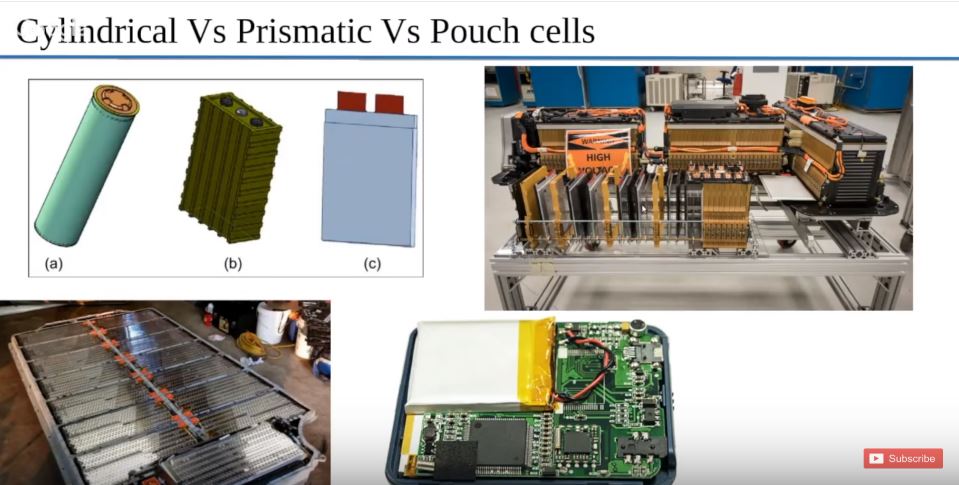
An overview of the different types of battery cells for electric vehicles. |
Image: Ravindra Kempaiah via Sean Mitchell/YouTube

https://cdn.teslarati.com/wp-content/uploads/2019/05/high-temp-high-voltage-bad-effects.jpg
A slide describing the Effect of high temperature and high voltage on
electric vehicles. | Image: Ravindra Kempaiah via Sean Mitchell/YouTube


video
https://youtu.be/18MYRkx_Vr4
How Tesla batteries work with PhD scholar Ravindra Kempaiah
Sean Mitchell’s full interview with Ravindra Kempaiah
]

Tesla’s dominance in the growing electric vehicle (EV) industry is largely
attributed to its unique approach to its battery technology. The engineering
behind the all-electric car maker’s cylindrical cells speaks for itself in
terms of the performance and range achieved, but in a recent interview with
a battery technology researcher, a few things detailed about Tesla’s
batteries stood out in particular.

Ravindra Kempaiah is a Ph.D. scholar at the University of Illinois Chicago
focusing on advanced battery materials for his thesis. In his interview with
Tesla owner and host of All Things EV, Sean Mitchell, Kempaiah explained
lithium-ion technology in EVs and the primary issues faced in their
development. Overall, the biggest challenge is balancing the three main
components in battery production: energy density, cost, and cycle life.
Increasing one area will significantly impact the other, and the ideal
equation is always being sought after. For example, if you increase energy
density for higher range and lower cost, the cycle life takes a major hit.
If you increase density and life cycle, the battery alone can cost as much
as $100k, as described by Kempaiah.

“We always want more range. We always want higher cycle life. We want our
batteries to last 15-20 years and the car to go 500 miles, but this is a
problem every battery scientist has faced for the last 30 years,” Kempaiah
commented in the interview.

Tesla deals with the same balancing act as other battery-electric car
makers; however, there are key factors which seem to have kept the company
ahead in the industry.

First, Tesla’s choice of cylindrical cells sets it apart from every other
electric vehicle on the market. This provides several advantages that drive
performance, flexibility, and cost control. Notably, Rivian is also using
cylindrical cells, [
https://www.teslarati.com/rivian-ny-auto-show-door-flashlight-2170-battery-blog/
] although their vehicles are not yet under production.

Out of the three types of cells available (cylindrical, prismatic, and pouch
cells), cylindrical is the most cost-effective to produce. Namely, the cost
per kWh is lower in cylindrical cells versus other types. The metallic
jacket around the 18650 and 2170 cylindrical cells used in the Tesla Model
S/X and Model 3, respectively, acts as scaffolding and provides structural
rigidity to the battery. Additionally, in high powered situations, current
draw and distribution of power is over the entirety of the battery pack
instead of concentrated in a certain section, according to Kempaiah.

Second, Tesla uses a liquid-cooled thermal management system to manage
battery temperatures whereas other automakers take a more economical air
cooling approach. By adjusting the temperature of the battery pack, Tesla is
able to ensure that cells are operating in their most efficient and optimal
states, thereby maximizing battery longevity as well as performance. While
reducing cost is an important factor in accelerating the growth of the
electric vehicle market, Tesla’s investment in thermal management technology
provides an upside for owners who may be looking for longevity and long-term
affordability of their cars.

Third, Tesla has actively sought to limit the amount of cobalt it uses in
its batteries and already uses less of the element than other companies in
the Model 3 batteries. The scarcity of cobalt and its mining sources have
subjected it to socioeconomic situations that are more than problematic in
the United States, i.e., child labor and similar abuses are widespread in
its sourcing. With this in mind, Tesla has been working on the question, “Is
cobalt really needed?”

Cobalt is used as a cathode in battery technology, and out of all cathode
materials available, it has the highest cost both fiscally and politically.
Current consensus on battery technology says that without cobalt, the
structural integrity and cycle life in batteries is compromised, as
described in the interview. However, some recent scientific literature was
cited by Kempaiah that indicated higher nickel content limited the impact of
cobalt on batteries, possibly removing the need to use it at all. Nickel is
more widely available across the globe, which keeps its cost down and
mitigates the socioeconomic impacts often associated with resource mining
operations. Overall, the discussion between Mitchell and Kempaiah indicated
that Tesla can probably go cobalt-free soon, making it less vulnerable to
the cobalt industry.

Finally, Tesla takes great care to educate its customers about proper
battery maintenance, especially with regard to the negative impact of bad
charging habits. Specifically, keeping an electric car battery charged at
100% for long periods degrades the battery very quickly, while keeping
charging states within an optimal range will give it a long life. Tesla
makes it a point to communicate to customers the importance of battery
health on their overall ownership experience and value of their purchase.

When asked for his opinion by Mitchell, Kempaiah attributed the lack of
education by other brands as a disconnect between engineering teams and
marketing teams. While battery “best practices” are provided to EV customers
by all manufacturers, the importance of communicating the true impact of bad
charging habits may not be emphasized enough to be included as prominently
as it should.

In summary, Tesla is constantly developing the technology in its vehicles,
and its particular attention to its batteries looks to have given the
company a significant advantage over its competitors. Perhaps other
automakers will take a few tips from Tesla in the future, even if it’s as
limited as improving communications with customers.
[© teslarati.com]


+
 (games for killing charge time)
https://www.thedrive.com/news/28131/teslas-could-soon-be-capable-of-playing-fortnite-rocket-league-with-game-engine-ports
Teslas Could Soon Be Capable of Playing Fortnite, Rocket League to Pass
Charging Time
May 22, 2019  Over the weekend, Tesla CEO Elon Musk confirmed on Twitter
that the ... The automaker has previously announced that its Superchargers
will begin to ...
https://twitter.com/elonmusk/status/1129940276745609219


For EVLN EV-newswire posts use:
 http://evdl.org/archive/


{brucedp.neocities.org}

--
Sent from: http://electric-vehicle-discussion-list.413529.n4.nabble.com/
_______________________________________________
UNSUBSCRIBE: http://www.evdl.org/help/index.html#usub
http://lists.evdl.org/listinfo.cgi/ev-evdl.org
Please discuss EV drag racing at NEDRA (http://groups.yahoo.com/group/NEDRA)