http://www.bnsf.com/news-media/railtalk/service/battery-electric-locomotive.html
BNSF leads the charge on testing battery electric locomotive
Aug 7, 2019  bnsf.com
[images
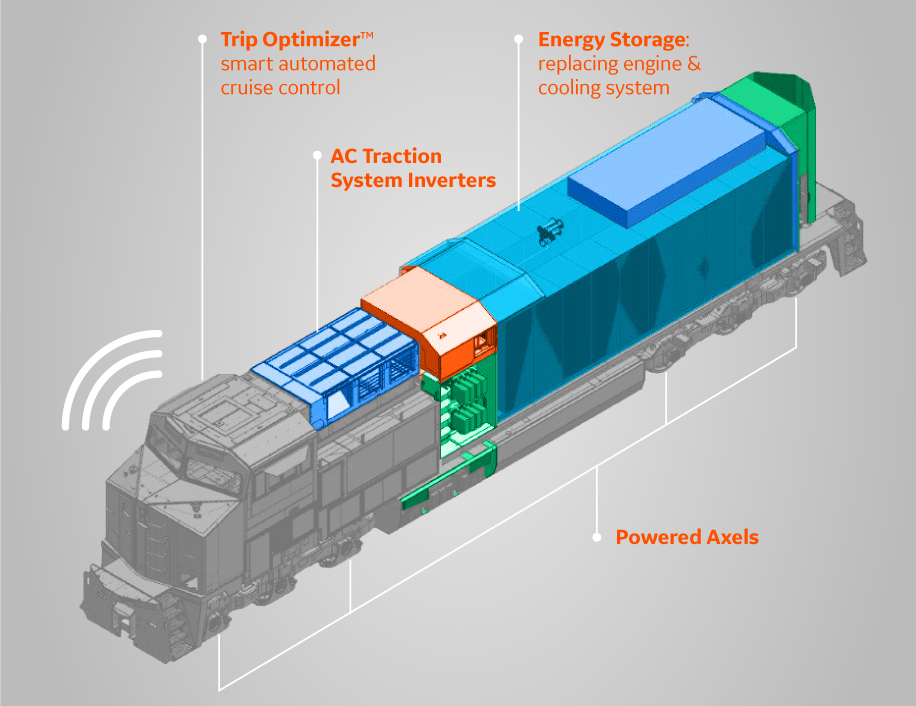
http://www.bnsf.com/news-media/images/rt-bel-ge_graphic-story.jpg

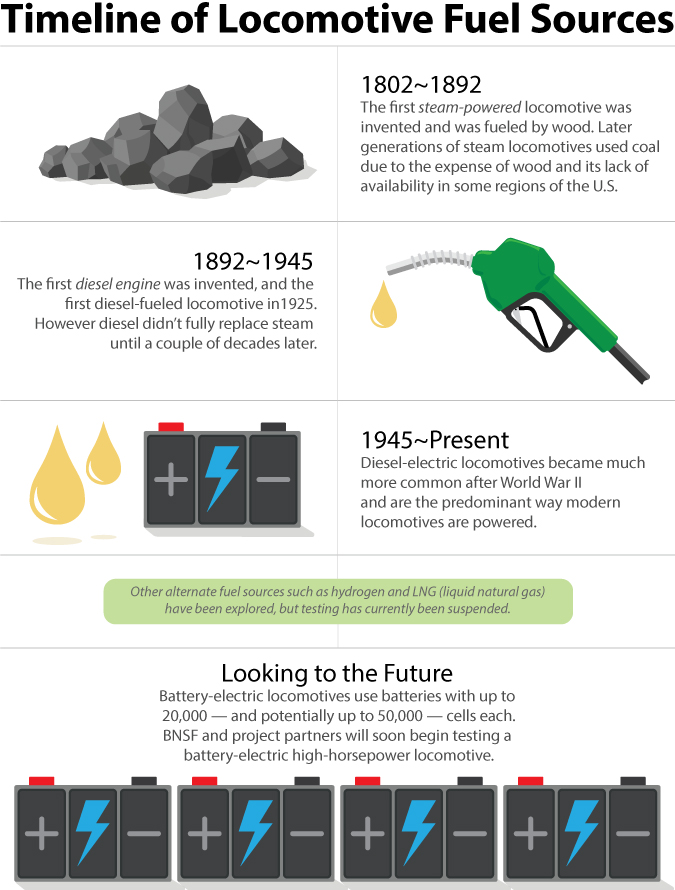
http://www.bnsf.com/news-media/images/rt-bel-fuel_source_infographic.jpg
]

BNSF leads the charge on testing battery-electric locomotive

BNSF and project partners are developing and will soon begin testing a
battery-electric high-horsepower road locomotive (the type that moves
freight trains from Point A to Point B). BNSF and other railroads have
tested low-horsepower battery-electric locomotives in rail yards for years,
but mainly for switching freight cars.

“What’s different about today’s batteries is that they are significantly
more powerful than before, and manufacturers have improved battery quality,
reliability and technology so we’re able to test their power for our road
locomotives,” said BNSF’s Michael Cleveland, senior manager, Emerging
Technologies.

In 2018, BNSF and Wabtec (formerly GE Transportation) joined forces to begin
developing a 100-percent battery-electric road locomotive prototype that
works with conventional diesel locomotives to make a battery-electric hybrid
consist. (Consist refers to when two or more locomotives are coupled
together.) Performance testing of the hybrid is expected to begin in late
2020.

The project is being supported by a grant from the California Air Resources
Board as part of its Zero- and Near Zero-Emission Freight Facilities
program. Once all the equipment and support systems are in place, the plan
is to run tests between Stockton and Barstow, California – about 350 miles.

Once fully developed, the battery-electric locomotive will provide
environmental benefits and fuel savings for the entire locomotive consist.
While in the rail yard, the consist will shut down or idle the other
locomotives (when possible) and use the battery-electric locomotive to
reduce local emissions and noise. Once on the road, the locomotive consist
will work behind the scenes to determine the best way to use the battery
power. Thanks to this capability, the consist could also choose to “graze”
on battery power when the train is cruising through open landscape, saving
hundreds of gallons of diesel.

Over the next few years, BNSF and Wabtec expect to learn much about how to
build, configure, operate and maintain a battery-electric locomotive. Like
the transition from steam to diesel-electric locomotives, it will take years
to support an all battery-electric fleet.

“It certainly has the potential to be a game changer, especially as the
technology continues to mature,” said Wabtec’s Dan McNair, senior product
manager for North American Locomotives. “Our demonstration project in
California with BNSF will give us tremendous insight into the capabilities
of battery power, as well as the best and safest operational methods of
leveraging the technology. Smart utilization of the batteries with diesel
power can provide multiple operational benefits, and I expect the
proliferation of battery locomotives will happen over the next decade."

BNSF’s prototype locomotive will use a battery cell similar to what you
might find under the hood of an electric car. It is a lithium-ion energy
storage unit with cells that contain a combination of nickel, manganese and
cobalt. In terms of size and packaging, however, it’s on a totally different
scale.

Consider a standard electric car battery usually holds a few hundred storage
cells — each around the size of a mini-tablet computer. The locomotive
prototype will have a battery with approximately 20,000 cells, and future
versions may have as many as 50,000 cells. The cells also must be able to
weather the heavy-going environment of a locomotive. From the outside, the
battery-powered locomotive won’t look much different from its diesel
counterparts.

Before the pilot testing of the locomotive can begin, a battery charger will
need to be designed and installed at BNSF’s Mormon Yard in Stockton later
this year. While the Stockton battery charging station will provide an
initial charge, the new locomotive will be designed to provide regenerative
power under braking to extend its range.

“The battery will recover energy through dynamic braking,” Cleveland
explained. (Dynamic braking is where the kinetic energy of a moving train is
used to generate electric current at the locomotive’s traction motors.)
“Essentially, every time dynamic braking is used to slow and control train
speed, the battery will refill its energy reserves, which is unlike anything
today’s diesel-powered locomotives can do.”

The battery-electric locomotives will also use an advanced version of train
energy management software to look at the route ahead and calculate how to
best use the battery to reduce fuel consumption.

“We're developing and testing the ‘next-generation’ locomotive now to build
our advantage over long-haul trucks, remain competitive and reduce our
operating costs,” said John Lovenburg, vice president, Environmental, BNSF.

And together, with our project partners, we’ll be leading the “charge” in
railroading’s future.
Did you know?

The BNSF/Wabtec battery-electric locomotive pilot project is being supported
in part by a grant from the California Air Resources Board, which has
awarded $22.6 million to BNSF Railway and the San Joaquin Valley Air
Pollution Control District for the Zero- and Near Zero-Emission Freight
Facilities Project. In addition to the locomotive technology development,
the Zero- and Near Zero-Emission Freight Facilities Project will pilot
several emissions-reducing technologies in and around railyards. The Zero-
and Near Zero-Emission Freight Facilities Project is part of California
Climate Investments, a statewide initiative that puts billions of
Cap-and-Trade dollars to work reducing greenhouse gas emissions,
strengthening the economy and improving public health and the environment —
particularly in disadvantaged communities. For more information, visit
http://www.caclimateinvestments.ca.gov/
[© bnsf.com/]


http://www.yelmonline.com/opinion/article_8f7de12a-bfa0-11e9-8850-7f846b70861d.html
Back to Business: Battery Operated Locomotives Could Be Coming Soon
2019-08-15  Don C. Brunell

More battery operated cars and trucks are making their way onto streets and
highways, so why not trains? That might not be too far off if BNSF tests are
successful.

BNSF and Wabtec (formerly GE Transportation) are developing a
battery-electric high-horsepower road locomotive — the type that moves
freight trains between Seattle and Chicago. Once all the equipment and
support systems are in place, the plan is to run tests between Stockton and
Barstow, California, (350 miles) beginning in late 2020.

BNSF and other railroads are already using low-horsepower battery-electric
locomotives in urban rail yards. Newer diesel hybrid switchers save fuel and
reduce greenhouse gas emissions by shifting power to banks of batteries
while idling. That technology is particularly important because cities have
high concentrations of noxious air emissions.

“What’s different about today’s batteries is that they are significantly
more powerful than before, and manufacturers have improved battery quality,
reliability and technology so we’re able to test their power for our road
locomotives,” said BNSF’s Michael Cleveland, senior manager of emerging
technologies.

Last year, BNSF and Wabtec, aided by a $22.6 million grant from the
California Air Resources Board, joined forces to begin developing a
100-percent battery-electric road locomotive prototype that works with
conventional diesel locomotives to make a battery-electric hybrid “consist.”
(Consist refers to when two or more locomotives are coupled together).

BNSF’s prototype will use a battery cell similar to what you might find
under the hood of an electric car. It is a lithium-ion energy storage unit
with cells that contain a combination of nickel, manganese and cobalt. In
terms of size and packaging, however, it’s on a totally different scale.

Once fully developed, the battery-electric locomotive is expected to
significantly reduce greenhouse gas emissions. It will have a battery with
approximately 20,000 cells and future versions may have as many as 50,000
cells.

While in the rail yard, “the consist” will shut down diesel engines when
possible. It will change over to a battery-electric locomotive unit which
also reduces noise. Once on the road, they can “graze” on battery power when
the train is cruising through open landscape, saving hundreds of gallons of
diesel.

The question arises: Why not just install overhead power lines and bring
back the old Milwaukee “Little Joe” electric locomotive?  Many trains in
Europe and in the northeastern U.S. still draw power from overhead electric
lines.

In the Pacific Northwest, the Milwaukee Road, the last transcontinental line
to be built, electrified its lines across the Rocky Mountains and to the
Pacific Ocean starting in 1915. However, the Milwaukee Road replaced
electric locomotives completely in 1974 before it ended service in 1980.

The chief disadvantage of electrification is the high cost for
infrastructure: overhead lines or third rail, substations and control
systems. Those costs were particularly high in the sparsely populated
western part of our country, which has lower volumes of freight and
passenger traffic.

Today, battery-operated trains are a key component of the railroads “green
strategy.”

According to the American Association of Railroads (AAR), in 2017 alone,
U.S. freight railroads consumed 732 million fewer gallons of fuel and
emitted 8.2 million fewer tons of carbon dioxide than they would have if
their fuel efficiency had remained constant since 2000.

AAR said U.S freight railroads, on average, move one ton of freight 479
miles per gallon of fuel. By comparison, a tug pushing a barge on the
Columbia and Snake rivers can haul a ton of wheat 576 miles on a single
gallon of fuel.

Hopefully, BNSF’s new hybrid system comes to fruition. It is a way to save
fuel, reduce air contaminants, provide family-wage jobs and keep America’s
economy moving
[© yelmonline.com]
...
https://www.google.com/search?q=Battery+Locomotives+Stockton+Barstow


[dated]
https://www.ge.com/reports/leading-charge-battery-electric-locomotives-pushing-us-freight-trains/
Leading The Charge: Battery-Electric Locomotives Will Be Pushing US Freight
Trains Further
Oct 24, 2018 ... BNSF will run the pilot program with help from GE
Transportation, which is developing the locomotive. Adding even one
battery-powered locomotive to the train could ...


For EVLN EV-newswire posts use:
 http://evdl.org/archive/


{brucedp.neocities.org}

--
Sent from: http://electric-vehicle-discussion-list.413529.n4.nabble.com/
_______________________________________________
UNSUBSCRIBE: http://www.evdl.org/help/index.html#usub
http://lists.evdl.org/listinfo.cgi/ev-evdl.org
Please discuss EV drag racing at NEDRA (http://groups.yahoo.com/group/NEDRA)