https://www.teslarati.com/tesla-roadster-2020-maxwell-supercapacitors/
How Tesla’s new Roadster can benefit from Maxwell’s supercapacitors
August 25, 2019  Simon Alvarez
[image
https://www.teslarati.com/wp-content/uploads/2019/06/tesla-roadster-red-1.jpg
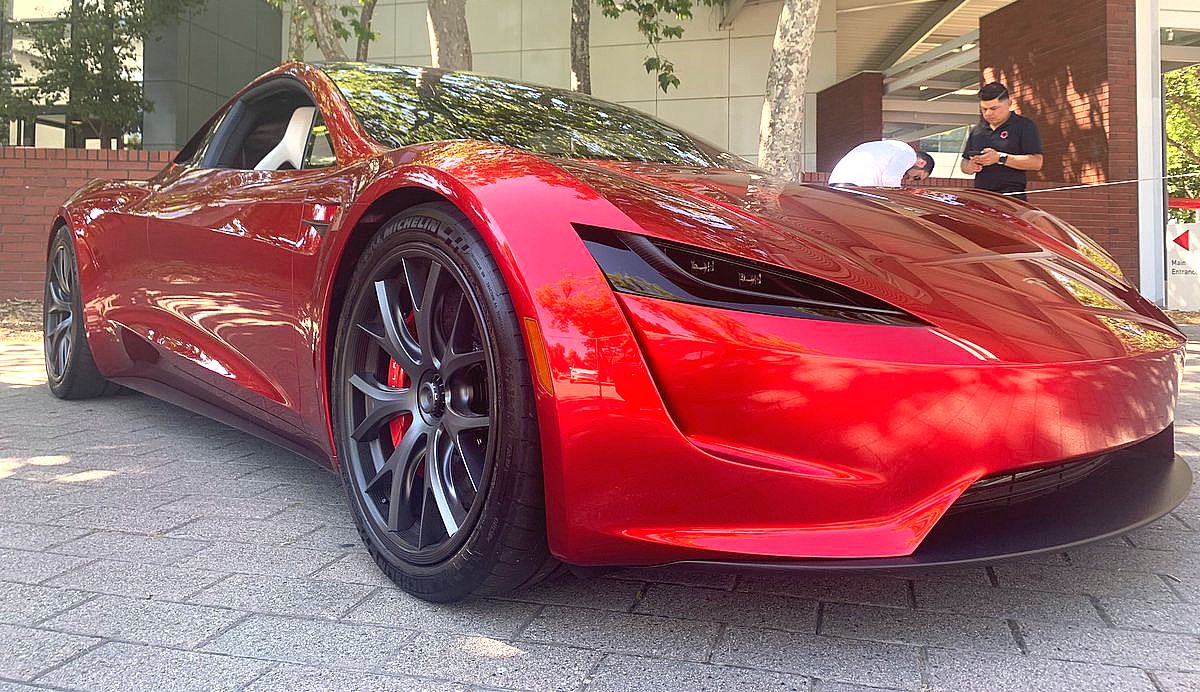
Tesla's next-gen Roadster and the Model Y at the 2019 Annual Shareholder
Meeting. (Photo: Vincent Yu/Twitter)
]

The new Tesla Roadster is the very definition of a halo car. Embodying all
the innovations that Tesla has developed and mastered over the years, the
next-gen Roadster is intended, as Elon Musk put it, to give a “hardcore
smackdown” to gasoline cars. During the CEO’s appearance at the Ride the
Lightning podcast, Musk even candidly mentioned that the upcoming vehicle
will have capabilities that are practically “unfair” to its internal
combustion-powered competition.

It has been almost two years since the vehicle was unveiled, and over this
time, Tesla has made headway in its electric vehicle tech. Earlier this
year, Tesla completed the acquisition of Maxwell Technologies, a company
that specializes in supercapacitors and the development of dry battery
electrode technology. These innovations, which Tesla has complete access to,
are a perfect fit for the next-generation Roadster.

Munro and Associates Sr. Associate Mark Ellis recently noted during an
interview with Tesla owner-enthusiast Sean Mitchell that Maxwell’s tech have
immense potential in the electric vehicle segment. “The dry battery
technology is game-changing if it comes to pass and they can put it in a
car,” he said. Ellis also explained that supercapacitor technology could
greatly help electric vehicles in terms of their battery management.

“One of the issues with the battery is, when I step on the throttle hard,
I’m pulling a lot of energy from the battery. And then, when I brake hard,
I’m pulling a lot of energy out of the regen, but the batteries can’t take
it fast enough. The batteries get really stressed when you try to pull it up
too much, so if I had supercapacitors that I could use as a cushion; so when
I need energy quickly, (I can) pull it from the supercapacitors and then
fill the supercapacitors back up with the battery slowly; and then when I
brake, I can capture more of that regen energy and do the supercapacitors
faster. I think that just makes logical sense, because now all of a sudden
I’ve got a sponge in front of my main energy source and I’m not stressing
(the battery) so much,” he said.

This “sponge” that Ellis mentioned will be greatly beneficial for vehicles
like the next-generation Roadster, which is designed to accelerate at
incredibly rapid speeds. The Roadster will be insanely quick on a straight
line with its 0-60 mph time of 1.9 seconds, and based on Musk’s previous
statements about the vehicle, the all-electric supercar will be able to take
on track driving as well. This means that the next-generation Roadster will
be a monster of a supercar, and it will require serious refinement in terms
of its battery and electric motors to maintain its optimum performance.

Tesla is a far more experienced carmaker today than it was when Elon Musk
unveiled the next-generation Roadster in 2017. Considering that Tesla is a
company with a culture of innovation, it is almost certain that the new
Roadster, once it is released, will be a far more refined vehicle than the
already-game-changing supercar that shocked the auto industry nearly two
years ago. Elon Musk, if any, has mentioned some of these updates, one of
which is a SpaceX package that will utilize cold gas thrusters (the same
technology used in SpaceX’s Falcon 9 rockets) to help the vehicle’s
acceleration, braking, and maneuverability.

The impending arrival of the next-generation Roadster appears to have
started a disruption in the hypercar market. Since the vehicle’s unveiling,
other carmakers have introduced all-electric monsters of their own. Among
these is the ~$2.5 million, 1,900 hp Pininfarina Battista, the ~$2 million,
1,973 hp Lotus Evija, and the $2.1 million, 1,914 hp Rimac C_Two.
Considering that the Roadster will start at around $200,000, the vehicle
will likely be closer in price to upcoming premium sports EVs like the
Taycan Turbo S, which is expected to command a notably higher price compared
to the ~$130,000 Taycan Turbo.
[© teslarati.com]


+ ($80k FMC transist-van-ice used for Tesla mobile service)
https://cleantechnica.com/2019/08/17/the-future-of-teslas-mobile-service-fleet/
The Future Of Tesla's Mobile Service Fleet
A Tesla Model S mobile service vehicle at the Fremont Service Center ...
performing mobile service at a customer’s home or office is far easier for
the customer. This is the kind of “little thing” that leads to happier
customers and more word-of-mouth sales ...
https://cleantechnica.com/files/2019/08/tesla-mobile-service-van-ranger-KYLE.jpg


For EVLN EV-newswire posts use:
 http://evdl.org/archive/


{brucedp.neocities.org}

--
Sent from: http://electric-vehicle-discussion-list.413529.n4.nabble.com/
_______________________________________________
UNSUBSCRIBE: http://www.evdl.org/help/index.html#usub
ARCHIVE: http://www.evdl.org/archive/index.html
INFO: http://lists.evdl.org/listinfo.cgi/ev-evdl.org
Please discuss EV drag racing at NEDRA (http://groups.yahoo.com/group/NEDRA)