https://www.desmogblog.com/2019/09/04/wall-street-journal-barrasso-koch-electric-car-tax-credit-myths
Wall Street Journal and Senator Barrasso Still Peddling Koch's Electric Car
Myths
September 4, 2019  Ben Jervey
[images
https://www.kochvsclean.com/wp-content/uploads/2019/02/KochVsClean_EVFactsTitleBlocks07.jpg

https://www.kochvsclean.com/wp-content/uploads/2019/02/KochVsClean_EVFactsTitleBlocks02.jpg


video
https://youtu.be/gLOgRmst1pw
Electric Cars As Affordable As Gas Cars
]

Senator John Barrasso and the Wall Street Journal (WSJ) editorial board are
once again attacking the federal electric vehicle tax credit, and are once
again relying on easily debunked talking points born of the Koch network’s [
https://www.desmogblog.com/koch-network-database
] influence machine.

Senator Barrasso has reportedly sent a letter to Republican colleagues in
the Senate, advising them not to extend the electric vehicle (EV) tax
credit.

The Wall Street Journal’s editorial board cheered Senator Barrasso’s act in
an editorial published Tuesday [
https://www.wsj.com/articles/subsidize-my-electric-car-please-11567459952
]. The deception and falsehoods are so rife in the WSJ editorial that it
that begs for rebuttal. So here goes.

The piece itself opens with a whopper.

    “Washington has been underwriting EVs for nearly 30 years.”

We asked the WSJ editorial board for a reference, but haven’t yet received a
reply. The EV tax credit wasn’t introduced until 2009, and government
research and development (R&D) spending on EVs was relatively small in
preceding decades.

In fact, in 1990, the federal government spent roughly $194 million on all
energy efficiency programs, a small percentage of which may have been
steered towards transportation electrification. It’s worth noting that this
$194 million was less than half of the R&D support provided to both the
nuclear industry and fossil fuel industries.

Possibly they are referring to California’s Zero Emission Vehicle mandate,
introduced in 1990. But, of course, California isn’t “Washington,” and a
mandate isn’t exactly “underwriting.”

Later, the board writes:

    “Itʼs hard to imagine a more blatant income transfer for the well-to-do.
Electric cars are significantly more expensive than the average vehicle,
with a starting price of around $36,000.”

Actually, according to Kelly Blue Book, the average price for a new vehicle
in the United States was $37,577 in December 2018.

They continue:

    “A recent Congressional Research Service study found that nearly 80
percent of the credits were claimed by households with adjusted gross income
of more than $100,000.”

Specifically, this CRS report explains that in 2016, 57,066 individual
taxpayers claimed $375 million in plug-in vehicle tax credits. Of these
57,066, 78 percent have an adjusted gross income of $100,000 or more.

However, this study ignores the significant role leases play in the EV
market. (And the CRS acknowledges as much in its methodology.)

Through 2017, the vast majority of EVs were leased — a full 80 percent of
non-Tesla EVs and still well more than half of all EVs including Tesla,
according to Bloomberg New Energy Finance. In 2016, when those 57,066
individuals claimed the EV tax credit, a total of 158,614 plug-in vehicles
were newly registered. This means that more than 100,000 were leased, or
nearly two-thirds of all new EVs put on the road that year. After a dealer
claims the $7,500 tax credit, it is applied as a rebate at the point of sale
and reduces the monthly lease payments, making EVs more affordable for
drivers of all income levels.

Finally, the WSJ editorial board claims — somehow, without any reference or
substantiation — that:

    “None of this will have the slightest impact on the climate.”

This claim only makes sense if you entirely deny the scientific realities of
how greenhouse gas emissions cause climate change. The transportation sector
is currently the largest source of greenhouse gas emissions in the United
States, and personal vehicles represent the majority of those emissions.

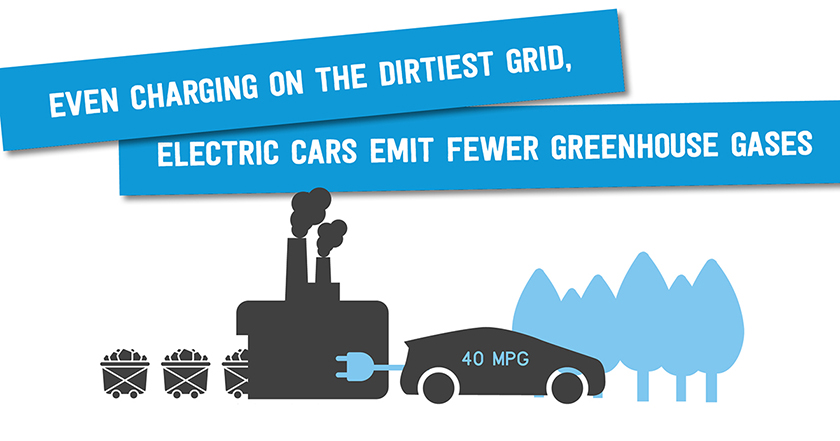
And while some reports have tried to portray EVs as equally polluting as
traditional gas-powered vehicles, the experts at Carbon Brief laid waste to
those deceptive talking points:

    “EVs are responsible for considerably lower emissions over their
lifetime than conventional (internal combustion engine) vehicles across
Europe as a whole.

    In countries with coal-intensive electricity generation, the benefits of
EVs are smaller and they have similar lifetime emissions to the most
efficient conventional vehicles — such as hybrid-electric models.

    However, as countries decarbonize electricity generation to meet their
climate targets, driving emissions will fall for existing EVs and
manufacturing emissions will fall for new EVs.

    Comparisons between electric vehicles and conventional vehicles are
complex. They depend on the size of the vehicles, the accuracy of the
fuel-economy estimates used, how electricity emissions are calculated, what
driving patterns are assumed, and even the weather in regions where the
vehicles are used. There is no single estimate that applies everywhere.”

Seeing as Senator Barrasso is the third-highest recipient of Koch cash in
the Senate, having taken in $45,400 from oil refining giant Koch Industries
from 2013 to 2018, it’s not hard to understand why he is opposing any
federal incentives for the technologies that will help American drivers buy
less gasoline.

It’s harder to grasp why the Wall Street Journal editorial board would take
such a strong stance on the relatively small electric vehicle tax credit
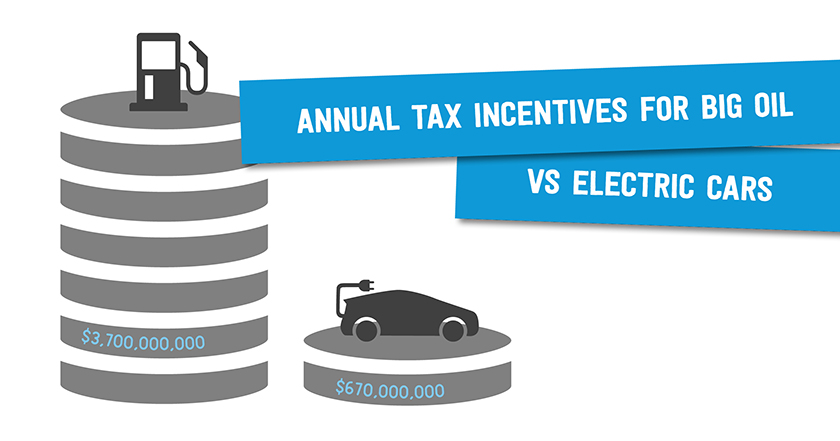
(which totalled $670 million in 2017), and yet remain silent on much larger
federal subsidies to the well-established (and terribly polluting) oil and
gas industries.

Those oil and gas handouts cost taxpayers at least $3.7 billion (and
probably closer to $4.7 billion) each year, and are possibly as high as $11
billion every year ...
[© desmogblog.com]


For EVLN EV-newswire posts use:
 http://evdl.org/archive/


{brucedp.neocities.org}

--
Sent from: http://electric-vehicle-discussion-list.413529.n4.nabble.com/
_______________________________________________
UNSUBSCRIBE: http://www.evdl.org/help/index.html#usub
ARCHIVE: http://www.evdl.org/archive/index.html
INFO: http://lists.evdl.org/listinfo.cgi/ev-evdl.org
Please discuss EV drag racing at NEDRA (http://groups.yahoo.com/group/NEDRA)