https://www.latimes.com/business/story/2019-11-14/tesla-electric-vehicles-classic-cars
They turn ’49 Mercurys and Shelby Cobras into EVs, one Tesla carcass at a
time
NOV. 14, 2019  Charles Fleming
[images
http://california-times-brightspot.s3.amazonaws.com/c8/c6/87cacaec4630a262cfbe07d36d4f/la-photos-1staff-471263-la-fi-hy-ev-tesla-classic-retro-cars-03.FO.jpg
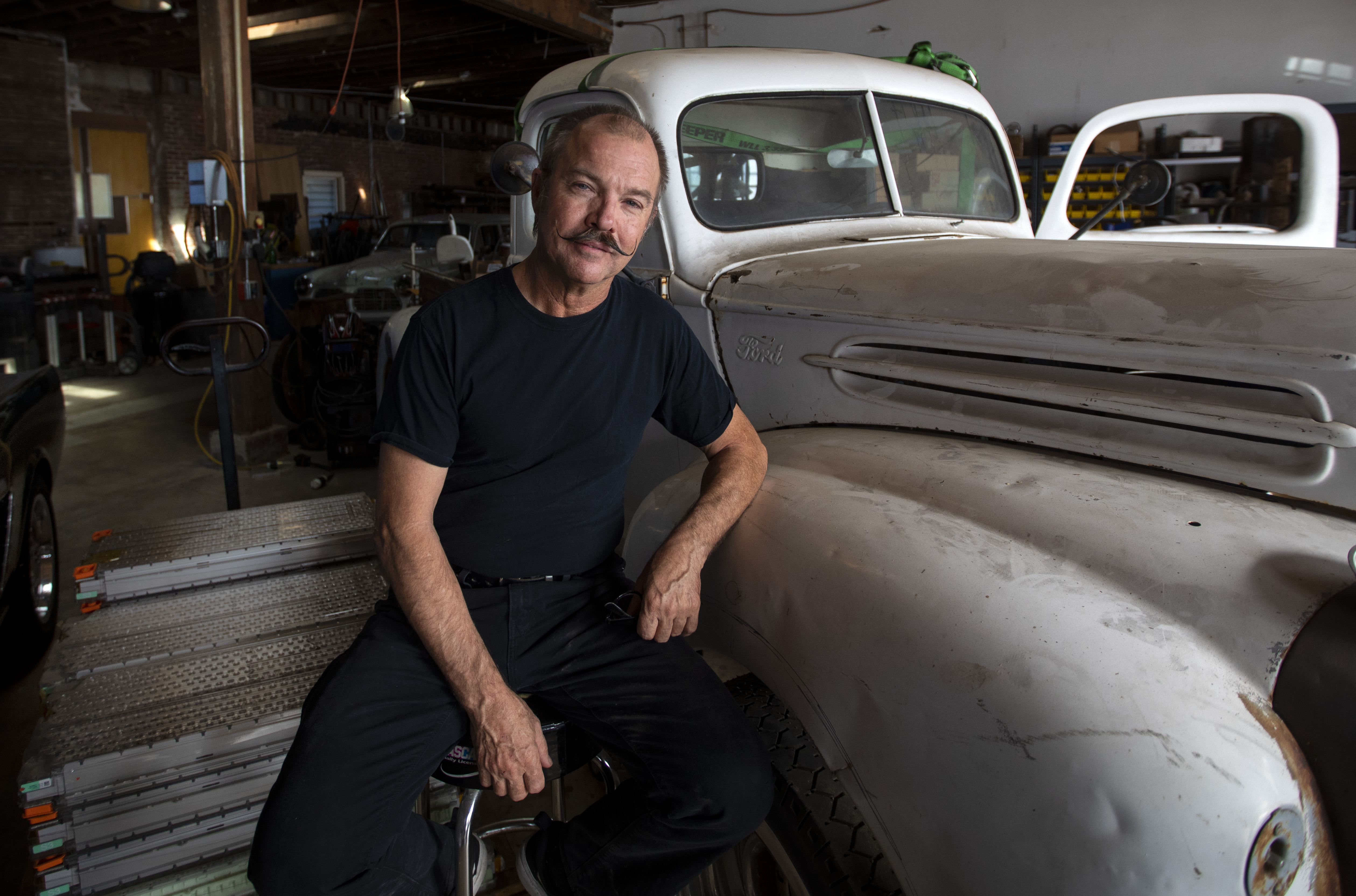
Greg “Reverend Gadget” Abbott, car inventor and EV whiz, in his shop in Los
Angeles. He converts retro sports cars to electric power. He is sitting next
to a 1947 Ford truck and Tesla car batteries. (Francine Orr / Los Angeles
Times)

http://california-times-brightspot.s3.amazonaws.com/cb/a2/63c19d1546f88e76d351b618e262/la-photos-1staff-467520-fi-hw-ward-icon-electric-vehicles-08-mjc.JPG
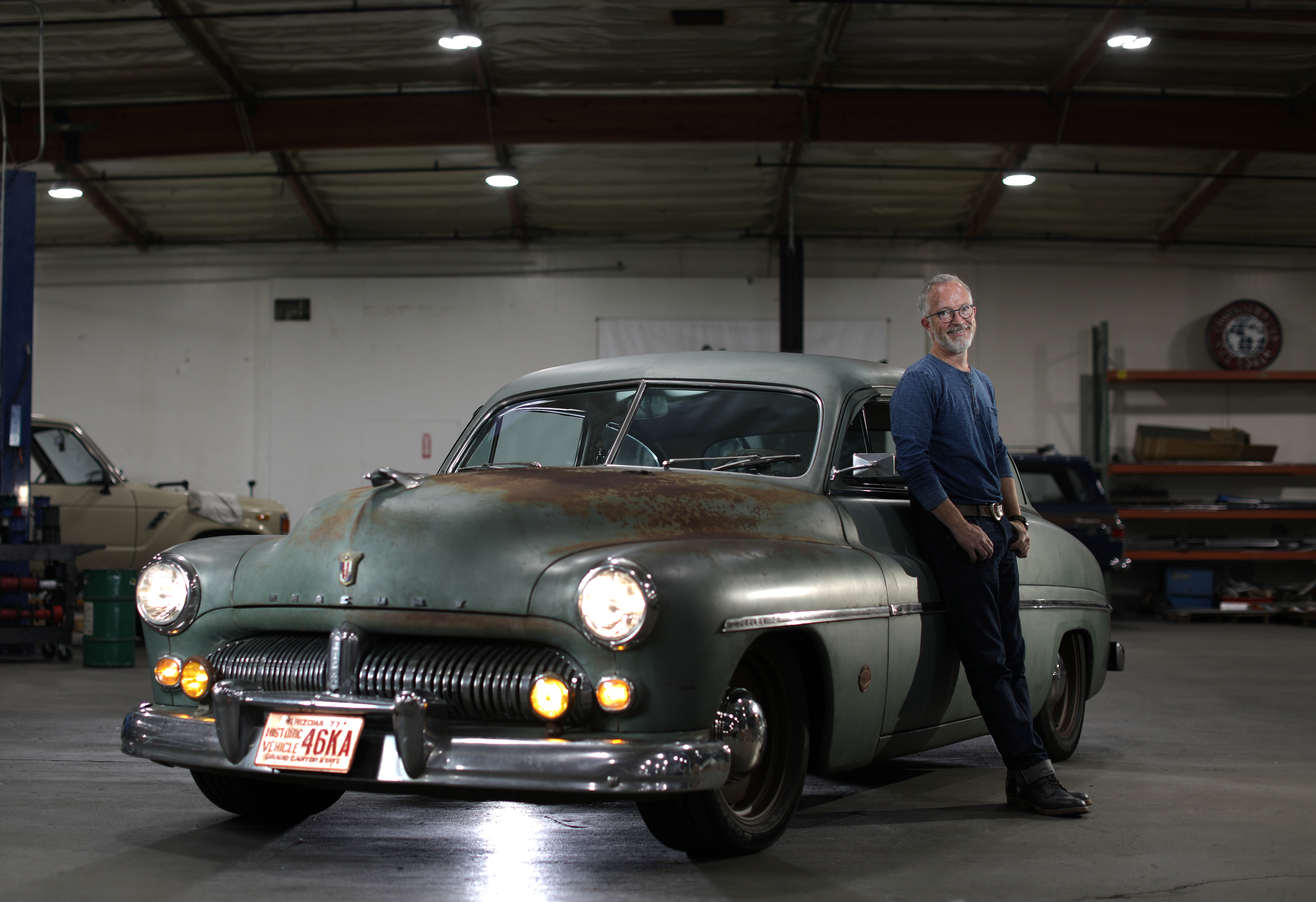
The Icon “Derelict” 1949 Mercury Coupe EV is a customized retro
electric-drive vehicle. The engine bay is filled with electronics and
batteries to give it the traditional V-8 engine look. The vehicle is powered
by Tesla 85-kWh batteries fitted throughout the car for ideal balance. Its
dual electric motors provide 470 pound-feet of torque and the equivalent of
400 horsepower.(Myung J. Chun / Los Angeles Times)

http://california-times-brightspot.s3.amazonaws.com/2b/9c/b686e38c4ec393d5f2d609cc1d9a/la-photos-1staff-467520-fi-hw-ward-icon-electric-vehicles-07-mjc.JPG
Classic car culture meets green culture in the dashboard of Icon’s
high-tech/low-tech “Derelict” 1949 Mercury Coupe EV. (Myung J. Chun / Los
Angeles Times)

http://california-times-brightspot.s3.amazonaws.com/08/a6/2f7608734c65b6a7853ddff20ece/la-photos-1staff-467520-fi-hw-ward-icon-electric-vehicles-01-mjc.jpg
Jonathan Ward’s Icon created this “Derelict” 1949 Mercury Coupe EV by
converting the classic car to an electric vehicle powered by Tesla
batteries.(Myung J. Chun / Los Angeles Times)

http://california-times-brightspot.s3.amazonaws.com/b4/22/8a00006a4bbba7f2113c95d83fc0/la-photos-1staff-467520-fi-hw-ward-icon-electric-vehicles-04-mjc.JPG
Tesla batteries are fitted throughout the Icon Derelict 1949 Mercury Coupe,
including the rear, where the gas tank would normally be, for balance. The
car has a range of 150 to 200 miles.(Myung J. Chun / Los Angeles Times)
]

In a garage near South Los Angeles, metal fabricator Greg Abbott [
http://leftcoastelectric.com
] fits battery packs borrowed from a decommissioned Fiat 500E under the hood
of a 1965 Mustang.

In Oceanside, Calif., former AAMCO mechanic Matthew Hauber combines the
suspension system and battery packs from a totaled Tesla to make an
800-horsepower, all-wheel-drive Shelby Cobra.

In an unlikely marriage of classic car culture and green technology,
sophisticated hot-rodders — mostly men, mostly Californians — are
cannibalizing crashed electric cars and using their batteries to create
electrified sports cars and muscle cars.

As comfortable wielding an ohmmeter as a spark-plug wrench, they are
expanding the automotive world’s consciousness about what can be done in the
electric-vehicle space — and making good money doing it. Their price can run
from $30,000 for a do-it-yourself conversion kit for a VW Bug to several
hundred thousand dollars for a fully customized, up-from-the-tires EV
overhaul.

“These guys are taking drivetrains out of Teslas and Nissan Leafs and
putting them in all kinds of vehicles,” said Gordon McCall, founder of the
Quail Motorsports Gathering in Carmel, Calif., one of the country’s most
respected annual automotive events. “They’re hot-rodding electric cars just
like their grandfathers did with 1932 Fords.”

The EV classics are gaining stature on the custom car circuit. August’s
Quail event featured “A Tribute to the Electric Car Movement.” On the
fairway were a VW microbus conversion and a battery-powered 1949 Mercury,
which took the top prize in the Quail’s first-ever electric car class.

Hauber became interested in electric vehicles after seeing the 2007
documentary “Who Killed the Electric Car?” about the demise of GM’s
1990s-era EV1 ... Soon he was building electric cars on his own.

Abbott started early, too. Sometime around 2004 the artist, furniture
builder and metal fabricator, who goes by the moniker Reverend Gadget,
converted a Triumph Spitfire into an electric vehicle, using old-fashioned
lead-acid batteries that were heavy and hard to control. Friends began
asking him to build them electric cars, too.


The process was tedious, and the results were undependable. Standing in his
cramped Florence-area workshop alongside a mid-electrification Porsche
Speedster, a classic Volvo station wagon and a rusting 1947 Ford pickup,
Abbott said, “They were like rolling science experiments, and you had to be
a tinkerer to own one.”


Salvation came in the form of Elon Musk and Tesla. Pouring massive resources
into batteries and battery management, the billionaire entrepreneur started
selling increasingly large numbers of electric cars powered by lithium-ion
energy packs that were powerful, rechargeable and reliable.

When Tesla owners crashed their Tesla Model S sedans and Model X SUVs, and
the cars wound up as insurance write-offs, EV scavengers came running. They
would scour local junkyards for the damaged cars and pay, in the early days,
only a few thousand dollars for their undamaged battery clusters.

That increased the power and range of the custom electrified vehicles and
made them a lot easier to own and operate. “Then you could just hand the
keys to someone, to anyone, and say, ‘Drive it until it runs out of
electricity and then plug it in,’” Hauber said.

Interest in retro EVs has accelerated in recent years.

In 2013, former advertising executive Dave Benardo and his wife and partner
Bonnie Rodgers traded San Francisco for San Diego to pursue their passionate
interest in vintage Volkswagens. When they electrified a Beetle and
documented the process online, customers came calling. To date, their
Zelectric Motors has converted about 30 Bugs, Karmann Ghias, microbuses and
VW Things into battery-powered runabouts.

They found that putting maintenance-free electric drivetrains into vintage
vehicles eliminated a lot of mechanical babysitting that classic cars demand
of their owners. “There are people who are in love with the design of these
classics, but they don’t want to do the wrenching on them,” Benardo said.
“They just want to spend more time driving.”

For one customer, Benardo recently electrified a 1973 Porsche 911 S. The car
looks exactly as it did when it was new, except that under the hood an
electric motor that makes 240 horsepower has replaced an engine that made
180.

“Now it’s just a question of going faster in an old car,” Benardo said.

Sometimes, too fast. The 800-horsepower Shelby Cobra that Hauber made for
commercial TV lighting technician Don Swadley of El Cajon, Calif., was so
powerful as to be virtually undrivable.

“Even with the motor tuned down, we couldn’t get any traction control,”
Swadley said. “At 50 miles per hour, you’d put your foot on the pedal and
the car would go completely sideways.”

Hauber’s solution: Make the Shelby more like a Tesla by adding a Tesla
drivetrain and suspension system, with the Model S’s standard P85 motor in
the back and an upgraded Tesla P100D motor up front. “It’s 2,600 pounds
lighter than a Tesla, and it’s absolutely faster than any Tesla on the
road,” Swadley said. “Now I can go down the road with the wind messing up my
hair and out-accelerate anything and not be killing any trees.”

Graphic designer Thomas Almodovar of Playa del Rey said he was thinking of
buying an electric car, in part to help the environment. Then he thought,
“It creates a lot of pollution to make a new car. But if you buy a used one
and convert it, you’re not polluting at all.”

Almodovar paid a local garage $2,500 for a 1979 MG that had come to the end
of its mechanical life. Then he spent $19,000 to have Abbott modify it. The
result: A silent-running convertible sports car that has amazing torque and
a 60-mile range.

In the case of Jonathan Ward and his Icon workshop in Chatsworth, the
classic cars are really classic.

The car builder and former Toyota designer, who made his name turning shells
of gas-powered Toyota Land Cruisers, Ford Broncos and Chevy pickup trucks
into modern street racers, spent three years and thousands of R&D hours
electrifying the Quail-winning 1949 Mercury for a loyal customer. When he
was done, he’d built a 400-horsepower EV bomb powered by Tesla batteries and
capable of being recharged using any of the charging systems currently in
use, including Tesla’s Superchargers, he said.

With a top speed of 120 mph and a range of 150 to 200 miles, the vehicle
offers the beauty of a classic Detroit cruiser with modern attributes such
as power steering, air conditioning and a Bluetooth connection.

Most of the retro-EV customizers power their vehicles with batteries from
wrecked Model S, Fiat 500 or Nissan Leaf cars that have less than 20,000
miles on them. They hold up well, the builders said, and are likely to last
well past the 100,000-mile mark typically exceeded by Teslas.

“I’ve never had one fail. Ever. Not one,” Hauber said.

The upside, for some customers, is ease of ownership. Like the EVs built by
major manufacturers, these Franken-vehicles have far fewer moving parts than
gas-powered cars and need little service attention. If the batteries or
other parts need replacement or the owners want to upgrade to more powerful
motors, the cars can be serviced by the builders.

Tesla — which did not respond to requests for comments — has actively
discouraged the use of salvaged vehicles or parts, and has been accused of
disabling the software on cars it has written off. It took creative work by
dedicated hackers to write third-party code that would allow builders to
remove the batteries and use them properly, Icon’s Ward said.

The downside, for many, will be the cost. Today, Hauber and other builders
say, Tesla batteries pulled from wrecked cars cost them $16,000 and up —
just for the batteries. That leaves aside the cost of the AC motor,
controllers and other parts. And the price is going up as competition among
EV customizers increases.

Hauber’s Stealth EV will sell a conversion kit for a VW Bug for about
$30,000. If his shop installs it, add $15,000 or more. If it’s a car “for
the performance horsepower enthusiast with a classic muscle car where the
buyer wants to go all out,” Hauber said, figure $130,000 and up — added to
whatever the host car cost in the first place.

In Chatsworth, the wiry, bespectacled Ward declines to say what he is
charging the new owner of the 1949 Mercury, though he says a similar project
went out the door at $500,000. When a valued repeat customer decided he
wanted his 1963 Ferrari GTE 250 restored and made electric, Ward says he
told him, “I can’t even begin to guess how long it will take or how much it
will cost.” The customer gave him the go-ahead anyway, on a car probably
valued at more than $500,000 — before the conversion.

Costs could begin to come down on some machines as more Teslas enter the
market. As many as 700,000 Teslas may be currently on U.S. roads. In
mid-October the company reported it sold 97,000 vehicles in the third
quarter.

Some of those cars, unfortunately, are going to crash and wind up in salvage
yards. But some of their batteries will have a second life powering custom
EVs.
[© latimes.com]


https://www.google.com/search?q=Greg+Reverend+Gadget+Abbott
 search on  Greg Reverend Gadget Abbott
...
http://electric-vehicle-discussion-list.413529.n4.nabble.com/template/NamlServlet.jtp?macro=search_page&node=413529&query=Reverend+Gadget&sort=date
 search evdl on  Reverend Gadget
...
https://www.facebook.com/pg/reverendgadget/about/
 ... Greg Abbott, known professionally as Reverend Gadget, is a steel
fabrication artist, craftsman, prop builder and television personality based
in Los Angeles, California. He is best known to television audiences as part
of the build team on the Discovery Channel series Big!, and has more
recently been part of their other series Monster House and Smash Lab. He and
his company, Left Coast Electric, are currently featured in the documentary
Revenge of the Electric Car, in which he advocates alternative energy
sources and converts classic cars to run on electricity.

Abbott took the name "Reverend Gadget" to reflect both his craftsman works
and the fact that he has been an ordained minister since 1986. He currently
holds 10 Guinness World Records for his works, some of which were with the
Big! build team ...


+
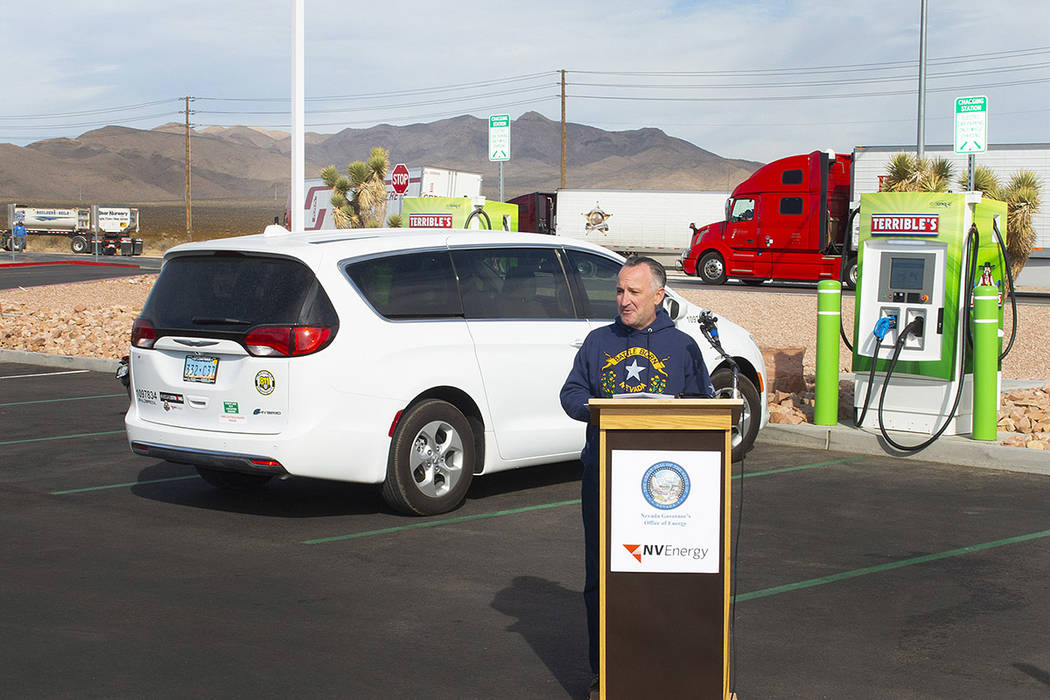
https://www.sandiegouniontribune.com/news/california/story/2019-11-15/electric-vehicle-charging-station-opens-off-i-15-in-nevada
Electric vehicle charging station opens off I-15 in Nevada
Nov. 15, 2019  LAS VEGAS — Electric vehicle owners have a new place to
charge batteries on the heavily-traveled freeway between Las Vegas and Los
Angeles. State and local officials on Thursday marked the start of use of
two rapid chargers at a Terrible’s Road House service station in Jean-NV.
That’s off Interstate 15, about 30 miles south of Las Vegas ...
https://www.reviewjournal.com/wp-content/uploads/2019/11/12981835_web1_NVE2019_7408R.jpg
...
https://www.reviewjournal.com/traffic/electric-vehicle-charging-station-goes-live-in-jean-1892980/


For EVLN EV-newswire posts use:
 http://www.evdl.org/archive/


{brucedp.neocities.org}

--
Sent from: http://electric-vehicle-discussion-list.413529.n4.nabble.com/
_______________________________________________
UNSUBSCRIBE: http://www.evdl.org/help/index.html#usub
ARCHIVE: http://www.evdl.org/archive/index.html
INFO: http://lists.evdl.org/listinfo.cgi/ev-evdl.org
Please discuss EV drag racing at NEDRA (http://groups.yahoo.com/group/NEDRA)