https://www.ornl.gov/news/second-act-used-electric-vehicle-batteries-charge-grid?utm_source=miragenews&utm_medium=miragenews&utm_campaign=news
Second act: Used electric vehicle batteries charge up the grid
December 6, 2019  Michael R Starke
[images  / Carlos Jones/ornl, U.S. Dept. of Energy
https://www.ornl.gov/sites/default/files/styles/content_carousel_style/public/2019-12/2019-P16567.png?h=036a71b7&itok=OZ9UMA-t


https://www.ornl.gov/sites/default/files/styles/content_carousel_style/public/2019-12/2019-P16569_0.png?h=036a71b7&itok=67ZsozIk
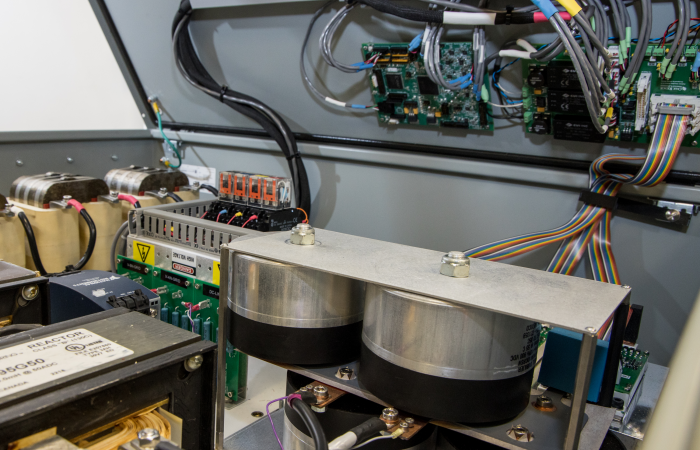
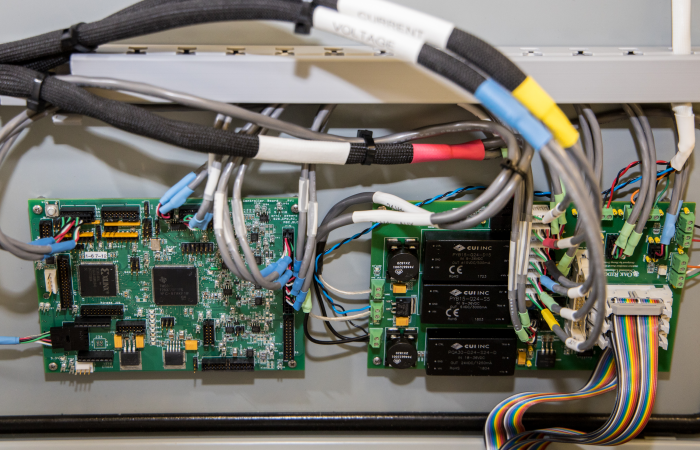
Oak Ridge National Laboratory engages in power electronics research for the
secondary battery energy storage system. Credit: Carlos Jones/Oak Ridge
National Laboratory, U.S. Dept. of Energy
]

Second act: Used electric vehicle batteries charge up the grid
Oak Ridge National Laboratory engages in power electronics research for the
secondary battery energy storage system.

Oak Ridge National Laboratory engages in power electronics research for the
secondary battery energy storage system. Credit: Carlos Jones/Oak Ridge
National Laboratory, U.S. Dept. of Energy

[image]  ORNL researcher Michael Starke is helping develop the hardware and
software to control an energy storage system made up of repurposed electric
vehicle batteries. Credit: Carlos Jones/Oak Ridge National Laboratory, U.S.
Dept. of Energy

Oak Ridge National Laboratory engages in power electronics research for the
secondary battery energy storage system. Credit: Carlos Jones/Oak Ridge
National Laboratory, U.S. Dept. of Energy

Oak Ridge National Laboratory engages in power electronics research for the
secondary battery energy storage system. Credit: Carlos Jones/Oak Ridge
National Laboratory, U.S. Dept. of Energy

ORNL researcher Michael Starke is helping develop the hardware and software
to control an energy storage system made up of repurposed electric vehicle
batteries. Credit: Carlos Jones/Oak Ridge National Laboratory, U.S. Dept. of
Energy

Researchers at Oak Ridge National Laboratory have developed an innovative
control system for repurposed electric vehicle battery packs to store
electricity for home use and are scaling up the technology to a large, power
grid-level project.

Even after batteries have reached the end of their first useful life
powering electric vehicles, or EVs, there’s still plenty of juice left.
These packs may no longer be able to stand up to the extreme charging and
discharging conditions for EVs, but they still have serviceable life as a
low-cost option for stationary energy storage — by some estimates, up to 10
more years of a second life.

The repurposed batteries are an ideal candidate for grid energy storage,
which is essential to keep power demand and supply balanced as more
renewable, intermittent generation sources are installed across the nation.
Renewables such as solar, wind and hydropower generated about 17% of
electricity in the United States in 2018, according to the U.S. Energy
Information Administration. More renewable energy sources are being
installed at homes and businesses.

But the cost of onsite energy storage systems using new batteries is still
quite high.

“Developing new technologies for energy storage is essential to a
well-balanced, modern power grid increasingly reliant on renewable,
distributed energy,” said Imre Gyuk, director of Energy Storage Research at
DOE’s Office of Electricity. “This project also supports a circular economy
by reusing a valuable commodity, minimizing waste, and ensuring reliable,
secure delivery of electricity for a robust economy.”

The potential for low-cost, repurposed battery energy storage is enormous.
About 1 million EVs are on the nation’s roadways currently, with the Edison
Foundation predicting another 18.7 million EVs by the year 2030, or about 7%
of total vehicles, all powered by battery packs.

ORNL researcher Michael Starke has been leading a project supported by OE’s
Energy Storage Program to create and enhance controls for secondary-use
battery energy storage, including deployment and testing of a 15-kilowatt
system at a Habitat for Humanity home site in North Carolina, as well as
testing at a research house ORNL maintains in a neighborhood near the lab.

Using the software and power electronics hardware developed by Starke and
his colleagues, the secondary-use battery system is designed to reduce a
home’s purchases from the utility to zero during critical peak demand
periods when the cost of electricity is at its highest. The home instead
uses electricity generated or stored from on-site renewables.

“The net benefit is a much lower electricity bill taking advantage of
real-time rate structures,” Starke said.

The process also frees up some of the demand from the utility’s service area
during peak periods, helping balance loads. “The big takeaway is the showing
that secondary-use energy storage is economically viable in these
applications,” Starke added.

“Secondary use is not just taking used car batteries and throwing it into
something. Getting to a utility-grade system is a challenge. Utilities want
something reliable and efficient that they can depend on for a long period.
And they want just one device to communicate with that can manage a huge
resource,” Starke said.

The ORNL-developed system features cloud-based communication to allow for
remote control, a flexible inverter to convert power for either household
use or utility transmission, and controls to synchronize the system with the
larger grid and to ensure safe startup and shutdown. The work is detailed in
the paper, “Residential (secondary-use) energy storage system and modular
software and hardware power electronic interfaces,” presented at the IEEE
Energy Conversion Congress and Exposition this fall.

Oak Ridge researchers have also tackled the challenge of integrating
batteries of varying ages from different manufacturers that have different
chemistries, voltages and capacities into a unified and efficient energy
storage system. The researchers developed a method that in essence proposes
a desired amount of charging or discharging with the batteries, then
responds with their status and ability to meet the request, resulting in
efficient dispatch of resources.

The work is detailed in the paper, “Architecture for utility-scale
multi-chemistry battery energy storage,” also presented at the IEEE
conference. The research is integral to the future of how EV batteries may
be repurposed into even larger projects to support utility-level grid
storage, Starke said.

Utility-scale energy storage is typically 100 kilowatts or higher, with at
least 1 megawatt systems being optimal. Such a project would need multiple
secondary-use battery systems.

“This is all behind what the utility sees,” Starke said. “Utilities just
want a block of energy, but there are a lot of subsystems that have to
coordinate and control these resources in order to make a 1 megawatt
system.”

Starke and his colleagues in the Electric Energy Systems Integration Group
at ORNL are currently developing a 100-kilowatt secondary-use battery system
to further test their controls and hardware solutions. It will be the first
project of its kind to repurpose EV batteries for a grid-scale system, on
the scale of a neighborhood with multiple homes.

ORNL is managed by UT-Battelle for the Department of Energy's Office of
Science, the single largest supporter of basic research in the physical
sciences in the United States. DOE’s Office of Science is working to address
some of the most pressing challenges of our time. For more information,
please visit http://science.energy.gov/.
[© ornl.gov]
...
https://www.newswise.com/doescience/?article_id=723642&returnurl=aHR0cHM6Ly93d3cubmV3c3dpc2UuY29tL2FydGljbGVzL2xpc3Q=
...
https://www.miragenews.com/second-act-used-electric-vehicle-batteries-charge-up-grid/


+
https://driving.ca/auto-news/news/plugged-in-the-changing-face-of-electric-vehicle-clubs
Plugged In: The changing face of electric vehicle clubs
2019-12-04  Electric vehicle clubs have been around for decades, and up
until just recently their memberships consisted of backyard tinkerers
converting gas-powered ...
https://postmediadriving.files.wordpress.com/2019/12/veva_bruce_stout.jpg


For EVLN EV-newswire posts use:
 http://www.evdl.org/archive/


{brucedp.neocities.org}

--
Sent from: http://electric-vehicle-discussion-list.413529.n4.nabble.com/
_______________________________________________
UNSUBSCRIBE: http://www.evdl.org/help/index.html#usub
ARCHIVE: http://www.evdl.org/archive/index.html
INFO: http://lists.evdl.org/listinfo.cgi/ev-evdl.org
Please discuss EV drag racing at NEDRA (http://groups.yahoo.com/group/NEDRA)