https://www.torquenews.com/8861/chevy-bolt-ev-owners-guide-50-kw-chargers
Chevy Bolt EV Owner's Guide to 50 kW Chargers
Dec 12 2019  Eric Way
[images
https://www.torquenews.com/sites/default/files/styles/news/public/images/evgo_berry_patch.jpg
EVgo BTC Power Berry Patch Orland

https://www.torquenews.com/sites/default/files/styles/news/public/125_a_evgo_charger.jpg?itok=Kk_SN7vF

https://www.torquenews.com/sites/default/files/styles/news/public/faster_than_50_kw.jpg?itok=juJq_eVo

https://www.torquenews.com/sites/default/files/styles/news/public/btc_power_l3r.jpg?itok=J10Eslg8

https://www.torquenews.com/sites/default/files/styles/news/public/100_a_charger.jpg?itok=KhbqCAGY

https://www.torquenews.com/sites/default/files/styles/news/public/btc_power_slim_line.jpg?itok=IxNWfvnR

https://www.torquenews.com/sites/default/files/styles/news/public/chargepoint_tritium_veefil-rt.jpg?itok=UziEawm4

https://www.torquenews.com/sites/default/files/styles/news/public/cpe_250.jpg?itok=vhmvb9Q9

https://www.torquenews.com/sites/default/files/styles/news/public/abb_terra_53.jpg?itok=2z9cllDh


videos
https://youtu.be/Q_k4JlKAmQY
Tesla Cybertruck's Flow Simulation Reveals Efficiency

https://youtu.be/Ib--w3-_Rpw
Bolt EV DCFC: Chasing a 130 A "Unicorn" Charger

https://youtu.be/NgI604rNPT0
Site Review: EVgo, Woodland: County Fair Fashion Mall

https://youtu.be/lCsL1OolzD0
Site Review: ChargePoint, Pomona 7-Eleven

https://youtu.be/7JzXJ9_wM08
Comparing EV Charging Networks: A Road Trip
]

I've done a lot of traveling and charging in my Chevrolet Bolt EV, and I've
been able to identify the good and bad about various "50 kW" DC fast
chargers. Join me as I explain what Chevy Bolt EV owners should look for and
expect out of a 50 kW charger.

Over the last three years and after over 100,000 miles of driving in my
Chevy Bolt EV, I found that it could be somewhat difficult to know what to
expect out of a given 50 kW CCS DC fast charger. Bolt EV owners find it
extremely confusing when some “50 kW” chargers recharge half the Bolt EV's
battery in 35 minutes while other “50 kW” chargers would take nearly 1 hour
to add the same amount of energy.

In this story, I will explain why these discrepancies between chargers
exist, and I'll share my process for identifying these chargers ahead of
time. In addition, I'll describe how these different power levels can affect
the time spent charging so that Chevy Bolt EV owners can set accurate
expectations and plan accordingly.

Background
The biggest reason for the discrepancies between chargers is that there is
no set, universal standard for what can be considered a 50 kW charger. Under
one rating system, charging providers will determine a charger's speed by
its potential peak power output, so a charger that can only output 100 A at
500 V would be considered 50 kW (100 A * 500 V = 50,000 watts). However,
because most electric vehicles have less than 400 V electrical systems,
real-world charging rates rarely even reach 40 kW.

In response, some charging providers have adjusted their ratings so that
they account for that 400 V charging limitation for most modern electric
vehicles. As a result, many newer chargers that provide 125 A at 500 V and
would be listed as 62.5 kW under the old model are now listed as 50 kW.
Given 400 V limits, 50 kW is probably the most accurate description for
these chargers.

Recently, we've started to see even newer 50 kW chargers that actually
provide 156 A, so a technical peak rate of 78 kW; however, the charging
providers who install these units actually list them as 62.5 kW, or the same
rating as others use for the 125 A at 500 V chargers. In the case of these
156 A chargers, the 62.5 kW rating is probably the most accurate description
for these chargers because most electric vehicles will be charging at less
than 400 V.
What adds to the confusion here is that many of the 100 kW or faster
chargers use the same outer shell as the 50 kW chargers, and some of the
older 100 A chargers can be upgraded to 125 A. Also, if a charging module is
broken in one of the newer 125 A chargers, it might only dispense 100 A.

In the following sections, I'll share images and videos of various 50 kW
chargers from different manufacturers and charging providers, and I’ll share
the impact on the charging speeds and average charging times for the
Chevrolet Bolt EV.

How Charging Rates Affect the Chevy Bolt EV
Before I dive into the chargers themselves, I want to share some of my basic
heuristics about charging the Chevrolet Bolt EV at these various chargers.
Hopefully, this will help set expectations for Bolt EV owners, so they
aren’t surprised at the differences they encounter from charger to charger.
As an abstract concept, it’s easy to see that a 100 A charger will be 33%
slower than a 150 A charger, but I want to illustrate just how much of a
time difference that represents for Bolt EV owners.

First, I want to say that, as a best practice, you should try to avoid
charging your 2017 to 2019 Chevy Bolt EV past 65% to 70% battery on public
DC fast chargers. The reason to not charge past 70% is that, at that point,
the Bolt EV is charging at less than half its peak charging rate. That 70%
battery still represents 160 miles of EPA rated range, which is generally
plenty of energy to get to the next charger, and it’s what I refer to as the
Bolt EV’s “subsequent charge range” (SCR). Essentially, after your initial
charge to a full battery, the SCR is the upper limit of how far you should
travel between DC fast charging stops on a trip.

Now let’s look at how the various charger speeds of 100 A, 125 A, and 150+ A
affect the amount of time it would take a Chevy Bolt EV owner to charge from
10% battery to 70%. Also, not that I am not accounting for the time lost to
battery conditioning during these charging sessions, which can add 5 to 10
minutes of additional charging time on the slower chargers.

Starting with the 100 A charger, I want to provide another rule of thumb. I
have found that, on the Chevy Bolt EV, a 100 A charger adds about 1% battery
per minute. Now, I wouldn’t set my watch to this, but I found it to be an
eerily accurate prediction of how long it took me to charge to a given
battery percentage. So if you find yourself using one of the 100 A chargers
I have listed below, expect a 10% to 70% charging session in the Bolt EV to
take about 1 hour.

The 125 A chargers are significantly faster, and it shows. Due to the Chevy
Bolt EV’s high-energy density battery cells, it can only maintain its peak
charging rate to about 50% battery (sometimes 55% if the battery is still
cool and sometimes only 45% if the battery is excessively hot). That means
that, after about 50% battery, the charging rate on the 125 A charger will
drop to 105 A, which is essentially the same charging speed as the 100 A
charger is capable of providing.

These 125 A chargers do have a side benefit that I don’t think is discussed
enough, though, and that is that their excess power can be used to run the
Bolt EV’s battery and cabin conditioning (up to a 10 kW draw) without
affecting the charging rate. Essentially, on a trip in cold weather, you can
heat and defog the cabin after 55% battery without ever affecting the
charging rate.

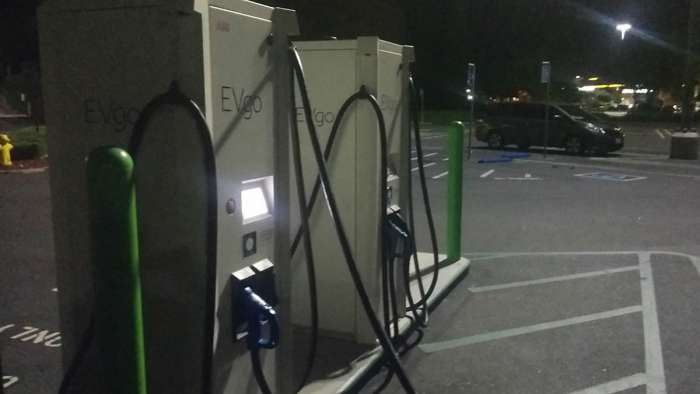
Chevy Bolt EV 125 A EVgo Charger

In terms of time savings, the 125 A chargers only take 33 minutes to charge
from 10% to 50%, a 7 minute savings over the 100 A chargers, and they get to
70% just slightly faster than the 100 A chargers. So a typical 10% to 70%
charging session on a 125 A charger will take about 50 minutes, saving
almost 10 minutes over a 100 A charger.

Because the Chevy Bolt EV’s peak charging rate is 150 A, though, there’s
room for even more improvement over the 125 A chargers. From 10% to 50%
battery, the Bolt EV will maintain over a 50 kW, and it can take less than
27 minutes to reach its charging rate stepdown at 50%. After the stepdown in
charging rate, the 150 A chargers will act the same as the 125 A chargers,
only charging at slightly faster than the 100 A units but with the option of
using surplus energy. A typical 10% to 70% charging session in a Chevy Bolt
EV on a 150 A or faster charger will take just over 40 minutes, so you can
expect to save 5 to 10 minutes compared to a 125 A charger and over 15
minutes compared to a 100 A charger.

Chevy Bolt EV 150 A Charger
On longer trips that require multiple charging stops, it’s possible to save
an hour or more simply by prioritizing 150 A chargers over 100 A and 125 A
chargers. So let’s look at how to identify the various 50 kW models.

BTC Power L3R
The BTC Power L3R is a common charger electric vehicle drivers will
encounter, and it’s been in use for many years. Right now, EV Connect and
EVgo are the charging providers who use these units the most. The Drive the
ARC program that built dozens of charging sites connecting the San Francisco
Bay Area to Tahoe used these chargers, and they are also the units used by
EVgo at Terrible Herbst locations throughout Nevada.

BTC Power L3R
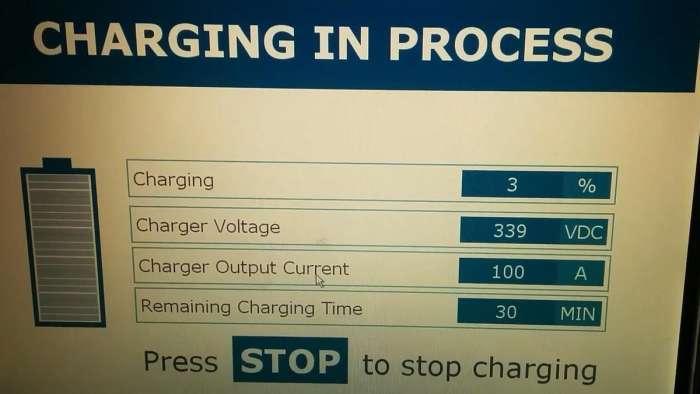
For the most part, I assume that these units are 100 A; however, these
chargers are capable of providing up to 125 A. The nice thing about these
BTC Power chargers is that they actually display their power output on the
screen.
If you’ve never been to a location with these chargers before, you can check
PlugShare for their power rating, but I recommend looking at the pictures
people post of the units while they are charging. Unless I see them display
more than 100 A, I assume that that is their power limit.

BTC Power 100 A Charger
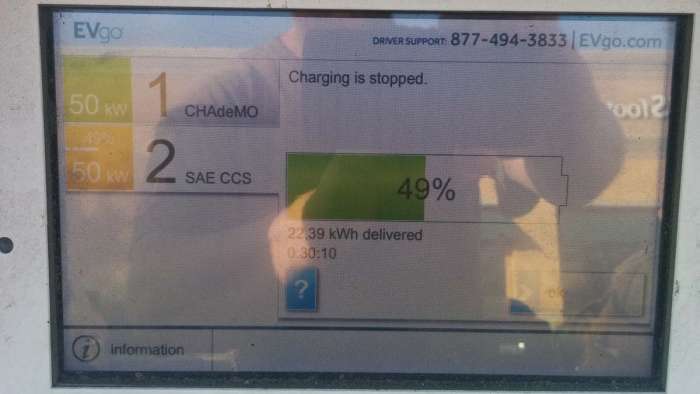
One interesting quirk about these chargers is, they sometimes display 130 A.
Now, the Chevy Bolt EV could easily absorb that extra power, but
unfortunately, the display isn’t accurate. I went “unicorn” hunting in one
of my videos, and I was able to confirm that, despite the BTC charger’s
display showing 130 A, it was only outputting 125 A.

BTC Power Slim Line
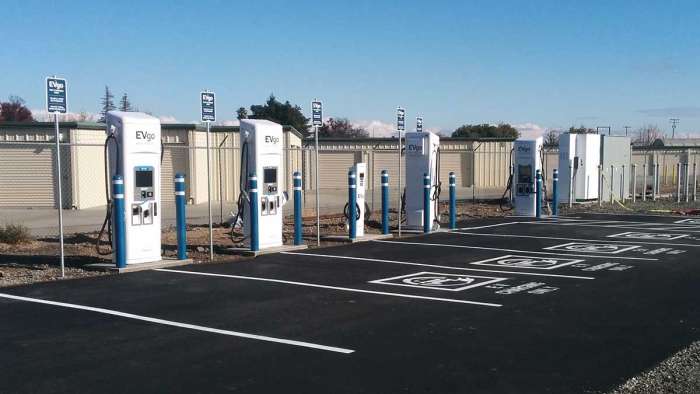
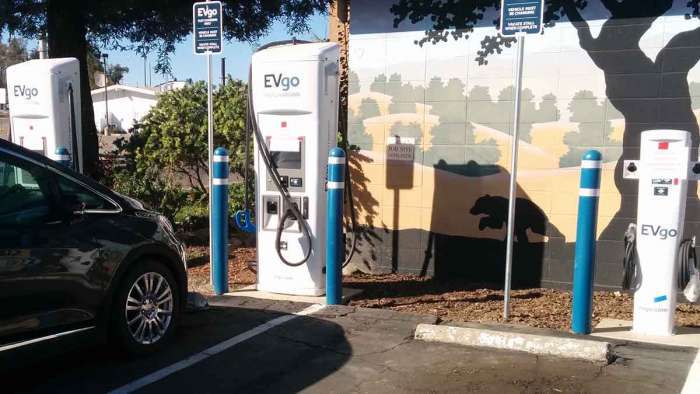
BTC Power’s Slim Line chargers are their newer 50 kW units, and so far, I’ve
primarily seen them being used by EVgo for their new California Energy
Commission (CEC) grant funded sites in Northern California.

Chevy Bolt EV BTC Power Slim Line
These are 125 A units, however, on a recent trip to review a site, I
realized that they can also be configured as 100 A chargers. This is
unfortunate because, like the BTC Power L3R chargers, you might need to
check images posted on PlugShare or even the placard on the charger itself
to know whether the unit is dispensing 125 A or only 100 A. Still, unlike
the L3R, for the most part, I would assume that these new BTC Power Slim
Line chargers are installed as 125 A unless I saw or read something
indicating they weren’t.

Most of the sites where the Slim Lines are being installed are still under
construction; however, I was able to test a few sites out where they’ve gone
online. While I used the 100 kW charger when I reviewed EVgo’s new site in
Woodland, California, the BTC Power Slim Line chargers are also in full
display.

Tritium Veefil-RT (ChargePoint)
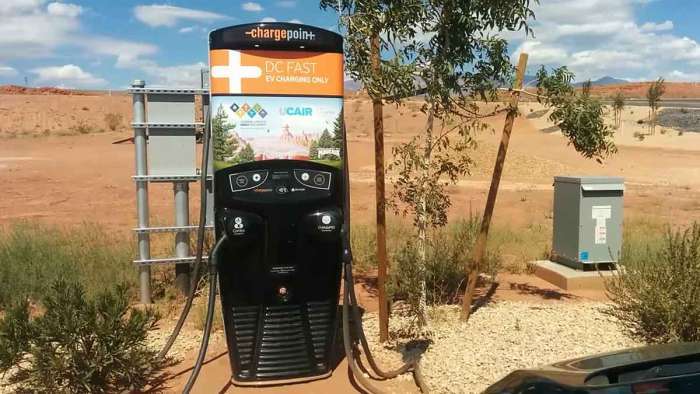
Tritium is an Australian company who manufactures the Veefil-RT chargers.
The Veefil chargers have a very unique design, and they are, as far as I can
find, only used by ChargePoint in the United States. These Veefil units are
always 125 A chargers, and in my experience, they provide some of the most
consistent charging rates of any of the 50 kW units.

Chevy Bolt EV Tritium Veefil-RT
ChargePoint won a number of CEC grants for building fast charging corridors
throughout the state of California, and it appears that they will primarily
be using these Tritium chargers to supply those sites. These Tritium
chargers are also used across the country, and ChargePoint has installed
units for the Utah Clean Air Partnership at several Maverik’s gas stations
along Interstate 15.

While these are good, consistent chargers for Chevy Bolt EV owners on long
trips, ChargePoint is no building their own units, which can be much faster.

ChargePoint Express 250
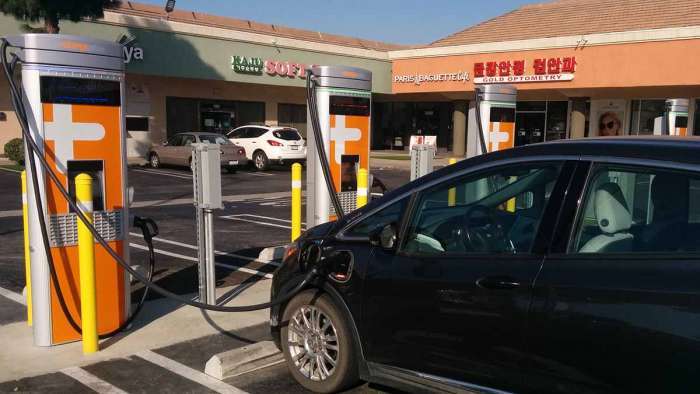
ChargePoint has been planning to build their own chargers for some time now,
and I first reviewed the ChargePoint Express (CPE) 250 unit installed at
their headquarters a couple of years ago.

Chevy Bolt EV ChargePoint Express 250
We are only now seeing these units installed, and these units can be
installed in either 125 A or 156 A configurations. In fact, they can also be
paired so that an individual charger can provide 125 kW when only one unit
is in use (I was able to review a 7-Eleven site with the paired
configuration).

In order to tell how much power these units are outputting, you have to look
at the front display. So far, I’ve seen three different ratings: 50 kW, 62.5
kW, and 125 kW paired. Regardless of whether you can confirm the speed
rating, these will be at least 125 A, and I would plan around that.

One exception is the Envision Solar sites I reviewed at Camp Roberts;
however, the power limitations for those chargers is based on the power
being generated by the overhead solar panels and the energy stored in their
battery because they have limited (if any at this point) power coming from
the grid.

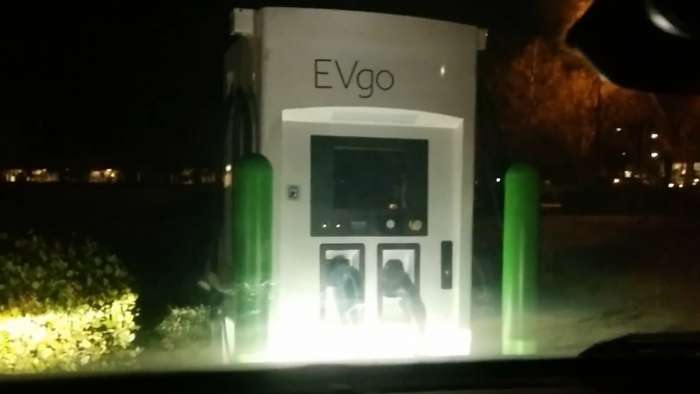
ABB Terra 53 (EVgo)
The ABB Terra 53 is primarily used by EVgo, and it has been, in my opinion,
the workhorse of their network. This was actually the first DC fast charger
I ever used with my Chevy Bolt EV, so despite no longer being one of the
fastest public chargers around, it’s still a personal favorite. Quite
frankly, without EVgo’s sites built using these Terra 53 units along the
freeway corridors of California in early 2017, my regular 500-mile trips in
the Bolt EV would have been dismal at best.

ABB Terra 53
Fellow YouTube host, Alex Venz, actually attempted to replicate a trip in a
Chevy Bolt EV using his Tesla Model S and a CHAdeMO adapter, but
unfortunately, the EVgo sites he chose were all using the 100 A BTC Power
L3R units described above. Had Alex focused on these Terra 53 sites instead,
he could have easily saved 10 to 15 minutes per stop during his trip.

These units Terra 53 units are located throughout California; however, it’s
unclear how many have been installed by EVgo in other states and regions. It
seems that most of the reports and complaints I hear from fellow Bolt EV
owners in other parts of the country aren’t related to these EVgo units but
rather EVgo’s BTC Power L3R units.

Regardless, if you see one of these units, it’s almost guaranteed to be 125
A; however, I have encountered several where one of the modules had gone
bad. At that point, these chargers will operate as 100 A units. That’s not
great, but hey, they still function.

Conclusion
As the public charging infrastructure continues to grow, the number and type
of chargers electric vehicle owners encounter will become even more diverse.
For Chevrolet Bolt EV and other electric vehicle owners, the newer, faster
chargers will all be roughly similar. However, when relying on the older,
slower 50 kW units, it’s important to be able to differentiate between
options.

The 150 A and faster DC fast chargers can save Bolt EV owners at least 10 to
15 minutes of time on typical charging stops, which can make trips faster
and more enjoyable. I hope this helped to explain some of the charging
options you will encounter in your travels.
[© torquenews.com]


+
https://www.energy-storage.news/news/mitsubishi-ev-batteries-come-full-circle-in-1mwh-bess-install-at-manufactur
Mitsubishi EV batteries come full circle in 1MWh BESS install at
manufacturing plant
12 Dec 2019  The 1MWh BESS is formed of second-life electric vehicle
batteries from ... the charge when it comes to using second life EV
batteries as stationary storage ... 3MW solar system to be installed
alongside the BESS ...
https://www.energy-storage.news/images/made/assets/images/editorial/Mitsubishi_second_life_EV_battery_BESS_555_347_80_s_c1.jpg


For EVLN EV-newswire posts use:
 http://www.evdl.org/archive/


{brucedp.neocities.org}

--
Sent from: http://electric-vehicle-discussion-list.413529.n4.nabble.com/
_______________________________________________
UNSUBSCRIBE: http://www.evdl.org/help/index.html#usub
ARCHIVE: http://www.evdl.org/archive/index.html
INFO: http://lists.evdl.org/listinfo.cgi/ev-evdl.org
Please discuss EV drag racing at NEDRA (http://groups.yahoo.com/group/NEDRA)