https://www.indystar.com/story/opinion/columnists/james-briggs/2019/12/20/blueindy-indianapolis-electric-car-sharing-greg-ballard/2709243001/
RIP BlueIndy, a great concept that was too clunky to work in Indianapolis
Dec. 20, 2019  James Briggs
[images
https://www.gannett-cdn.com/media/2016/10/07/INGroup/Indianapolis/636114402933033051-06-blueindy-123014.jpg
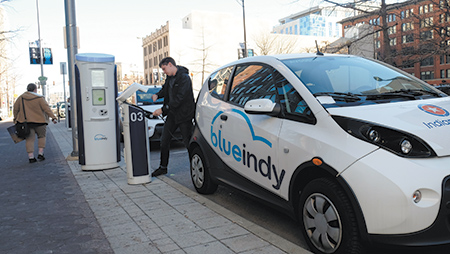
BlueIndy electric cars are parked at the company's charging station on the
northeast corner of Meridian and Washington streets, Indianapolis, on
Tuesday, Dec. 30, 2014. (Photo: IndyStar file photo)

https://www.gannett-cdn.com/media/2017/08/01/INGroup/Indianapolis/636371841780096866-BlueIndy-Stations-JRW02.JPG
BlueIndy has installed a station of five parking spots for their rentable
smart cars, eliminating a stretch of public parking in front of SoBro Cafe
along 52nd Street, Indianapolis, Monday, July 31, 2017. Some business owners
say the BlueIndy stations have occupied public parking that was integral to
their business. (Photo: Jenna Watson/IndyStar)
]

I’d like to say that Indianapolis is going to miss BlueIndy. But that’s not
true. There have never been enough people using the electric car-sharing
service for any tears to be shed over its failure.

So, instead, I’ll tell you why I’ll miss it — and why I think Indianapolis
is worse off now that it is going away.

BlueIndy parent company Bollore Group on Friday announced it will shut down
in May after more than four years of sluggish growth and financial losses.
BlueIndy’s demise eliminates one of Indianapolis' only alternatives to car
ownership before most people really even understood what it was.

BlueIndy should have gained traction. It had a simple model of enabling
people to rent a car in one neighborhood and leave it in another for a
relatively low cost. The service fizzled for many reasons, though, some of
which are explicitly Bollore Group’s fault and others that could be chalked
up as unforeseen market limitations.

For starters, Indianapolis’ car ownership culture presented a small base of
potential adopters — probably smaller than anyone understood when the
service launched in 2015. That problem was compounded by BlueIndy’s user
experience, which was too clunky to convert the members it gained into
evangelists who would convince other people to sign up.

Even the people who used BlueIndy didn’t really love it. As a result,
BlueIndy rentals plateaued at around 50,000 per year after starting out with
36,150 in its first year, according to a recent report from the Indianapolis
Business Journal.

BlueIndy is the best way to go to the airport
I say all this from the perspective of being a frequent BlueIndy user and
apologist, who also spent a fair amount of time on the phone with customer
service representatives over all-too-common problems such as station kiosk
malfunctions.

At its best, BlueIndy made my life easier. As I’ve written before, it has
enabled my wife and me to share one car while living in Irvington, even with
a baby, because I could walk to a BlueIndy station and drive Downtown for
work in 12 minutes at a cost of about $4. That is more than the cost of a
bus ride, yet less than half the cost of a trip through Uber or Lyft (not to
mention the added benefit of avoiding awkward conversations with drivers).

I’ll especially miss BlueIndy whenever I need to travel to or from the
airport. Being able to drive a car to the parking garage and walk over to
the terminal (and use the same process in reverse upon arrival) made trips
to and from Indianapolis International Airport uniquely stress-free.

Alas, for each example of things that went well, there is an equal number of
examples of stations not working properly, cars making weird noises and
either no cars or parking spaces available where I needed them. The cars
were unpleasant to drive and the check-out process was over-complicated and
prone to glitches.

France-based Bollore Group, which launched a similar service in Los Angeles,
never demonstrated the wherewithal to improve BlueIndy’s service or convince
more people to try it. BlueIndy maxed out around 3,000 memberships, many (if
not most) of which were free.

There was no apparent path to growth or profitability for BlueIndy. It’s a
shame.

Many people wanted BlueIndy to fail
There are, of course, many people who disagree with my perspective and
likely will cheer the implosion of BlueIndy.

They include business owners who are angry about losing street parking in
front of their stores and restaurants for the sake of BlueIndy stations.
They also include some Democrats, who argue that former Republican Mayor
Greg Ballard agreed to a bad deal on behalf of the city.

Those Democrats have a point. Indianapolis stands to lose substantial money.

BlueIndy launched as a $50 million investment, with $6 million coming from
the city. BlueIndy agreed to share profits, which it never earned, as well
as pay the city $45,000 a year. I’m not great at math, but I know that
$45,000 times four years of service equals less [than] $6 million.

Now, the city is stuck with nearly 100 BlueIndy electric charging stations
and no easy answers for what to do with them.

The politics of BlueIndy have always been strange. If you were to forget
everything you know about Indianapolis and hear that the city subsidized a
car-sharing program that scattered all-electric vehicles across town, and
that one political party supported it while the other opposed it, you might
reasonably assume Democrats were the ones in favor.

You would, of course, be wrong.

BlueIndy is ceasing service at an interesting moment — when many Republicans
are complaining about a new rapid bus route in Indianapolis called the Red
Line, which is off to a rough start. Many of those same Republicans have
been die-hard supporters of BlueIndy, while many of the Democrats brushing
off the Red Line criticism have wanted to shut down BlueIndy since it
launched.

Both projects warrant criticism. But, when it comes to innovative
transportation solutions, BlueIndy and the Red Line are pretty much all
Indianapolis has (barring the long-term viability of scooters, which might
yet be a fad). The loss of BlueIndy is a setback for everyone who cares
about having a city where mobility is not synonymous with car ownership.

Largely because of BlueIndy’s own failures, though, its exit from the market
will be like a tree falling in the forest. Few people will notice and even
fewer will be disappointed.

Indianapolis is losing an asset that never really felt like one.
[© indystar.com]


https://www.ibj.com/articles/blueindy-ceasing-operations
Electric car service Blue Indy ceasing operations
December 20, 2019 ... the electric-car-sharing service that launched in
September 2015, is pulling the plug on its Indianapolis fleet. “We regret to
announce that Blue Indy ...
https://cdn.ibj.com/wp-content/uploads/2019/01/rop-blueindy1-120417-450bp.jpg


+
https://skystatement.com/2020-democratic-candidates-where-each-stands-on-electric-cars/
2020 Democratic candidates: Where each stands on electric cars
DECEMBER 22, 2019 ... look at what the leading candidates say about electric
vehicles ...


For EVLN EV-newswire posts use:
 http://www.evdl.org/archive/


{brucedp.neocities.org}

--
Sent from: http://electric-vehicle-discussion-list.413529.n4.nabble.com/
_______________________________________________
UNSUBSCRIBE: http://www.evdl.org/help/index.html#usub
ARCHIVE: http://www.evdl.org/archive/index.html
INFO: http://lists.evdl.org/listinfo.cgi/ev-evdl.org
Please discuss EV drag racing at NEDRA (http://groups.yahoo.com/group/NEDRA)