https://www.controleng.com/articles/aqueous-lithium-ion-battery-improves-safety/
Aqueous Lithium-ion battery improves safety
DECEMBER 22, 2019  RENSSELAER POLYTECHNIC INSTITUTE (RPI)
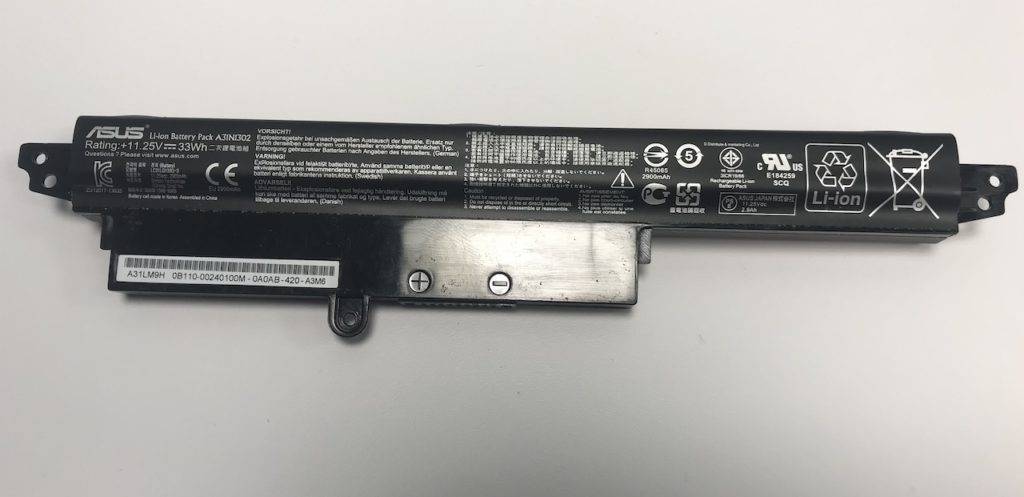
[image
https://www.controleng.com/wp-content/uploads/sites/2/2019/12/CTLx_WEB_IMG_Battery-1024x497.jpg
Courtesy: Chris Vavra, CFE Media
]

A team of engineers at Rensselaer Polytechnic Institute (RPI) have found
using aqueous electrolytes instead of the typical organic electrolytes for a
lithium-ion battery doesn't reduce power or overall performance.

As the lithium-ion batteries that power most phones, laptops, and electric
vehicles become increasingly fast-charging and high-performing, they also
grow more expensive and flammable.

A team of engineers at Rensselaer Polytechnic Institute (RPI) demonstrated
how they could — by using aqueous electrolytes instead of the typical
organic electrolytes — assemble a substantially safer, cost-efficient
battery that still performs well.

Reprints
The inside of a battery contains two electrodes — an anode and a cathode.
These electrodes are immersed in a liquid electrolyte that conducts ions as
the battery charges and discharges.

Aqueous electrolytes have been eyed for that role because of their
non-flammable nature and because, unlike non-aqueous electrolytes, they
aren’t sensitive to moisture in the manufacturing process, making them
easier to work with and less expensive. The biggest challenge with this
material has been maintaining performance.

“If you apply too much voltage to water it electrolyzes, meaning the water
breaks up into hydrogen and oxygen,” said Nikhil Koratkar, an endowed chair
professor of mechanical, aerospace, and nuclear engineering at RPI. “This is
a problem because then you get outgassing, and the electrolyte is consumed.
So usually, this material has a very limited voltage window.”

In this research, Koratkar and his team — which included Fudong Han, an
endowed chair assistant professor of mechanical, aerospace, and nuclear
engineering and Aniruddha Lakhnot, a doctoral student at Rensselaer — used a
special type of aqueous electrolyte known as a water-in-salt electrolyte,
which is less likely to electrolyze.

For the cathode, the researchers used lithium manganese oxide, and for the
anode, they used niobium tungsten oxide — a complex oxide that Koratkar said
had not been explored in an aqueous battery before.

“It turns out that niobium tungsten oxide is outstanding in terms of energy
stored per unit of volume,” Koratkar said. “Volumetrically, this was by far
the best result that we have seen in an aqueous lithium-ion battery.”

The niobium tungsten oxide, he explained, is relatively heavy and dense.
That weight makes its energy storage based on mass about average, but the
dense-packing of niobium tungsten oxide particles in the electrode makes its
energy storage based on volume quite good. The crystal structure of this
material also has well-defined channels — or tunnels — that allow lithium
ions to diffuse quickly, meaning it can charge quickly.

The combination of fast-charging capability and the ability to store a large
amount of charge per unit volume, Koratkar said, is rare in aqueous
batteries.

Achieving that kind of performance, with a low cost and improved safety, has
practical implications. For emerging applications such as portable
electronics, electric vehicles, and grid storage, the ability to pack the
maximum amount of energy into a limited volume becomes critical.
[© controleng.com]


+
https://www.torquenews.com/8861/heres-how-far-electrify-america-charging-network-has-come
Here's How Far Electrify America's Charging Network Has Come
Dec 21 2019  Because of Electrify America's efforts, it is now possible for
200-mile electric vehicles to ..... For those who own the Hyundai Kona
Electric or Kia Niro EV, Electrify ...
https://www.torquenews.com/sites/default/files/styles/news/public/chevy_bolt_ev_electrify_america_0.jpg?itok=WmNWaS1T


For EVLN EV-newswire posts use:
 http://www.evdl.org/archive/


{brucedp.neocities.org}

--
Sent from: http://electric-vehicle-discussion-list.413529.n4.nabble.com/
_______________________________________________
UNSUBSCRIBE: http://www.evdl.org/help/index.html#usub
ARCHIVE: http://www.evdl.org/archive/index.html
INFO: http://lists.evdl.org/listinfo.cgi/ev-evdl.org
Please discuss EV drag racing at NEDRA (http://groups.yahoo.com/group/NEDRA)