https://electrek.co/2020/01/10/new-study-high-soft-costs-are-slowing-down-ev-charging-infrastructure-even-for-tesla/
New study: High ‘soft costs’ are slowing down EV-charging infrastructure,
even for Tesla
Jan. 10th 2020  Bradley Berman
[images
https://i0.wp.com/electrek.co/wp-content/uploads/sites/3/2020/01/charing-construction-1100.jpg

https://electrek.co/wp-content/uploads/sites/3/2020/01/rmi-charger-cost-1.jpg

https://electrek.co/wp-content/uploads/sites/3/2020/01/rmi-charger-cost-2.jpg

https://electrek.co/wp-content/uploads/sites/3/2020/01/rmi-charger-cost-4.jpg?resize=1024,512
]

Public EV charging infrastructure is growing fast, but a lack of charging is
still blamed as an obstacle to electric-car adoption. What’s holding things
up? According to Reducing EV Charging Infrastructure Costs, a study
published yesterday [
https://rmi.org/insight/reducing-ev-charging-infrastructure-costs
] by the Rocky Mountain Institute (RMI), it’s not the cost of the hardware
and software. The problem faced by charging networks and utilities is soft
costs, like onerous permitting and regulations. After two-dozen interviews,
RMI breaks down the expenses for both public and private chargers.

The 24 interviews took place between May and October 2019. They were
conducted under nondisclosure agreements with utilities, hardware providers,
software providers, operators of charging networks, and others. RMI admits
that some interviewees were reluctant to talk about costs.

Nonetheless, the research organization found that the cost of hardware
components and software systems is a relatively small part of the total EV
infrastructure cost. The killer is easement processes, marketing, and
prolonged delays for permitting. We heard something similar when we spoke
with Electrify America in November. Those add up to three to five times the
value of the charger itself.

The RMI report explains:

    “We strongly suspect that soft costs are a big part of the reasons why
charger installation costs in the United States are three to five times the
cost of the charger itself, a much higher ratio than that seen in Europe
(even after allowing for some charging hardware in Europe having higher
costs). Indeed, soft costs were frequently cited as more significant cost
drivers than charging station hardware in the United States.”

    “Soft costs were also identified as some of the most problematic and
unpredictable costs that developers of charging networks encounter, and they
are often the reason why a candidate site for a charging station is rejected
or abandoned, even after significant expenses have been incurred in its
development. Worse, when a site under development must be abandoned, the
normal expenses incurred for activities like securing a site lease,
designing an installation, and building it can be compounded by additional
costs such as late fees and penalties”

The cost for each component or service associated with a public charging
location can vary, creating an unpredictable economic landscape.

Chris Nelder, one of the co-authors of the study, told Electrek that
automakers were not interviewed for the study. Tesla and its Supercharger
network might operate in a slightly different manner, but that doesn’t mean
the EV-maker can escape the realities of charging installations. Nelder, in
an email, wrote:

    “Anyone who deploys EV charging stations will encounter all of the
issues, esp. relating to soft costs, that we have detailed in our report.
Because they’re not a consequence of who is deploying the charging network.
They’re a consequence of utilities, building & planning departments,
legislators, etc. Tesla is no exception.”

For both Level 2 and DC fast chargers, costs go up with higher power
ratings. Similarly, the final price is affected by connectivity, the number
and length of charging cables, and weatherization.

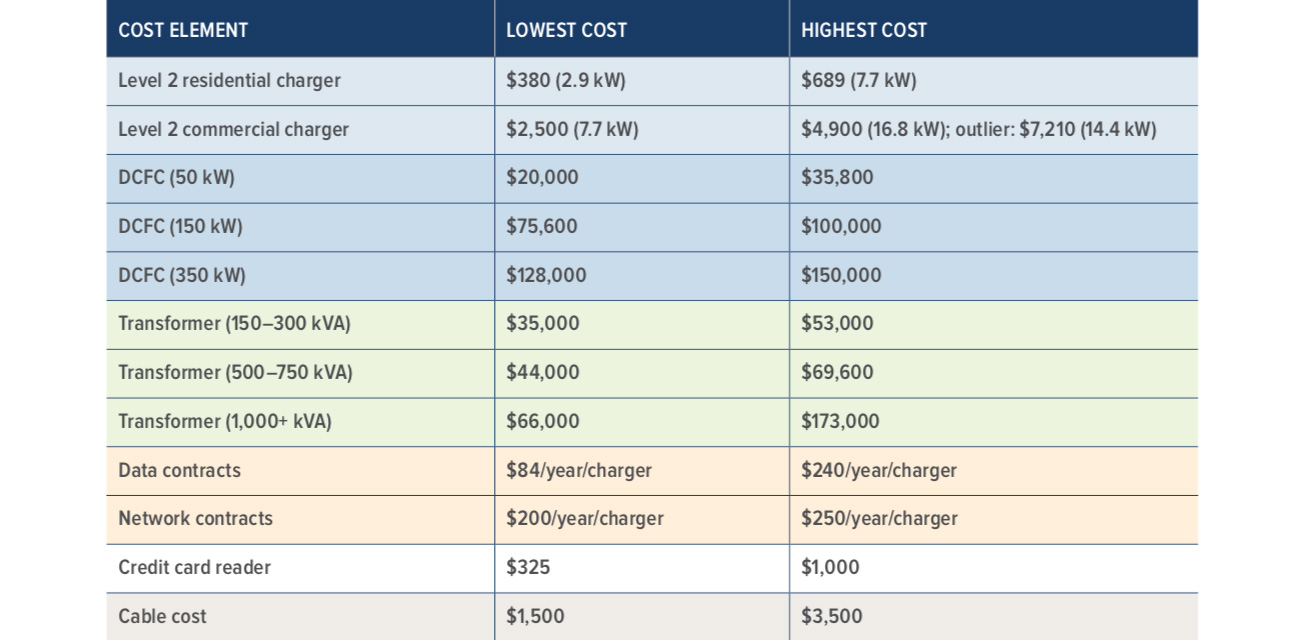
    The cost for adding physical credit-card readers, which are required in
California, alone can add between about $325 and $1,000 in expense.
    Equipping public fast-chargers with redundant CCS and CHAdeMO can add 5
to 10% to the charger, meaning that cabling alone can cost as much as $3,500
    Reducing cable length could save hundreds of dollars per charger,
something that would be possible with standardized locations for vehicles’
charging ports

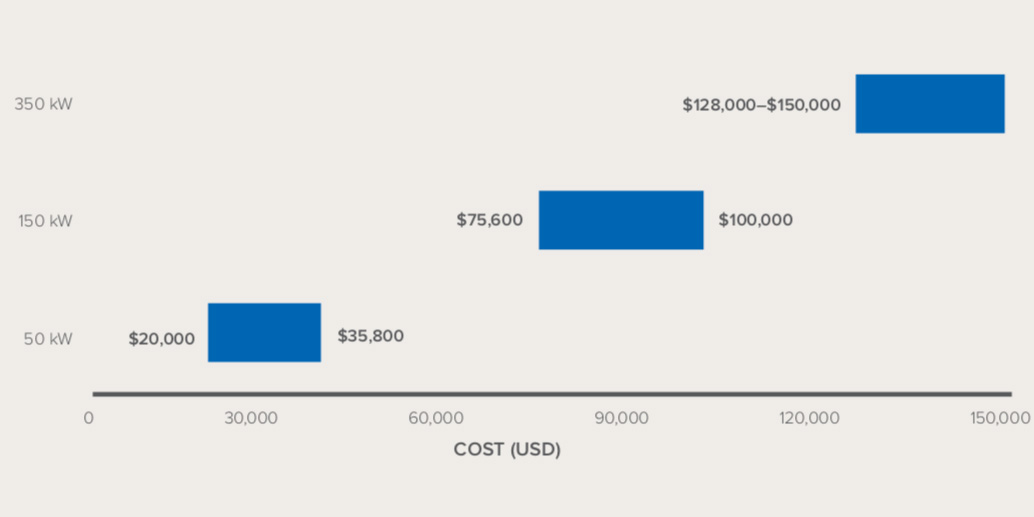
Increasing the kilowatt charging rate means dramatically higher costs, as
this RMI chart shows:

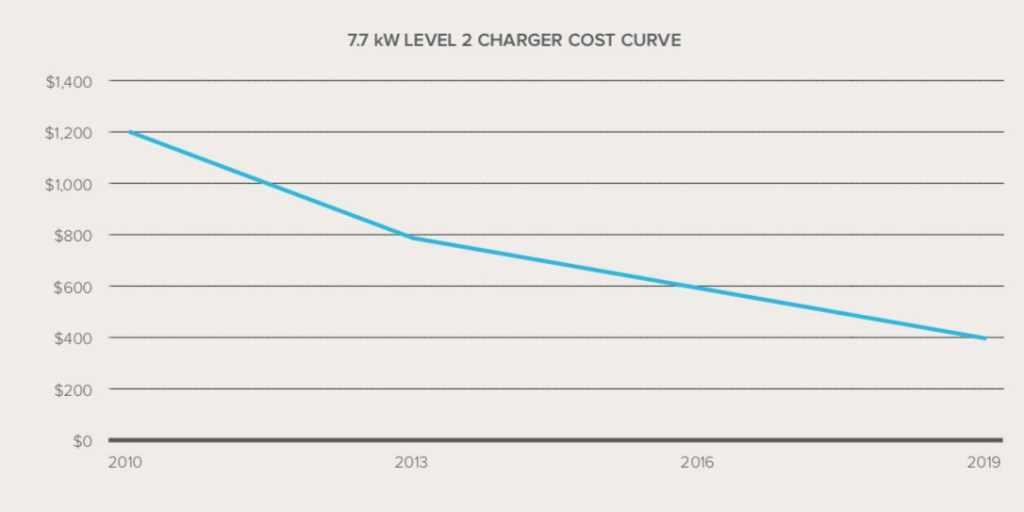
While the study’s focus is commercial, public EV charging, RMI said that the
numbers also shine a light on home charging costs. The hard cost of a 7.2-kW
EV charger consistently fell between 2010 and 2019:

The main message of the study is that soft costs are the killer. Charging
network operators complained about poor communication with utilities, which
led to costly delays and forced operators to rework their plans. The process
for evaluating prospective sites with adequate capacity might take several
weeks. The process gets weighed down further if battery storage is part of
the installation.

The complexity, and therefore the delays, gets worse when future-proofing is
considered. That’s the process of installing excess capacity and make-ready
elements for future expansion after initial installation. RMI reports that
“existing future-proofing practices can lack clarity, structure, and
consistency.”

Real-estate easements, sometimes encountered midway through a project, on
average take 59 business days, but some interviewees said it could take up
to 234 business days. The complexity of codes and permitting, which can
contain 10 or so unique permitting processes, can take from three to eight
weeks.

Among RMI’s recommendations are establishing state or national standards for
permitting, increasing the number of chargers per installation, and
installing charging during the construction process.
[© electrek.co]


+
https://insideevs.com/features/397201/magnetic-fields-evs-health-risks/
Fear Not: Magnetic Fields In EVs Unlikely To Pose Health
Risk
Feb 06, 2020 ... “There is absolutely no cause for concern. The difference
between this research and similar earlier work is that we have taken into
account what contributes to the magnetic fields. The rotation of the wheels
themselves generates considerable magnetic fields, irrespective of vehicle
type.” ...
...
http://electric-vehicle-discussion-list.413529.n4.nabble.com/template/NamlServlet.jtp?macro=search_page&node=413529&query=Magnetic+Fields


For EVLN EV-newswire posts view:
 http://www.evdl.org/archive/
https://mail-archive.com/[email protected]/maillist.html


{brucedp.neocities.org}

--
Sent from: http://electric-vehicle-discussion-list.413529.n4.nabble.com/
_______________________________________________
UNSUBSCRIBE: http://www.evdl.org/help/index.html#usub
ARCHIVE: http://www.evdl.org/archive/index.html
INFO: http://lists.evdl.org/listinfo.cgi/ev-evdl.org
Please discuss EV drag racing at NEDRA (http://groups.yahoo.com/group/NEDRA)