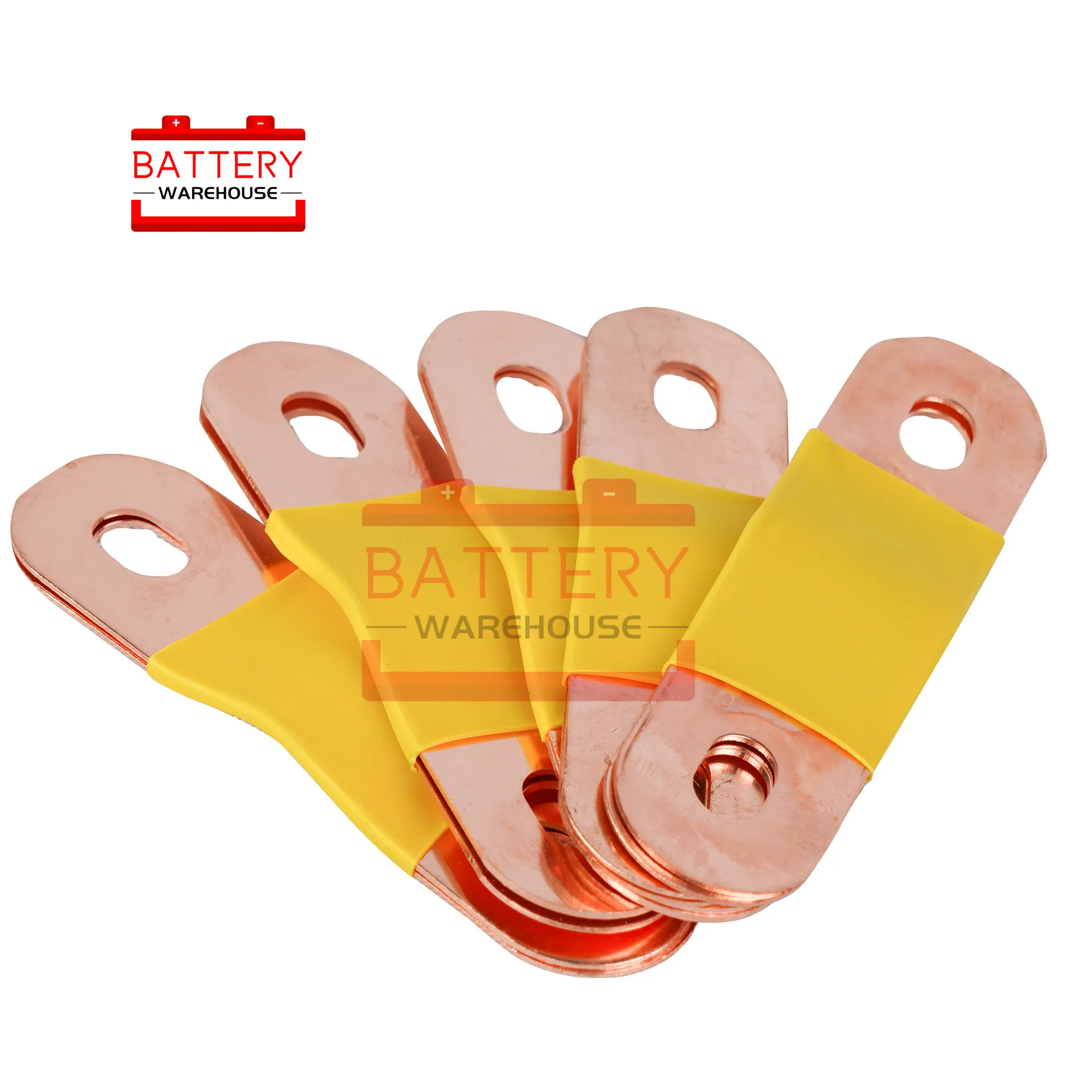
You generally should avoid solid busbars linking cells.   A good design
uses thin copper sheets that are stacked with a double fold or arched dome
in the middle.  This allows flex and cell movement which even occurs in a
stationary application from putting undue stress on the cell terminals
which contain seals that are critical to the cell's operation.  These
terminals while metal (usually one copper one aluminum) are fastened in
place with plastic that cannot take repeated stress such as will be caused
by vibration or even CTE (Thermal Expansion) as the pack temperature
changes.
Example (not affiliated):
https://eelbattery.myshopify.com/products/4pcs-flexible-new-nickel-plated-copper-bus-bar-terminal-connectors-accessoriesshort-long
This looks like a solid busbar, but it's made of thin foil sheets stacked
and die cut with a relief in the middle.  They will easily bend with just
finger pressure.

The factory supplied low-cost busbars from many battery companies are
usually a cheaper variant with thicker copper, but still several sheets
with a bend in the middle, like this (no affiliation):
https://ae01.alicdn.com/kf/H2e4303fd465641ef91afac9f225e2563u/Copper-Bus-Bar-cell-to-cell-For-lithium-3-7V-CALB-CATL-3-2V-3-7V.jpg
These aren't as good, but still way better than rigid!   Here's a good
video:  https://www.youtube.com/watch?v=Ci2XGohIFxU

You can also just do traditional crimped copper lugs on high-strand-count
welding wire, just be sure to make them slightly longer than the distance
between cell terminals and arch them when you install so they can flex as
needed.  Another type is flat braided with crimps on each end:
https://www.alibaba.com/product-detail/Customizable-100a-200a-300a-dc-lifepo4_1600435917793.html
 I don't like these because they oxidize easily.

If you look at all OEM Automotive packs, you will always see flexible
busing for this reason.   Even if you think you are OK in a stationary
application, the cells still swell somewhat when charged/discharged, and
this gets more evident later in the cell's life.

This also applies to other components such as contactors, you NEVER want to
put high stress on it's terminals by bolting to a rigid bus bar, it can
lead to premature failure.   Many HV contactors have hydrogen inside, and
if this leaks out the contactor will be subject to arcing and welding
failure.

If you must use some kind of a rigid busing system, bend arches into them
in the middle so the ends can grow/shrink a bit.   The other side effect of
having flexible bussing is much lower contact resistance over time, as the
joints will have better contact area and will not be placed under angular
stress and/or bending moments that will cause uneven contact pressure and
also lead to the joint loosening over time which could cause a fire.
(Especially in mobile applications!)

On Wed, Feb 25, 2026 at 8:37 AM Barry Oppenheim via EV <[email protected]>
wrote:

> When I used Calb cells I connected them with copper busbars.
>
> https://justanotherevconversion.blogspot.com/2011/07/just-finishing-up.html
>
> The cells had threaded terminals which I used to secure the busbars.
> Unfortunately I don't remember the size or composition of the bolts and
> washers.
>
> https://justanotherevconversion.blogspot.com/2011/06/just-lego-blockssorta.html
>
> Barry
> JustAnotherEVConversion.blogspot.com
>
> On Wed, Feb 25, 2026 at 11:05 AM Greg William via EV <[email protected]>
> wrote:
>
> > When I did my Sparrow lithium conversion I bought a bunch of the Nord
> lock
> > washers sized for the CALB cell bolts.  I used the copper bars that came
> > with my 53 cells (I bought a spare).  Then I made up a few longer copper
> > bars out of 1/2" copper tubing, drilled and heat shrink wrapped as
> > appropriate.  Used the remaining Sparrow cables and it all worked well.
> I
> > wanted a non-conductive hold down arrangement so used a bunch of the
> Harbor
> > Freight large white zip ties.  They are about 24" long, 1/2" wide, very
> > strong and re-usable.  Not cheap, though.  Then when it was all tested, I
> > put an inch of spray foam around the base of the cells to avoid vibration
> > and movement.  Cells were all tight up against each other and could never
> > tell any heat build up charging or discharging.  I would do it the same
> way
> > again.
> >
> > On Tue, Feb 24, 2026, 3:45 AM Jay Summet via EV <[email protected]>
> wrote:
> >
> > > With respect to just "connecting" them, standard cables like you would
> > > use for Lead Acid batteries work fine, typically with ring terminals
> (vs
> > > clamp).
> > >
> > > Size the cables based upon your amperage. If you are replacing a lead
> > > acid pack, I'm going to assume 90-200 volts, and LOTS of amps, so you
> > > probably want to use 00 welding cables.
> > >
> > > Get crimp ring connectors sized for the bolts that go into your cells
> > > and a hydraulic crimping tool.
> > >
> > > However, you may find that the lithium modules are a lot smaller than
> > > Lead Acid batteries, so need more connections (and the connections may
> > > be closer together.
> > >
> > > Also, many/most LiIon modules need to be kept under compression so they
> > > don't swell during charging or discharging.
> > >
> > > A solution I used was to package up the modules into "battery sized"
> > > chunks, clamped together (threaded rod through plywood end pieces,
> > > although you could use metal) with a copper busbar sized perfectly for
> > > the "clamped" spacing of the modules.   You don't want to use a solid
> > > busbar between modules that can move relative to each other as it may
> > > rip the bolt/terminal out of the module, but it's OK to do so far ones
> > > that are physically clamped together.
> > >
> > > Then I just used the (flexible) 00 welding wire to connect the
> > > "batteries" together, much like the original Lead Acid.
> > >
> > > https://www.youtube.com/watch?v=PjTwhR-DrqQ
> > >
> > > You can find a lot more here by going backwards in age:
> > > https://www.summet.com/blog/tag/etruck/
> > >
> > > Jay
> > >
> > >
> > >
> > > On 2/24/26 01:42, Daniel Eyk via EV wrote:
> > > > I recently sent an email about lithium batteries and I want to
> thankyou
> > > for
> > > > replying as
> > > > it helped me a lot.
> > > >
> > > > I have a followup question about how to hook up the lithium batteries
> > and
> > > > what
> > > > parts are needed to do that. I am used to the old lead acid batteries
> > and
> > > > after looking
> > > > at my battery box, I realized that I don't know how to connect the
> > > > batteries.
> > > >
> > > > Also, someone asked me what kind of lithium batteries I have. They
> are
> > > > Calb lithium ion batteries. They have a red cap and a black cap and
> > > there is
> > > > a barcode with this number on it. NSA 601305040234. I don't know if
> > that
> > > > will
> > > > help or not in identifying the batteries, but that is what it says.
> > > >
> > > > Well, if anyone can tell me what parts I need and maybe cables, I
> > > > would appreciate it. I did get around $300 worth of cables based on
> my
> > > > knowledge of lead acid batteries and hate to lose that value, but you
> > > > can't have everything.
> > > >
> > > > Thanks in advance for any information you can provide.
> > > >
> > > >               Dan Eyk
> > > > -------------- next part --------------
> > > > An HTML attachment was scrubbed...
> > > > URL: <
> > >
> >
> http://lists.evdl.org/private.cgi/ev-evdl.org/attachments/20260223/a965d6e5/attachment.htm
> > > >
> > > > _______________________________________________
> > > > Address messages to [email protected]
> > > > No other addresses in TO and CC fields
> > > > HELP: http://www.evdl.org/help/
> > > >
> > >
> > > _______________________________________________
> > > Address messages to [email protected]
> > > No other addresses in TO and CC fields
> > > HELP: http://www.evdl.org/help/
> > >
> > >
> > -------------- next part --------------
> > An HTML attachment was scrubbed...
> > URL: <
> >
> http://lists.evdl.org/private.cgi/ev-evdl.org/attachments/20260225/39cd3928/attachment.htm
> > >
> > _______________________________________________
> > Address messages to [email protected]
> > No other addresses in TO and CC fields
> > HELP: http://www.evdl.org/help/
> >
> >
> -------------- next part --------------
> An HTML attachment was scrubbed...
> URL: <
> http://lists.evdl.org/private.cgi/ev-evdl.org/attachments/20260225/d316e140/attachment.htm
> >
> _______________________________________________
> Address messages to [email protected]
> No other addresses in TO and CC fields
> HELP: http://www.evdl.org/help/
>
>
-------------- next part --------------
An HTML attachment was scrubbed...
URL:
<http://lists.evdl.org/private.cgi/ev-evdl.org/attachments/20260225/84e84941/attachment.htm>
_______________________________________________
Address messages to [email protected]
No other addresses in TO and CC fields
HELP: http://www.evdl.org/help/