From: [email protected]
[mailto:[email protected]] On Behalf Of Edgar L. Owen


>>All, this seems like a very reasonable scenario and is in line with my
>>thinking...... Edgar


Without wishing for it – nobody (except, the Doomerist lunatic fringe perhaps,
actually wants it to happen) – I look at the facts on the ground and see
collapse as having a pretty high probability of becoming manifest. Industrial
civilization has burned through and used up about half of everything – from
oil, to aquifers, to top soil, to all manner of strategic minerals and so on –
in a geologic blink of an eye. The pace of resource consumption ramped up – due
to the multiplier effect of cheap liquid energy, i.e. the Oil Age and this
prodigious amount of energy has enabled our species to very effectively
withdraw our planets – recoverable -- natural resource bank account towards
zero. We humans are entropy multipliers.

Realism is often much harder than pretending everything is fine and persistent
unsolvable problems get swept under the rug by us for as long as we can
possibly manage…. These persistent – kick the can down the road type of problem
– can be band-aided for a while and ignored, but in the end if not addressed
will lead to systemic and often quite sudden collapse… as the article points
out, something that has occurred multiple times in human history.

Chris


<http://www.theguardian.com/environment/earth-insight/2014/mar/14/nasa-civilisation-irreversible-collapse-study-scientists>

http://www.theguardian.com/environment/earth-insight/2014/mar/14/nasa-civilisation-irreversible-collapse-study-scientists


NASA-funded study: industrial civilisation headed for 'irreversible collapse'?


Natural and social scientists develop new model of how 'perfect storm' of
crises could unravel global system

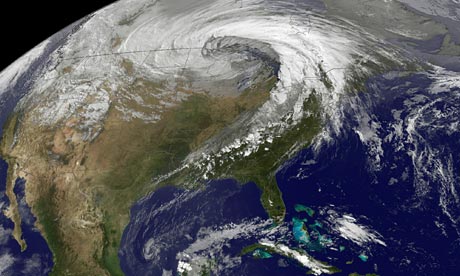
 This NASA EarthObservatory released on
<http://static.guim.co.uk/sys-images/Guardian/About/General/2010/11/1/1288641509988/This-NASA-Earth-Observato-006.jpg>


This Nasa Earth Observatory image shows a storm system circling around an area
of extreme low pressure in 2010, which many scientists attribute to climate
change. Photograph: AFP/Getty Images

A new study sponsored by Nasa's Goddard Space Flight Center has highlighted the
prospect that global industrial civilisation could collapse in coming decades
due to unsustainable resource exploitation and increasingly unequal wealth
distribution.

Noting that warnings of 'collapse' are often seen to be fringe or
controversial, the study attempts to make sense of compelling historical data
showing that "the process of rise-and-collapse is actually a recurrent cycle
found throughout history." Cases of severe civilisational disruption due to
"precipitous collapse - often lasting centuries - have been quite common."

The research project is based on a new cross-disciplinary 'Human And Nature
DYnamical' (HANDY) model, led by applied mathematician Safa Motesharri of the
US National Science Foundation-supported  <http://www.sesync.org/> National
Socio-Environmental Synthesis Center, in association with a team of natural and
social scientists. The study based on the HANDY model has been accepted for
publication in the peer-reviewed Elsevier journal, Ecological Economics.

It finds that according to the historical record even advanced, complex
civilisations are susceptible to collapse, raising questions about the
sustainability of modern civilisation:

"The fall of the Roman Empire, and the equally (if not more) advanced Han,
Mauryan, and Gupta Empires, as well as so many advanced Mesopotamian Empires,
are all testimony to the fact that advanced, sophisticated, complex, and
creative civilizations can be both fragile and impermanent."

By investigating the human-nature dynamics of these past cases of collapse, the
project identifies the most salient interrelated factors which explain
civilisational decline, and which may help determine the risk of collapse
today: namely, Population, Climate, Water, Agriculture, and
<http://www.theguardian.com/environment/energy> Energy.

These factors can lead to collapse when they converge to generate two crucial
social features: "the stretching of resources due to the strain placed on the
ecological carrying capacity"; and "the economic stratification of society into
Elites [rich] and Masses (or "Commoners") [poor]" These social phenomena have
played "a central role in the character or in the process of the collapse," in
all such cases over "the last five thousand years."

Currently, high levels of economic stratification are linked directly to
overconsumption of resources, with "Elites" based largely in industrialised
countries responsible for both:

"... accumulated surplus is not evenly distributed throughout society, but
rather has been controlled by an elite. The mass of the population, while
producing the wealth, is only allocated a small portion of it by elites,
usually at or just above subsistence levels."

The study challenges those who argue that technology will resolve these
challenges by increasing efficiency:

"Technological change can raise the efficiency of resource use, but it also
tends to raise both per capita resource consumption and the scale of resource
extraction, so that, absent policy effects, the increases in consumption often
compensate for the increased efficiency of resource use."

Productivity increases in agriculture and industry over the last two centuries
has come from "increased (rather than decreased) resource throughput," despite
dramatic efficiency gains over the same period.

Modelling a range of different scenarios, Motesharri and his colleagues
conclude that under conditions "closely reflecting the reality of the world
today... we find that collapse is difficult to avoid." In the first of these
scenarios, civilisation:

".... appears to be on a sustainable path for quite a long time, but even using
an optimal depletion rate and starting with a very small number of Elites, the
Elites eventually consume too much, resulting in a famine among Commoners that
eventually causes the collapse of society. It is important to note that this
Type-L collapse is due to an inequality-induced famine that causes a loss of
workers, rather than a collapse of Nature."

Another scenario focuses on the role of continued resource exploitation,
finding that "with a larger depletion rate, the decline of the Commoners occurs
faster, while the Elites are still thriving, but eventually the Commoners
collapse completely, followed by the Elites."

In both scenarios, Elite wealth monopolies mean that they are buffered from the
most "detrimental effects of the environmental collapse until much later than
the Commoners", allowing them to "continue 'business as usual' despite the
impending catastrophe." The same mechanism, they argue, could explain how
"historical collapses were allowed to occur by elites who appear to be
oblivious to the catastrophic trajectory (most clearly apparent in the Roman
and Mayan cases)."

Applying this lesson to our contemporary predicament, the study warns that:

"While some members of society might raise the alarm that the system is moving
towards an impending collapse and therefore advocate structural changes to
society in order to avoid it, Elites and their supporters, who opposed making
these changes, could point to the long sustainable trajectory 'so far' in
support of doing nothing."

However, the scientists point out that the worst-case scenarios are by no means
inevitable, and suggest that appropriate policy and structural changes could
avoid collapse, if not pave the way toward a more stable civilisation.

The two key solutions are to reduce economic inequality so as to ensure fairer
distribution of resources, and to dramatically reduce resource consumption by
relying on less intensive renewable resources and reducing population growth:

"Collapse can be avoided and population can reach equilibrium if the per capita
rate of depletion of nature is reduced to a sustainable level, and if resources
are distributed in a reasonably equitable fashion."

The NASA-funded HANDY model offers a highly credible wake-up call to
governments, corporations and business - and consumers - to recognise that
'business as usual' cannot be sustained, and that policy and structural changes
are required immediately.

Although the study is largely theoretical, a number of other more
empirically-focused studies - by
<http://www.kpmg.com/global/en/issuesandinsights/articlespublications/future-state-government/pages/resource-stress.aspx>
 KPMG and the
<http://www.bis.gov.uk/assets/goscience/docs/p/perfect-storm-paper.pdf> UK
Government Office of Science for instance - have warned that the convergence of
food, water and energy crises could create a 'perfect storm' within about
fifteen years. But these 'business as usual' forecasts could be
<http://ceasefiremagazine.co.uk/the-end-of-the-world-as-we-know-it-the-rise-of-the-post-carbon-era/>
 very conservative.

 <http://www.nafeezahmed.com/> Dr Nafeez Ahmed is executive director of the
<http://www.iprd.org.uk/> Institute for Policy Research & Development and
author of  <http://www.crisisofcivilization.com/> A User's Guide to the Crisis
of Civilisation: And How to Save It among other books. Follow him on Twitter
@nafeezahmed <https://twitter.com/NafeezAhmed>


--
You received this message because you are subscribed to the Google Groups
"Everything List" group.
To unsubscribe from this group and stop receiving emails from it, send an email
to [email protected].
To post to this group, send email to [email protected].
Visit this group at http://groups.google.com/group/everything-list.
For more options, visit https://groups.google.com/d/optout.

--
You received this message because you are subscribed to the Google Groups
"Everything List" group.
To unsubscribe from this group and stop receiving emails from it, send an email
to [email protected].
To post to this group, send email to [email protected].
Visit this group at http://groups.google.com/group/everything-list.
For more options, visit https://groups.google.com/d/optout.