This was put together by me. Hope it is enjoyed.
===================================================
Serpents, Spirals and Prayers - A Journey Through Symbolic Forms in
Jewelry
===================================================

Going through regular monthly cycles, the moon inevitably came to
be identified with femininity and the fact that it showered
soothing and comforting rays from an eminent position high above
in the sky ensured that our venerable ancient forefathers (and
mothers), ascribed the status of a goddess to this nocturnal
body. This is one reason why the early mainstream religions, with
their marked preference for the male of the species, found the
veneration towards what was a palpably feminine deity hard to
digest and hence came to associate such an inclination with an
aberration of the mind and it was not long before the word
'lunatic', with its lunar associations, came to brand such
devotion as insanity.

However, notwithstanding the injunctions to the contrary, the
moon as a symbol continued to fascinate humans. To observers on
the earth, it was the most changeable of all celestial phenomena.
In earlier times, the appearance of the new crescent was often
greeted with joy as a return of the moon from the dead. In
ancient Egypt, the sickle-shaped deity signified the goddess Isis
and any jewel fashioned in its likeness was believed to protect
infants. The crescent's association with babies derives from the
fact that it is itself the small, newborn moon. (It was always
the waxing moon, never the waning one.) Specifically, since it
appeared to give birth to itself, it was natural for the heavenly
body to become the patron deity of childbirth. Even when
submerged in the sea of night, the moon possesses the secret of a
new, evolving life. Similarly are all babies born into life out
of the dark waters of the womb.

To the skeptic the fact that the moon has no light of its own but
merely reflects the sun is an indication of the inferior status
of the former. It is left to the sacred text Prasna Upanishad to
bring things into perspective:

'The sun is the principle of life and the primeval waters are the
moon. And these waters are the source of all that is visible or
invisible. Hence the waters are the image of all things.' (Tr.
>From Sanskrit By Alain Danielou.) Thus does the moon reflect the
sun's light. Further, by analogy, it is the same archetypal waters
which fertilize the male seed floating in its infinite depths.

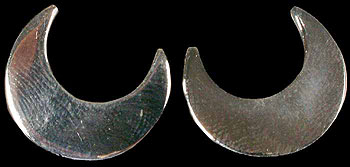
It is all the more auspicious to craft the crescent out in silver
as it is considered the moon's metal much as gold is associated
with the sun.

Illustration: http://www.exoticindia.com/artimages/jet99.jpg

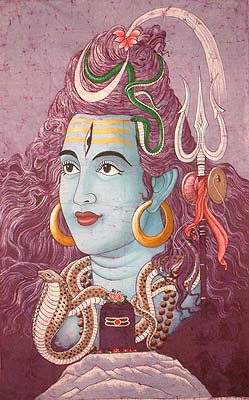
Then there is Shiva, the Hindu god of destruction, who adorns his
crest with the crescent, which both softens and sensualises his
appearance at the same time.

Illustration: http://www.exoticindia.com/artimages/bg22.jpg

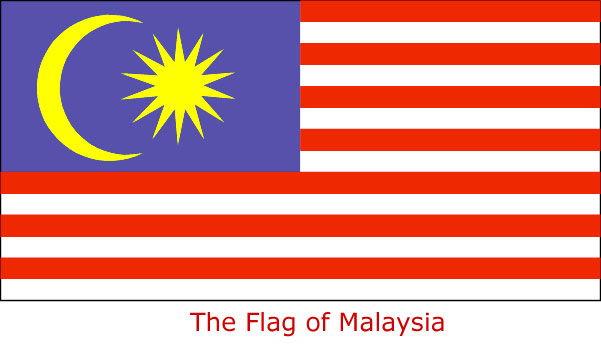
In Islam too, the crescent is considered sacred since it was
Prophet Muhammad himself who proclaimed the lunar dating system,
replacing the earlier one based on a combination of the solar and
lunar calendars. The crescent motif, known as the hilal, has been
much used throughout the centuries in Islamic art and appears on
the flag of many nations thus inclined.

Illustration: http://www.exoticindia.com/artimages/flag.jpg

The stand-alone crescent is in a sense incomplete, without the
mating male element, represented by the sun. The two heavenly
bodies, juxtaposed in a number of imaginative ways, denote the
sacred marriage of the two underlying principles, which are the
building blocks of the universe. In the world's earliest book,
the Rig Veda, there is a hymn glorifying the union of Soma (moon)
with Surya (sun).


The Creative Tension in Chinese Thought

One night in China, the venerable sage Chang San Fang had a vivid
dream of a contest between two creatures, a snake and a crane.
The former came up from the earth, and the latter flew down from
a tree, and then began a struggle over a morsel of food. The
dream recurred, night after night, and yet neither creature was
ever wholly victorious. The contest was very evenly matched - an
example of opposites in dynamic harmony.

This active engagement of the two principles was given visual
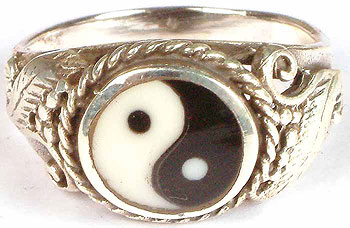
form in an ingenious diagram known in Chinese as the Tai Chi Tu.
It is a perfect circle, divided into two equal parts by a
central, vertical S, which symbolically represents the coiled
dragon of Chinese mythology. In the white section, which is
associated with the hard, male principle (yang) is a black dot.
The latter signifies the presence of the softer feminine, known
as yin.

Illustration: http://www.exoticindia.com/artimages/jdk86.jpg

The black region belongs to the yin and has the corresponding
white dot representing the male. This overlapping suggests that
nothing in the world is wholly yin or yang in itself, but each
contains the seed of the other. Also, one may be yang in relation
to something, but yin in relation to another. Hence, a
grandfather is yang to the grandmother, but perhaps yin to his
grandchildren (hopefully).

The incongruent dots, each occupying the sphere of its opposite
are a great spur to creative activity; inasmuch as a oyster gives
rise to a pearl when a foreign matter enters it, similarly does
the trace of the disparate element present in the two fields
become the root behind all creative impulse.


Amulets, Talismans and the Like

Though in popular parlance, the terms amulet and talisman are
used interchangeably, there is a fine distinction between the
two. While the former wards off bad luck, a talisman is believed
to be an enhancer of good fortune. Amulets and talismans are two
sides of the same coin. One repels what is baneful while the
other impels on the beneficial. The employment of both rests on
the belief that the inherent quality of a thing can be
transmitted to human beings by contact.

The choice of objects used as amulets and talismans is determined
by several different criteria, at the root of which lies the
basis that "like affects like". For example, parts of animals
exemplifying certain characteristics - hare for swiftness or bull
for strength; relics of holy or heroic persons, or even dust from
their graves, believed to be imbued with their charisma; models
of common objects to which a symbolic significance is attributed,
such as a miniature ladder representing the soul's ascent to
heaven.

The color of an object may also be decisive and a yellow stone
may be used against jaundice while a red one to relieve menstrual
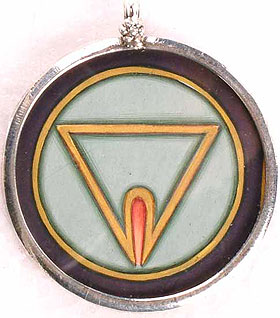
disorders. Ubiquitous also are models of the male and female
genitalia, thought to increase the procreative ability and its
associated pleasures.

Illustration: http://www.exoticindia.com/artimages/lm33.jpg

It is not only material things that function as effective amulets
and talismans. In primitive thought, the name of a person was not
a mere verbal appellation but an essential component of his
being, that of a god or demon written on a slip or engraved on a
gem could therefore serve as a potential magical instrument.
Similarly, scrolls or scripts containing mantras or excerpts from
scriptures were (and still are) considered extremely powerful.
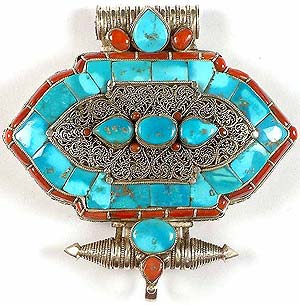
Such sacred written treasures naturally required equally
beautiful receptacles to hold them. Thus was born the unique box
container, the skilled craftsmanship of which was taken to
dazzling heights by the Tibetans, where it was called the 'gau'.

The gau is used widely throughout the western and eastern
sub-Himalayan area by tribes which follow Buddhism. The origin of
this container-pendant can be traced to the often inhospitable
environment of Tibet. Violent natural phenomena, such as seasonal
floods, hail, winds and sandstorms, affect the success of the
crops upon which the people's very existence depends. An ancient,
animistic Tibetan iconography shared by most people in this
region provides them with a means of coping with such natural
disasters. Elemental in this system is the belief that the
physical elements in the environment possess power attributed to
the presence of natural spirits, some benevolent (trinchhem-po)
and others malignant (sem ngem-po). The former must be
propitiated, and magical protection secured against the latter.
It is either of these two functions, which influences the choice
of the gau's contents.

The gau combines in itself form and function. Since it is a
container to hold and protect various charms placed within, it
consists of two basic parts that fit together, so that access to
its inner space is possible. Most generally the gau is made of
silver (nga), which is used for the visible front, and the
removable back half can be copper, brass, or silver itself.

In addition to being a functional object, the gau is also a
decorative one, often of considerable artistic merit - with the
flat surface ornamented with wire work, stamped units, and often,
turquoise and coral stones. The main space may be filled with
filigree (cha-ku le-ka) in scrolling and tendril patterns, that
symbolize the ever-flowing essence of nature.

Illustration: http://www.exoticindia.com/artimages/jim52.jpg

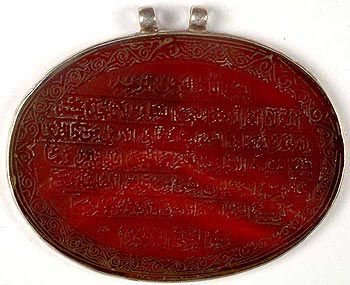
In some cultures, the written word may directly serve as a
magical ornament. Among Muslims for instance, the most potent
amulet is believed to be a small and flat sheet, usually made of
gold or silver (or a gemstone), on which is inscribed a verse
from the sacred Quran. Looking like a tiny page from the sacred
book, it displays a special verse in Arabic script. Their
spiritual strength is derived not from the shape or design, but
rather the massive power that is invested in the holy words
inscribed on their surface. Craftsmen (and women) from
Afghanistan, create the finest examples in this genre,
embellishing their calligraphic plates with tedious arabesque and
other decorative patterns. The preferred materials for carving
out the sacred texts are lapis lazuli and carnelian, the latter
renowned for its special connection with Prophet Muhammad, who
reputedly adorned his finger with an inscribed ring of the same
stone.

Illustration: http://www.exoticindia.com/artimages/jim93.jpg


The Story of The Evil Eye

Another ancient motif, which has amuletic connotations, is the
eye, encountered on many prehistoric walls and monuments. These
represent the providential vigilance of benevolent gods and
spirits, counteracting the evil eye of the malevolent demons.
This belief is particularly prevalent in the Arab world, where a
proverb goes: "the evil eye empties houses and fills tombs".

According to a related Turkish legend, there was once a massive
rock by the sea, which even the force of a thousand men and a
load of dynamite couldn't move or crack. There was also a man in
the town, known to carry the evil eye (nazar). After much
persuasion, he was convinced to come to the rock. He took one
look at it and said, "My! What a huge rock". No sooner had he
uttered the words than there was a rip, roar and crack and the
impossible boulder split into two.

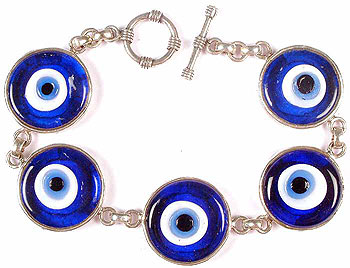
Indeed, the deep-seated fear of the harmful eye has meant that
wearing a rival eye - a protective symbol that can outstare the
evil one - has proved immensely popular over many centuries. One
such object is the blue eye from Turkey, known locally as nazar
boncuk, which is set into a variety of jewelry forms.

Illustration: http://www.exoticindia.com/artimages/jew49.jpg

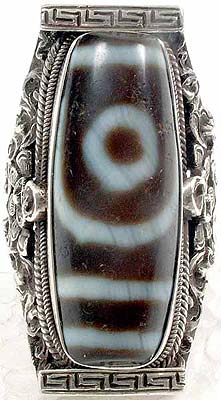
Another rebuff to the negative eye are the Tibetan gzi beads,
believed to be the droppings of the mythical bird Garuda as it
flies across the skies.

Illustration: http://www.exoticindia.com/artimages/us13.jpg


The Potential Power of the Spiral

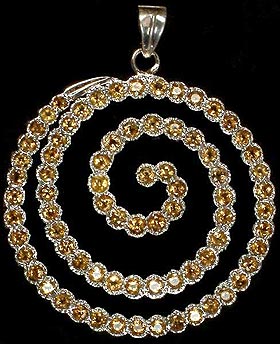
The spiral is one of the oldest pagan symbols in existence. It
represents the perpetual motion of life, with the spring-like
coils suggesting latent power, presenting a picture of life as an
endless, evolutionary process bound within the cycles of time.
Although each loop of the spiral brings us back to the same
place, it takes us to a higher and more evolved level.

Illustration: http://www.exoticindia.com/artimages/jhn61.jpg

Triple Spiral

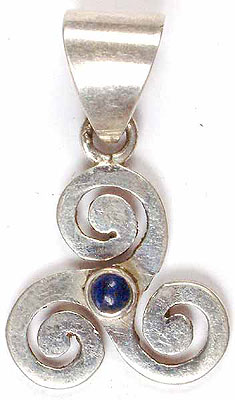
This Celtic spiral represents the triple goddess of the three
ages of womanhood (maiden, mother and crone). It later came to
signify the holy trinity in Christianity, God the Father, Son and
Holy Spirit. This motif is also called the triskele.

Illustration: http://www.exoticindia.com/artimages/jdx29.jpg


Beaded Prayers

The activity of using beads in spiritual practice is not a recent
or ancient phenomena but rather an archetypal one, as is borne
out by the fact that it is common to all traditions. When strung
together, these beads are used as a device to count recitations
of prayers or as an aid to meditation.

The etymology of the word 'bead' helps us to understand this
function, deriving as it does from the Sanskrit buddh, which
refers to self-realization (Buddha being one such realizer) and
from the Saxon verb bidden, to 'pray'.

The rosary however, is only one of the several ways to count
prayers. The earliest means involved summing on fingers or
shifting pebbles from one pile to another. These unwieldy methods
were replaced by tying knots on a cord and the string of prayer
beads probably evolved from this knotted thread. The Greek
Orthodox Church still employs such a knotted rosary known as the
kombologion.

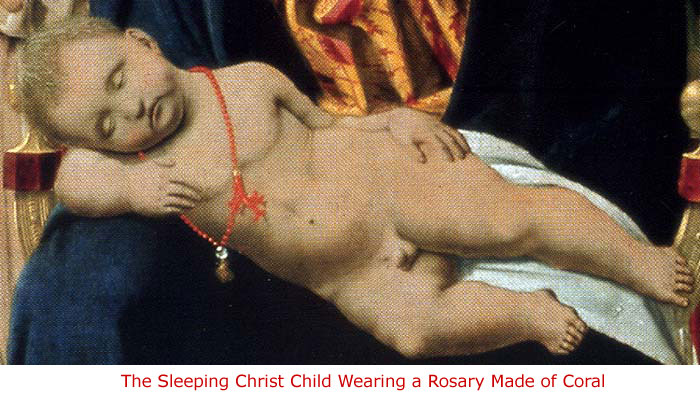
The present Catholic rosary is believed to have been given by the
Virgin Mary to St. Dominic (1170-1221 AD), bidding him to teach
it to the faithful. The term rosary itself is loaded with
symbolic significance, one of its meaning being a necklace of
roses suggesting the stringing together of prayers in the form of
blossoms. Further, the red rose symbolizes Christ's blood and the
purity of the Virgin Mary. Also, collections of medieval prayers
and hymns were bound into books called rosaria (flower gardens).
Thus was the spiritual identity of roses extended to beads, which
came to signify a permanent garden of prayers.

Illustration: http://www.exoticindia.com/artimages/rosary.jpg

Since Catholics must say 150 prayers, their rosary is divided up
into 15 sets of 10 beads. Each set of ten is separated from the
next by a larger bead and, at one point in the circle, there will
be a special punctuation, probably in the form of a crucifix, to
mark the end of the cycle. For common use, there is a lesser
rosary of only 50 beads, in which each piece is worth three
prayers.

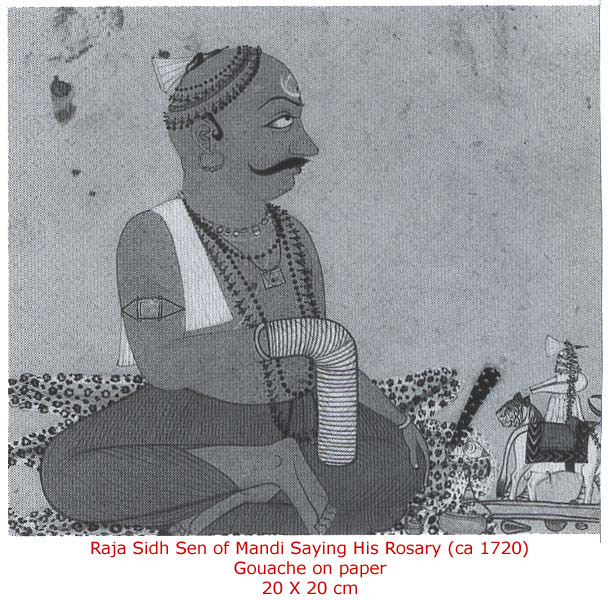
The credit of inventing the rosary goes to Brahmanical Hindus, as
early as 1500 BC. It came to be known as the mala, literally
meaning a 'garland of flowers.'

Often worn as a necklace in India, the rosary thereby became a
form of devotional jewelry. Today however, many prefer not to
display it as a personal adornment and wear it out of sight under
clothing. In fact, some place the rosary and the hand counting it
into a small, often embroidered bag, so as not to make a public
exhibit of their devotion.

Illustration: http://www.exoticindia.com/artimages/mala.jpg

The Hindu rosary has 50 beads, corresponding to the number of
characters in the Sanskrit language. The number may go up to 108
incorporating the nine planets in 12 zodiac houses. This is also
the number of dairymaids (gopis), who surrendered themselves to
Krishna. Here it is relevant to observe that no material is
regarded as too lowly or precious to form mala beads, just as any
soul is perfect enough to seek union with god.

The Buddhist mala too consists of 108 beads, echoing the number
of Brahmins present at the birth of Buddha. This is also the
number of earthly desires of ordinary mortals in the Japanese
Nichiren tradition. It is common to see Buddhists wearing their
rosaries either as a necklace or wrapped like a bracelet around
the left hand. Its constant presence makes the mala always
available for use in leisure time which is more often than not
devoted to its counting. Even when occupied with other routine
tasks, a Buddhist will commonly say his beads and will tend to
stick to one string throughout his life, its inevitable wear and
tear reminding him of the impermanence and transience of one's
own life.

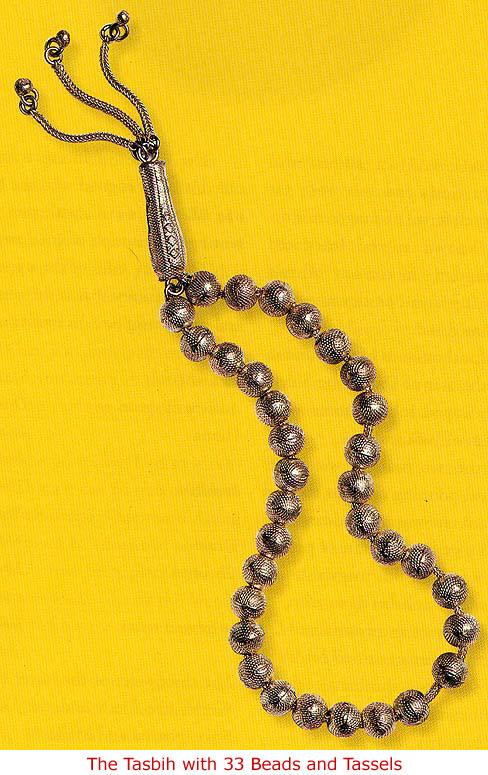
The Muslim rosary is known as the tasbih, derived from the Arabic
root s-b-h, which means 'to glorify'. It consists of 99 pieces,
divided into three equal groups, usually by a bead (different
from the rest in shape and material) placed after the 33rd and
66th piece. These markers are considered equivalent to the round
mark (ayat) in the Quran text where a reader may occasionally
pause. The beginning (or the end) of the rosary is hung with
tassels. These are said to repel the evil eye, which specifically
dislikes such ornamental fringes. The number of the beads
represents the 99 beautiful names of God, Asma'u'llah (Quran,
Surah, vii 179). According to Muhammad, "Verily there are 99
names of God and whoever recites them shall enter into Paradise"
(Mishkat, Book cxi).

Often the rosary will have a 100th special piece representing the
ineffable name of God: Allah. However, theologians differ on
this, rejecting the idea that the essence of God the Creator
could be thus rendered into concrete terms.

Like the Christian one, the lesser version of the Muslim rosary
may contain 33 beads only, each equivalent to three prayers.

Illustration: http://www.exoticindia.com/artimages/tasbih.jpg


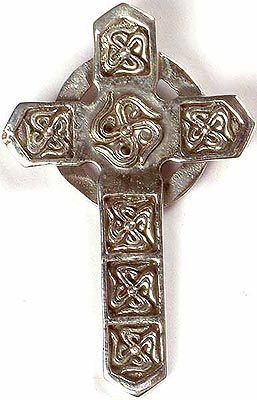
The Cross

Though the prophet Isaiah castigated women who wore charms
(3:20); nevertheless, the cross has developed into the principal
symbol of the Christian religion, recalling the crucifixion of
Jesus Christ and the redeeming benefits of his passion and death.
It is thus both a sign of Christ himself and the faith of the
Christians.

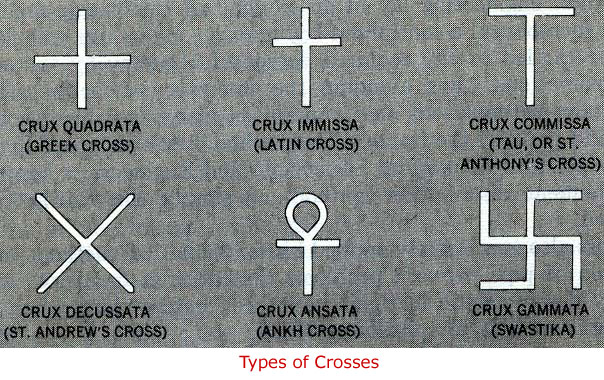
There are four basic types of iconographic representations of the
cross:

1). The crux quadrata, or Greek cross with four equal arms.

2). The crux immissa or Latin cross whose base stem is longer
than the other three arms.

3). The crux commissa, in the form of the Greek letter tau, and
sometimes called St. Anthony's cross.

4). The crux decussata, named from the Roman decussis or symbol
of the numeral 10, also known as St. Andrews cross.

Tradition favors the crux immissa as that on which Christ died,
but some believe it was the crux commissa.

The symbol of the cross however predates Christianity. Two of the
earliest forms are the Swastika from India and the ankh from
ancient Egypt.

Illustration: http://www.exoticindia.com/artimages/cross.jpg

The cross was not the symbol of choice for the early church, for
whom the crucifixion presented a problem. It had to convince
unbelievers of what would have seemed a bizarre claim, that its
god was a victim of this foul, and then still very current, form
of punishment. Historically, crucifixion was not a punishment
meted out by the Jewish authorities, whose preferred method of
execution was stoning; it was imported into Palestine by the
Romans, and so was an instrument of imperialism and subjugation.
Secondly, it was used in particular on slaves found guilty of a
crime. Therefore, it was humiliating for Jesus the Jew to die
like a slave on the Roman cross.

It was only over time that Christians began to think through the
implications and meanings of the crucifixion, and to glorify the
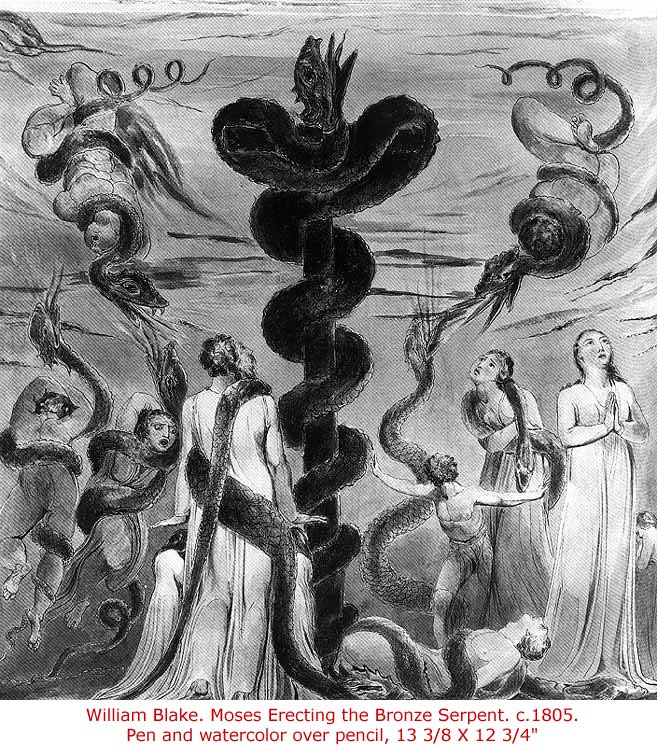
cross. It seems though that Jesus always understood the cross'
positive significance. He had predicted his death by such means
and compared himself to the bronze snake that Moses erected
during the Exodus ('Just as Moses lifted up the snake in the
desert, so the Son of Man must be lifted up, that everyone who
believes in him may have eternal life', John 3:14-15). The
purpose of the snake was to cure people from poisoning. God had
sent a plague of snakes to the Israelites but he also provided a
cure, which was effected by looking at the bronze snake. Poison
is a Christian symbol for sin, and Jesus' words suggest a direct
analogy between the power of the bronze snake to cure poisoning
and his own potential to do the same for sin.

Illustration: http://www.exoticindia.com/artimages/bronzesnake.jpg

The cross is also a cosmic symbol, with its vertical and
horizontal lines spanning the universe. According to Rutherford:
'The cross of Christ on which he was extended, points, in the
length of it, to heaven and earth, reconciling them together; and
in the breadth of it, to former and following ages, as being
equally salvation to both.'

A beautiful thing about the cross is that its center of gravity
is not at its exact center, but upwards where the stake and the
crossbeam meet. In simple terms it symbolizes the tendency to
remove the center of man and his faith from the earth and to
"elevate" it into the spiritual sphere.

Illustration: http://www.exoticindia.com/artimages/jim90.jpg


The Serpent - Friend or Foe?

For many, the serpent is an enemy to be feared and avoided at all
costs. Its venom makes it a villain. However, in several parts of
the world, this slithering reptile, with its peculiar and swift
locomotion, is viewed as a sacred protective power. Snake amulets
were being worn at least 3,000 years ago and still are today. How
can this contradiction be explained?

The answer lies in the serpent's ability to renew itself by
shedding its skin. When the ancients observed this, they may have
imagined them to be immortal. One day, they would see a snake
with a dull, damaged skin and eyes glazed over. The next morning,
the same creature would be smooth and glistening, with eyes once
again clear and penetrating. It appeared as if the snake was
capable of rejuvenating itself, much like the moon and thus it
was concluded that it held the secret to eternal life.

The world traditions are replete with positive references to the
serpent. According to the Celtic druids, the world originated
from an egg that came from the mouth of a snake; in some Gnostic
writings there is the notion that the first human beings crawled
on the ground like snakes; the Ngala tribe of central Congo
believes that the moon once lived on earth as a python; and then,
there is the well-known saying of Jesus: "Be wise as serpents"
(Matthew 10:16).


Some Unique Images of the Viper

The double serpent (or dragon) - one with a head at each end -
can simultaneously symbolize both the sun and the moon.

Illustration: http://www.exoticindia.com/artimages/jif65.jpg

When depicted with three-and-a-half coils, the snake represents
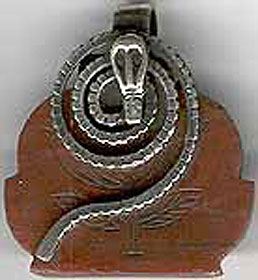
the inherent potential energy which lies coiled at base of our
spine (kundalini).

Illustration: http://www.exoticindia.com/artimages/jg71sm.jpg

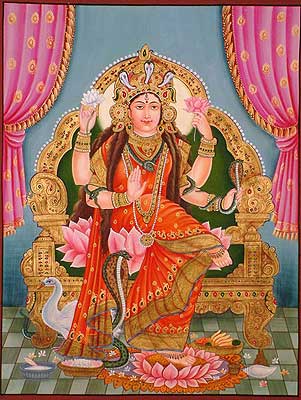
The Indian snake goddess Manasa is even today invoked against
snakebite.

Illustration: http://www.exoticindia.com/artimages/wb64.jpg

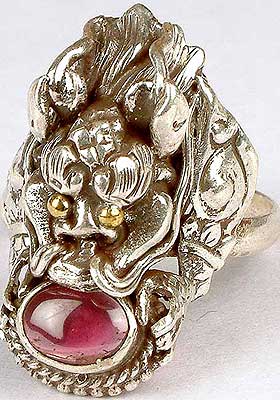
The dragon shares the cosmic stage with the serpent. According to
a legend, when the Chinese monster Kung Kung battled with the
emperor Yao and tore a hole in the sky, it was a dragon who
replaced the cavity, causing daylight when it opened its eyes and
night with their closure. When this great sky dragon inhaled, it
brought forth summer, and by exhalation, winter.

Illustration: http://www.exoticindia.com/artimages/jij42.jpg

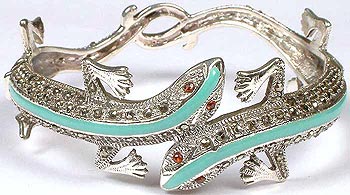
The Egyptians regarded the lizard as a benevolent spirit, keeping
watch over the house or hearth. Indeed this diminutive reptile,
that basks in on the stone walls of houses or gardens in
Mediterranean countries, drinking in the sunshine and snapping up
little insects, has become a familiar, protective creature and a
symbol of domestic happiness.

Illustration: http://www.exoticindia.com/artimages/jhm07.jpg


The Chinese Journey to Paradise

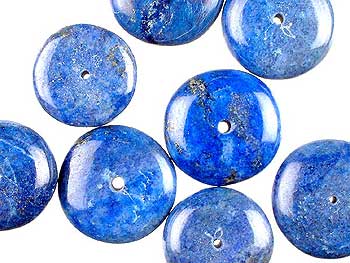
If one visits the Chinese market in Singapore and asks for a
lucky charm, the amulet that is most likely to be offered will be
a simple, circular, flat disc with a hole in the center. It is
none other than the ubiquitous donut. This is the Chinese symbol
of heaven known as the Pi (or Bi) disc. One tomb dating from the
fourth millennium BC contained no fewer than 24 such rings, which
had been placed there to ensure the deceased's ascent to heaven.

Illustration: http://www.exoticindia.com/artimages/qn39.jpg

It seems strange to envisage paradise shaped like a circle with a
hole in the middle, rather something like Nestlé's Polo mint. The
orifice at the center is said to signify the 'path of
transcendence', which leads to eternal bliss. In other words, the
thread that passes through such a bead, recreates in a sense the
journey to heaven.


The Power of Sikh Unity

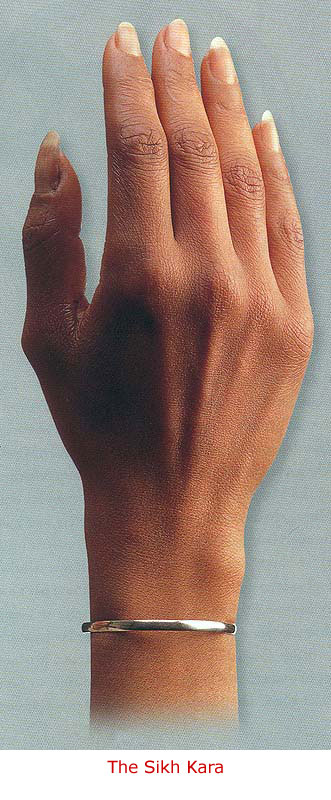
A follower of the Sikh religion feels unprotected without a
symbolic bodyguard in the form of the metal bangle called the
kara. This religious bracelet, worn permanently by both sexes on
the right wrist, must be made of iron or steel. It is forbidden
to fashion it from either gold or silver.

Illustration: http://www.exoticindia.com/artimages/kara.jpg

Officially, the function of the kara is to act as a visible
symbol of power and unity. The material represents the strength
while the circular shape signifies the essential oneness of the
Sikh faith.


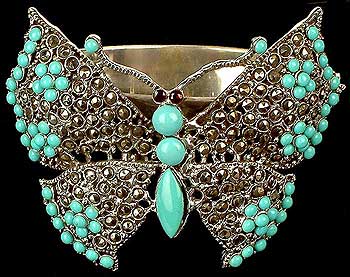
The Butterfly and the Moth

The latter is irretrievably attracted to a flame, and the moth
that immolates itself at the lighted candle is one of the
favorite images of Sufism. It is a metaphor for the soul losing
itself in the divine fire.

The life cycle of the butterfly presents a perfect analogy for
immortality:

a). The crawling caterpillar signifies the ordinary life of
mortals, preoccupied with fulfilling our trivial needs.

b). The next stage, the dark chrysalis (cocoon), represents death.

c). The butterfly symbolizes rebirth and a new beginning in life,
with the soul fluttering free of material concerns and restrictions.

Illustration: http://www.exoticindia.com/artimages/jin01.jpg

These three stages also serve as a microcosm for the biography of
Jesus Christ - life, death and resurrection.


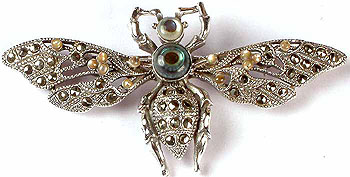
The Stabilizing Dragonfly

They are fantastic and confident flyers, darting like light,
twisting, turning, changing direction, even going backwards as
the need arises. They are inhabitants of two realms - starting
with aquatic bodies, and moving to the air with maturity, but
nonetheless staying close to water. Thus, the motif of the
dragonfly is believed to endow on the wearer a relative stability
deriving from a sense of rootedness, and mental control and
clarity as against emotional and impulsive excitability.

Illustration: http://www.exoticindia.com/artimages/jib39.jpg


The Peacock - The Transformed Beauty of Venom

The magnificently endowed peacock has posed and strutted in the
gardens of kings and emperors during biblical times and before
and has attracted attention throughout the world ever since. When
he raises the feathered train high above his back, rattles his
quills, and emits raucous, harsh screams, he is unsurpassed in
drama and beauty. Although this display is part of the peacock's
courtship ritual (small wonder that peacocks have harems of two
to five hens), he will not hesitate to repeat the performance for
attentive humans.

According to a Greek legend, the peacock was sacred to the
goddess Hera. She directed Argus, the creature with 100 eyes, to
spy on a rival. When Argus was slain, Hera placed his eyes on the
tail of her favorite bird. However, the earliest mention of
peacocks in Western Literature is in the play The Birds, written
by Aristophanes in 414 BC.

In Hinduism, the peacock is the vehicle of the god of war
Karttikeya, and in Buddhism that of Amitabha - one of the five
Dhyani Buddhas. It is said to be capable of swallowing vipers
without coming to harm itself. In fact, the peacock is believed
to derive its rich plumage from the poison of the snakes on which
it feeds. This symbolism, of being open even to poison, and
transmuting it into beauty, gives us a feeling of the purifying
and transforming power of this fascinating bird. For us ordinary
mortals, it is a reminder that perhaps even our darkest and most
venomous aspects are capable of reformation.

Illustration: http://www.exoticindia.com/artimages/jha01.jpg


===========================================
References and Further Reading:
===========================================

Alun-Jones Deborah and John Ayton: Charming - The Magic of Charm
Jewelry: London, 2005.

Andrews, Tamra. A Dictionary of Nature Myths: Oxford, 2000.

Beer, Robert. The Encyclopedia of Tibetan Symbols and Motifs:
Boston, 1999.

Bontekoe, Ron and Eliot Deutsch. A Companion to World
Philosophies: Oxford, 1999.

Cashford, Jules. The Moon Myth and Magic: London, 2003.

Chebel Malek and Laziz Hamani. Symbols of Islam: Paris, 1997.

Colin, Didier. Dictionary of Symbols, Myths and Legends: London,
2000.

Cooper, J.C. An Illustrated Encyclopedia of Traditional Symbols:
London, 1999.

Danielou, Alain. The Myths and Gods of India: Vermont, 1991.

Dubin, Lois Sherr. The History of Beads (Concise Edition):
London, 1995.

Fontana, David. The Secret Language of Symbols: London, 1997.

Gideons International. The Holy Bible: Tennessee, 1978.

Henry, Gray and Susannah Marriott. Beads of Faith: London, 2002.

Huxley, Francis. The Eye - The Seer and the Seen: London, 1990.

Jones, Lindsay (ed). Encyclopedia of Religion (Previously Edited
by Mircea Eliade) 15 volumes: MI, 2005.

Leaman, Oliver. Eastern Philosophy Key Readings: New Delhi, 2004.

Leaman, Oliver. Key Concepts in Eastern Philosophy: New Delhi,
2004.

Morris, Desmond. Bodyguards Protective Amulets and Charms:
Boston, 1999.

Nissenson, Marilyn and Susan Jones. Snake Charm: New York, 1995.

Purce, Jill. The Mystic Spiral (Journey of the Soul): London,
1997.

Taylor, Richard. How to Read a Church: London, 2003.

Tresidder, Jack. The Hutchinson Dictionary of Symbols: Oxford,
1997.

Untracht, Oppi. Traditional Jewelry of India: London, 1997.

------------------------------------------------------------

The illustrations along with the text can be read at the
HTML version of the article:
http://www.exoticindia.com/article/symbolicjewelry/

------------------------------------------------------------
This article was send as a newsletter from the website:
http://www.exoticindia.com

Nitin G.


------------------------ Yahoo! Groups Sponsor --------------------~-->
Get fast access to your favorite Yahoo! Groups. Make Yahoo! your home page
http://us.click.yahoo.com/dpRU5A/wUILAA/yQLSAA/JjtolB/TM
--------------------------------------------------------------------~->

To subscribe, send a message to:
[EMAIL PROTECTED]

Or go to:
http://groups.yahoo.com/group/FairfieldLife/
and click 'Join This Group!'
Yahoo! Groups Links

<*> To visit your group on the web, go to:
    http://groups.yahoo.com/group/FairfieldLife/

<*> To unsubscribe from this group, send an email to:
    [EMAIL PROTECTED]

<*> Your use of Yahoo! Groups is subject to:
    http://docs.yahoo.com/info/terms/