On Thu, Nov 13, 2008 at 07:05:48PM +0200, مؤيد السعدي wrote:
> > I designed the liveusb creator in a way that makes it very easy to throw
> > any GUI on top of it.  I initially started writing a PyGTK gui, but
> > switched to PyQt because: 1) The implementation turned out to be much
> > cleaner and 2) It ran great out of the box on Windows.
> >
> yes, you have done good job, but it's different use case
> I'm not making a replacement to livecd-creator
> I love the windows port, and KDE livecd may love the qt port
>
> > The liveusb.creator module already does all of the hard work for you,
> > and wrapping a GUI around it is quite easy.  You can find the latest
> > liveusb-creator API documentation here:
> >
> >     http://lmacken.fedorapeople.org/liveusb-creator/api/
> >
> thanks, I'll use that when I'm done with the GUI design
>
> > Now, in order to be the 'default' liveusb-creator GUI, it needs to be
> > fully feature compliant (to the extent that the liveusb.creator module
> > currently is), and it needs to run on Windows.  If the GTK
> > implementation can meet those requirements, then I would be fine with
> > making it the default; assuming that the implementation is as
> > clean as the current, and is easily maintainable.
>
> then I don't want it to be the default
> I want to satisfy my ojuba.org users
> http://fedoraproject.org/wiki/DerivedDistributions/LiveCDs#Ojuba_Linux
Ok, that's fine with me.

> as we used to have a howto for making a liveusb using the your
> liveusb-creator on windows
> and another one using the livecd-iso-to-disk in linux (from within the
> livecd on the fly)
> but we get this question why the linux tool is cli
> and our livecd is already overburned (as we ship OpenOffice.org)
> there is no place for pyqt and even with that there is no way to set the
> source to be the CD device (/dev/sr0)
>
> as I said I would love to see it beside
> >> liveusb-creator (API) and liveusb-creator-qt (and maybe adding
> liveusb-creator-cli)
> and make the API and the cli pleasing to add feature more than the current
> bash script
> livecd-iso-to-disk
> so that Jermey find it fun and pleasing to add his new feature there

Yeah, I started working on the cli version, but I'm not sure if I ever
got a chance to finish it.  It shouldn't be very difficult to polish up.

The API is currently pretty clean, and it is quite easy to add new
features.  The liveusb-creator is lagging a little bit behind
of the livecd-iso-to-disk in terms of features, mainly because I don't
have time to constantly port Jeremy's changes :)

> > As far as GTK is concerned, the current liveusb-creator is actually
> > rendered with GTK widgets on a Fedora 10 GNOME desktop, thanks to
> > QGtkStyle.  So, I guess the only reason for creating a brand new
> > interface from scratch is to avoid the PyQt dependency on livecds?  That
> > doesn't exactly sounds like the best reason for re-implementing the
> > interface, but if someone is willing to write the code, I'm not
> > complaining ;)
> >
> yes it's, the dependency and the on-the-fly issue

Understandable; I think your interface will be a valuable asset to the
live media in that case.

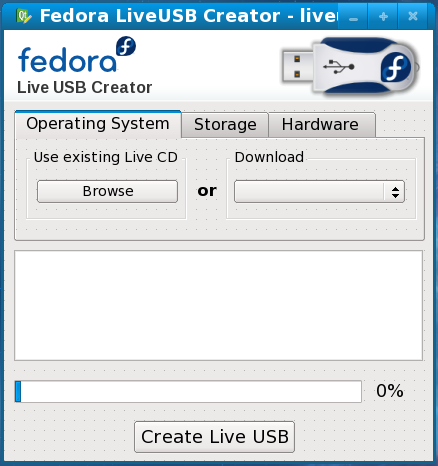
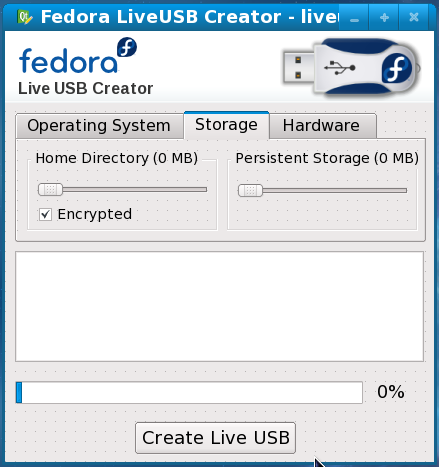
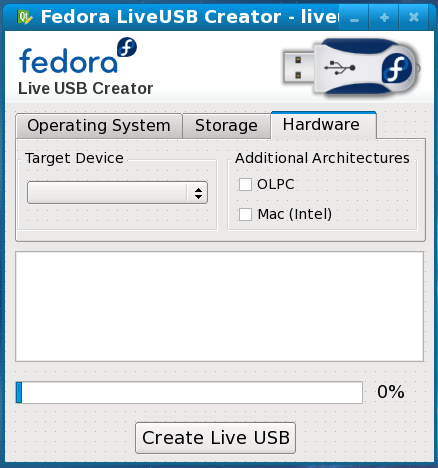
> > Here are some prototypes of what the next major release of the
> > liveusb-creator will probably look like:
> >
> http://lmacken.fedorapeople.org/liveusb-creator/liveusb-creator-tabbed-0.png
> >
> http://lmacken.fedorapeople.org/liveusb-creator/liveusb-creator-tabbed-1.png
> >
> http://lmacken.fedorapeople.org/liveusb-creator/liveusb-creator-tabbed-2.png
> >
> not good for my use case
> 1. no way to do on the fly ie. no iso and no download
> 2. my users don't like to see the logs (which takes half of the window)
> 3. my users thinks that tabs are used for independent things, not for steps
> 4. my users want things to just work ie. if they just click OK without
> thinking it should work

Opening the program and clicking "Create LiveUSB" will Just Work, as it
auto-detects all of the hardware, and defaults to downloading the ISO.
But yes, I understand your use case, and I think the liveusb-creator is
definitely capable of supporting it.

> 5. valid values for tab #2 are taken from tab #3 (the max value for the
> size of home or persistent layer can't be more than the free space on
> target [on tab#3] minus the size of the iso)

Yeah true.  As I said before, that is merely a non-functioning prototype
at the moment.  I'm completely open to
suggestions/improvements/criticism/patches/etc.

> ok, let me tell you how it work
> I used hal to get the list of usable target partitions
> I used hal to set the source device (/dev/sr0)
> so when the user runs it, he just plug his usb pen and it will be selected
> automatically as target
> and when he inserts the CD it will just chosen as source (and if he is
> running the livecd it will already be selected), without any interaction

Yep, the liveusb.creator module currently has support for auto-detecting
usb keys from HAL via DBus, and monitors add/remove device events so it
can populate that field on-the-fly when someone plugs their USB stick
in.

As far as CD support, there is nothing there to handle that at the
moment, but I think it would be a great addition.

> all advanced features are hidden in side the expander
> [the only thing I'm looking for is away to guess if a system is an XO or an
> intel MAC
> some people suggested checking for PCI ids that exists only in intel macs]
>
> > Let me know if you have any questions, and please keep me in the loop on
> > the progress!  There is also a liveusb-creator mailing list where we can
> > discuss further implementation details.
> >
> > Cheers,
> >
> > luke
>
> I would love to be there
> I'm moving the rest of the talk there then

Sounds good.

Cheers,

luke

--
Fedora-livecd-list mailing list
[email protected]
https://www.redhat.com/mailman/listinfo/fedora-livecd-list