On 20 Nov 2007 at 18:02, John Howell wrote:

> At 5:53 AM -0500 11/20/07, dhbailey wrote:
> >
> >But if someone would know the false relationship is a common feature
> >of this style of music, they would very likely also know that the F
> >would be lowered on the descending melodic line after having been
> >raised on the ascending line.
>
> OK, several people (well, at least two!) have brought up this
> "descending melodic line" and I haven't commented, but I really have
> to.  The ascending and descending thing simply wasn't a rule in
> renaissance music.  They would have been trained in hexachordal
> analysis and in the rules of ficta, and those would have guided their
> realization of a melodic line.  (Although I do appreciate that people
> have recognized the alto line as an independent melodic line.)  The
> F# has nothing to do with an ascending line.  It is raised by ficta
> because the alto line forms a cadence with one of the other lines (I
> didn't save the example, but that's what I recall looking for and
> finding).  If it did appear in the copy source (which i assume it
> did), it was probably because it was a passing cadence in the middle
> of a line of text and the singer could have been uncertain.
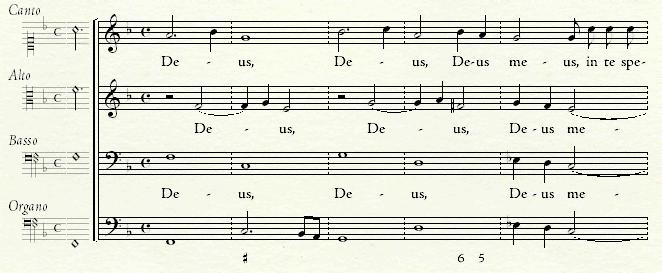
The reason the # was supplied in the source was because it was a
cadential leading tone approached by 3rd, instead of the normal
stepwise approach.

> "Because it's a descending line" is NOT sufficient reason in
> renaissance theory, at a time when the melodic minor scale was not
> even invented yet.  (And that's actually where the idea came from,
> I'm pretty sure.)

There's an intervening barline, and a non-cadential figure in a
hexachordal context where the F would be natural. That's two reasons
why the # no longer applies, and why a natural need not be notated.

Actually, I think the figures in the bass are the best place for
cautionary additions:

  http://www.philomela.net/ex/deus.jpg

because there is no indication of the # third in the 4th measure, and
what seems like an unnecessary # third in the 2nd measure (perhaps
the context before was very Eb heavy -- I'd assume we're gradually
moving from a "g minor" to a "d minor" context, and would expect the
following measures to be a resolution on the chord of F Major), and
last of all, no # third in the last measure. If I were editing this,
I would add a parenthetical sharp figure for the continuo line on the
first beat of m. 4 and the 3rd beat of the last measure (where
there's a mode change that's not going to get played if the continuo
player is reading from a bass line alone).

--
David W. Fenton                    http://dfenton.com
David Fenton Associates       http://dfenton.com/DFA/


_______________________________________________
Finale mailing list
[email protected]
http://lists.shsu.edu/mailman/listinfo/finale