Nick -
Part of my noticing of the sky has been from growing up at least partly
under the stars (a place with little artificial light, little humidity
and high altitude) with lots of motivations to be outside well into the
evening, outside the normal flyways for airlines and during the early
era of satellites, meaning that anything moving in the night sky was
*really cool*!) and partly from a contemporary version of this (my wife
and I slept outside regularly during the warmish months until the last
few years). Of course, when it comes to Trivial Pursuit, I don't have a
chance against my peers who grew up watching game shows and prime-time TV.
I'm appalled when I hear "white folks" ooh and aww about how much this
native or that native tribe (contemporary or ancient) knew about the
night sky, about the movements of the celestial bodies... *of course*
you notice them if you are not in your glass/steel skyscraper watching a
big screen TV! Of course, now I spend most of my life with my head
stuffed into the screen of my laptop, so I guess everything I will soon
know about the sky I will have to learn from Stellarium!
As to the particulars... I sorted the north-south sunrise first by
holding a globe at it's relatively proper inclination to an imaginary
sun and imagine the sun shining on it, considering myself at a given
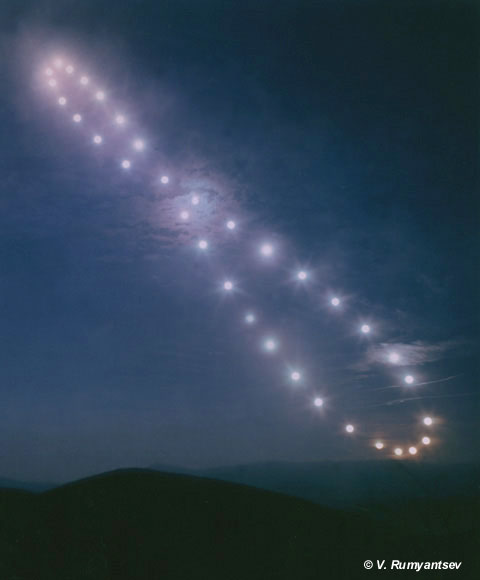
point on the globe (like the place I lived)... of course your Analemma,
as a chart, works pretty well to suggest these things as well, right?
As for the moon, the biggest trick is realizing that *it's* orbit is in
the plane of the earth's orbit around the sun (ecliptic) rather than
around the rotational axis of the earth. Thus the apparent east-west
motion during it's orbital period (Isomorphic to the earth around the
sun). I don't know if this works any better than a beachball, an
orange and a flashlight, but it worked for me.
- Steve
Steve,
Given your awareness of the sky you have probably noticed something
that remarkably few people have noticed. While they HAVE noticed that
the sunset/rise moves N and south along the horizon in spring and
fall, Few have noticed that the moon makes that same trip in a
month. Wise people have attempted to explain this with me using a
beachball, an orange a grape and a floodlight, but the explanation
still hasn't taken. Other wise people have tried to assure me that
rotating around something is precisely the same as being rotated
around, if you happen to be tilted. But I still can't make it work.
Nick

*From:*Friam [mailto:[email protected]] *On Behalf Of *Steve Smith
*Sent:* Thursday, December 20, 2012 1:19 PM
*To:* The Friday Morning Applied Complexity Coffee Group
*Subject:* Re: [FRIAM] Winter Solstice Sunrise

Nick -

Nice thing to notice...
My wife and I live very much by the sun, but not so much by the clock,
so while I have occasionally noticed artifacts of the complex relation
between sun, earth axial tilt, earth orbit, I had not (until you sent
this) recognized the implications so bluntly. I had always chalked
these anomolies up to the "flatness" of the top of the sine wave
without regard to the "tilt".
I often notice when my (active air) solar panels on my roof start and
stop which I take to be a rough measure of the altitude and azimuth of
the sun, based on time of day and year. It is also, unfortunately,
also a function of how clear the sky is, how cold the day is, how cold
the night before was, and how windy it is. I had never factored in
(intuitively or formally) the phenomena you just pointed out...
As a child, I remember being fascinated not only by the many wonderful
destinations around the globe, but also the annotations such as the
longitude and lattitude lines... the Analemma of course, was the most
puzzling. I did not learn trigonometry until much later but did see a
lissajous figure on an oscilliscope quite early, and assumed the two
had something in common (Lissajous and Analemma) and guessed it was
somehow the combination of the earth's orbit and tilt. I'm still
puzzling a bit about the lemniscate of bernoulli which might "just" be
what a lissajous becomes when working with an elliptical orbit?
Thanks for the early Christmas Present. One of my fields of play
(for pay) these days is with Planetaria which puts me in the position
of wanting/needing to be more familiar with items astronomical.
For some good first person synthetic experience at your desktop, I
recommend "Stellarium <http://www.stellarium.org/>". I'm working
with one of the (open source) developers who is trying to make it
Archaeologically accurate over millenia... currently it is only good
for a fraction of that. So if you want to see the position of the
stars on Jesus' birthday (or crucifixion), you might have to wait a
few more months to have it be accurate!
- Steve

    My favorite seasonal marker is December 7, when the AFTERNOONS
    start getting longer.  The MORNINGS don't start getting longer
    until January 4th or so.  On December 21 ... the solstice .... the
    mornings start getting longer faster than the afternoons continue
    to get shorter.  Since I am not a MORNING person, I celebrate
    December 7th as the first sign of spring.

    I assume that somebody on this list can explain why this is the
    case.  I used  to watch the sun set every afternoon from the
    corner chair at the old Ohori's and the setting sun does this odd
    little dance during the month of December.  If I  remember
    correctly, the plane of the setting sun sinks steadily until
    December 7th, and then remains pretty much the same through
    December.  But the sun arrives along its path later and later,
    thus prolonging the afternoon as December wears on.  I think it
    has to do with the analemma
    <http://apod.nasa.gov/apod/image/0207/analemma_vr_big.jpg>..

    It explains the feeling that you get shortly after Christmas that
    the afternoons are already a bit longer.  Actually, they are by then.

    Nick

    -----Original Message-----
    From: Friam [mailto:[email protected]] On Behalf Of glen
    e. p. ropella
    Sent: Thursday, December 20, 2012 10:18 AM
    To: Friam Friam
    Subject: [FRIAM] Winter Solstice Sunrise


http://www.nps.gov/chcu/planyourvisit/event-details.htm?eventID=521654-452862

    12/21/2012

    Location: Kin Kletso | Map

    Time: 7:00 AM to 7:30 AM

    Fee Information: Free with Paid $8 entrance fee Contact Name:
    Visitor Center Contact

    Email: e-mail us Contact

    Phone Number: 505-786-7014

    Join Ranger Cornucopia at Kin Kletso to view a winter solstice marker.

    Park gates will open at 6:00 am. Park at Pueblo del Arroyo and
    walk to Kin Kletso.  When the parking lot fills, visitors will
    park at Pueblo Bonito.

    --

    glen e. p. ropella, 971-255-2847, http://tempusdictum.com

    ============================================================

    FRIAM Applied Complexity Group listserv

    Meets Fridays 9a-11:30 at cafe at St. John's College

    to unsubscribe http://redfish.com/mailman/listinfo/friam_redfish.com


    ============================================================

    FRIAM Applied Complexity Group listserv

    Meets Fridays 9a-11:30 at cafe at St. John's College

    to unsubscribehttp://redfish.com/mailman/listinfo/friam_redfish.com


============================================================
FRIAM Applied Complexity Group listserv
Meets Fridays 9a-11:30 at cafe at St. John's College
to unsubscribe http://redfish.com/mailman/listinfo/friam_redfish.com
============================================================
FRIAM Applied Complexity Group listserv
Meets Fridays 9a-11:30 at cafe at St. John's College
to unsubscribe http://redfish.com/mailman/listinfo/friam_redfish.com