[email protected] wrote:
It is possible if we exclude 'global climate'.
I don't find any reason to do so.  Your examples indicate changes in proximity
to some area affecting that area, so it is only possible to assume that you
argue nothing but a matter of scale.  Are you claiming to have personally
proven that environmental changes can only have impact over a given distance -
say over a hundred miles but not over a thousand miles?  What do you base this
assumption on?
I base this assumption on inherent stability of climate and of
ecosystem. You must put the system on the verge of stability for it to
allow further propagation of local changes. It is related to 'stochastic
resonance'.
For example one ecosystem in north poland is on the verge of stability.
Grassy land, lower precipitations. There was sand mine on one place in
this area, so there is one place without grass. But dryness allow
instability to propagate, so area of sand grows slowly over the time. If
there were more precipitations, area of sand would be the same or nature
would take the sand area back.
The base assumption I read from your statements is that nature has some
"preferred" climate for the surface of the earth.  This would require more
proof - and short of a theistic argument beg more frank credulity - than any other
alternative.  Every evidence is that the surface of the earth is not the one particular
charmed natural artifact in the universe.  Gases and liquids and solids will interact
here in the same pseudo-random fashion they do anywhere, with whatever result physics
dictates and with no regard to what humans find survivable.
Basically, you are asking me to prove if earth's climate is stable (for
unspecified amount of time).
We know that weather is chaotic system. And that means average has no
same meaning as one would expect from data governed by gaussian
distribution. Weather has alpha-stable distribution. This means varince
is infinite, at least in theory. So, central limit theorem does not hold
=> you can't reduce variance by averaging the data. Stationarity of
series of data is questionable (at least at some moments, such as
starting points of ice ages). Measuring temperature extremes for every
day of the year provide more valuable data. Since we use solar calendar,
the measurements will sync to changes of solar irradiation naturally
(this is good, sun is main driver of weather and climate).
I'll find you some data for the temperature extremes, but I'm waiting
for download to finish.
The extremes in temperatures for each day are very useful in determining
climate type. The type is determined mostly by temperature and
precipitation ranges (you shoukd use plant types for determining it
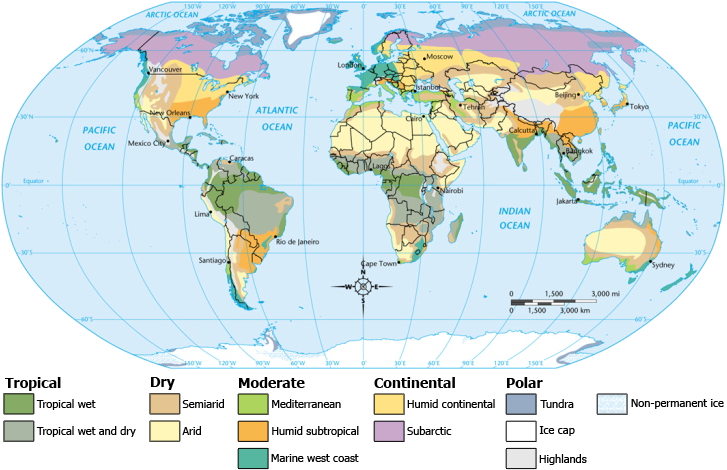
also). Actual map of earth climates:
http://upload.wikimedia.org/wikipedia/commons/d/df/ClimateMap_World.png
We know by historical measurements and records that climate zones shift
slightly over the time. For example climate in France, during medieval
warm period, must have been subtropical. There are historical tax
records on taxation in _oranges_.
We know that there are fast shifts in climate. Ice cores are suggesting
that ice ages happened from year to year. This means the system was on
the verge of stability globally. You need to take _a_lot_ of energy out
of system to do this. Only the sun can do this.
So, the climate behaves like any other chaotic system. Is is stable for
hundreds of years, then small change occurs. It is stable for tens of
thousands of years, then bigger change occurs.
But, speaking of 'greenhouse gases', human impact is minimal. I talked
on this with geologist and with ecologist. CO2 produced by
nature (mostly by volcanos) is about two ordes of magnitude higher
than quantity produced by human. So, if anyone want to impact
levels of CO2, he should ban volcanos. :-) And situation on methane is
similar.
So, it is a matter of scale you are arguing, not a matter of capacity?  If
mankind upped the output of carbon and became (by your numbers) only a single
order of magnitude less than all natural inputs then it would possibly make a
difference?  Equal to all natural inputs?  Double?  The global climate might be
changed by human effort if we arranged for a large enough rock to fall to earth?
AFAIK temperature is dependent, beyond other factors, on logarithm of
CO2 concentration. The most significant factor in temperature changes is
water. If you calculate difference of energy from sun with radiated
energy, Earth should have average temperature about -2 degrees of
celsius (28 F). Higher temperature is archieved by atmospheric
temperature mirrors, which won't work without water.
So, it would matter if human increase CO2 output say twenty times. It
would cause temperature change you can measure even from satellites (0.1C).
Humans can change climate globally, but there is just one way available
to human now: to blow up the oceans. If you use nuke in the ocean and
the nuke is big enough, you can dissociate the water the way
dissociation will keep spreading through all the water it has direct
contact to. But I'm quite sure after this event there will be noone to
confirm the climate change.
There are sporadically happening events that cause change
of climates globally. But I think this is not standard situation.
This is definitely the standard situation.  The climate began with a heavy rain
of rocks and moons, settled into a few billion years of poisonous (by our
standards) gases, is in a brief hiatus of 21% oxygen and 78% nitrogen and will
end as the outer shell of a dying red giant star.  At any given moment along
the way the climate may be called upon to process the mass and energy of a
passing comet, which has measurable impact on every cubic inch of the global
biosphere every time it happens.
You are reinterpreting it on very different timescale.
So you can measure global area represented by different
climates, but averaging temperature over the areas (or globally) is
quackery. Average global temperature has no meaning.
During the Snowball Earth stage the averaged temperature was below 0C and this
did in fact result in no place being above 0C, the Cretaceous hothouse (again,
relative to today) resulted in an average ocean-bottom temperature about 10C
greater than it is today (where the average is about 4C) and a complete lack of
icecaps.  This did in fact affect climates everywhere on the earth.
There is difficulty in measuring temperature of water in chalky period.
Is is measured by isotopes in plankton. But there is wide range of
depths in which plankton can live. So, the scientists don't know the
depth where the measurement is actually taken. And iceball earth
hypothesis is a weird one. AFAIK it only tries to explain some deposits
in tropical areas, which are supposed to be of glacial origin. There is
one difficulty with this hypothesis. Once the Earth has frozen
completely, high albedo of the surface will reflect more energy back to
the space. It is stable state which is very difficult to leave. It
requires so much energy to melt the ice that this state is considered
impossible to leave when reached.
I believe that if icecaps are melted, almost all temperature averages
you can construct will show you bigger average than today. I didn't
study craceous period much. What makes you think icecaps were melted for
real?
I assume it has some importance in politics, such as
environmentalism, because it is scalar and can be
presented in scary graphs.
"Just because two people disagree does not prove that either is correct."

The misuse of data does not prove that the data in question does not exist.
Whether some people have political motivations to show that Humans Are Bad And
Stupid (that, I believe, you and I agree some do) is immaterial to the question
of whether humans are capable of - and in fact potentially accomplishing -
global environmental change.  Regardless of political leanings it is possible
to make some basic logical conclusions (i.e. if we infinitely double our carbon
output it will at some point matter) and make some irrefutable empirical
measurements (i.e. that particulate matter from Chinese coal-fired power plants
is increasingly thick in Californian air).
I agree. (excluding doubling of CO2 levels, which would matter only if
climate system on the whole earth was on the edge of instability :-)
Whether or not the human-induced increase in atmospheric carbon is sufficient
to cause temperature shifts at this or another given point - and whether this
is even a good or bad thing - are more finely-tuned questions than most of the
tabloid-level public debate touches on.  But it is certainly possible to
determine whether the earth has a static climate that is impervious to any
action by man or nature, and it most certainly is not.
Earth climate changes is definitely caused by natural causes. There are
well-known Milankovitch cycles:
http://en.wikipedia.org/wiki/Milankovitch_cycles
Human has not yet enough knowledge and energy sources to change climate
globally. Excluding blowing up ocean mentioned above of course.
--
Martin Tomasek

"Those who sacrifice liberty for security deserve neither." --Benjamin Franklin
_______________________________________________
Fun and Misc security discussion for OT posts.
https://linuxbox.org/cgi-bin/mailman/listinfo/funsec
Note: funsec is a public and open mailing list.