I must say that I find this argument below quite convincing and it fills in
what for me was a missing link between the real economic world (and the
current crisis) and the world of peak/easy oil/resources etc.

M

-----Original Message-----
From: [email protected]
[mailto:[email protected]] On Behalf Of Ryan
Sent: Sunday, May 30, 2010 8:27 AM
To: Peer-To-Peer Research List
Subject: [p2p-research] Gulf Oil Spill: With so many oil resources,can't we
just drill somewhere else?
Sent to you by Ryan via Google Reader:


Gulf Oil  <http://feedproxy.google.com/~r/theoildrum/~3/NKXjJ8Dt-OM/6517>
Spill: With so many oil resources, can't we just drill somewhere else?

via The Oil Drum - Discussions about  <http://www.theoildrum.com/frontpage>
Energy and Our Future by Gail the Actuary on 5/29/10


This post is an adaptation of one posted in December 2009, relating to a
talk given at that time. A PDF of the talk can be found here
<http://www.theoildrum.com/files/We%20have%20lots%20of%20oil%20but%20.%20.%2
0..pdf> .

There is a huge amount of oil which theoretically can be extracted. The
question isn't whether it is there--the question is whether the cost to
extract the oil will be cheap enough for us to be able to afford the oil. If
oil is too expensive, the high prices seem to cause a recession, similar to
what we recently have been experiencing.


<http://www.theoildrum.com/files/A%20huge%20amount%20of%20oil%20is%20availab
le%20rev.png>

In many ways, people who say we have lots of oil are correct. All one has to
do is include the oil which is extremely expensive and slow to extract. Much
of the cheap, easy-to-extract oil has already been removed.


<http://www.theoildrum.com/files/Theory%20says%20oil%20prices%20can%20rise.p
ng>

Economic theory talks about oil prices rising, and substitutes being found,
which will tend to bring prices back down. When oil prices rose, we found
substitutes, but they were poor substitutes-- generally more expensive, and
hard to scale up. Corn ethanol requires huge land use and imported
fertilizers. Wind isn't a transportation fuel--it is a substitute for
natural gas and coal in electricity production. Making sufficient electric
cars and trucks to replace our current fleet would be a huge expensive
project, requiring many years, at best.

In the above slide, I purposely exaggerated the impact of an oil price rise
on food and gasoline. The effect would be greatest on a low income
individual. It would also be very great, if the price rise were to something
like $400 barrel.


<http://www.theoildrum.com/files/If%20oil%20prices%20rise,%20something%20has
%20to%20give.png>

This is pretty obvious, if you think about it. Does it sound like anything
we have run into in the last few years?


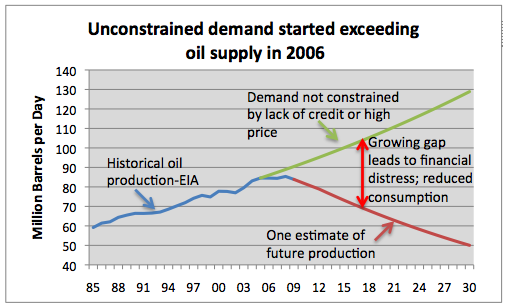
 <http://www.theoildrum.com/files/Unconstrained%20demand.png>

Many people think of the effects of peak oil as a future event. But we are
really experiencing them here and now. Oil production stopped rising in
2005, so by 2006, we were feeling the effects of the squeeze. The effects
were being felt as early as 2004, when oil prices began to rise.


<http://www.theoildrum.com/files/1%20Oil%20production%20rises%20then%20decli
nes.png>

The US was the earliest place where drilling for oil, and the earliest place
where production began to decline, in spite of technological improvements
and increased drilling. But fortunately, when oil begin declining in 1970
there were other places that were not too hard to reach.


<http://www.theoildrum.com/files/2_Alaska%20oil%20production%20rise%20and%20
decline.png>

After the US 48 states production began to decline, production was ramped up
in a number of places, including Alaska, shown here. It production began to
decline only a few years later.


<http://www.theoildrum.com/files/3_North%20Sea%20Oil%20Production%20decline.
png>

The North Sea was another place where production was ramped up after US
production began to decline. It too began to decline rather quickly. I
didn't show Mexico, but it was another nearby location that was ramped up,
but then began to decline, after US 48 states production began to decline.


<http://www.theoildrum.com/files/Now%20the%20easy%20oil%20is%20mostly%20gone
.png>

At this point, most of the fields that are in easy to access locations are
in decline, and we are "stuck" with what is left--the slow to extract,
expensive oil from difficult locations. Deep water oil is one of the kinds
of oil we have left, but it is expensive to extract, and, as we have just
seen, if there are oil spills, they can be very difficult to stop.


<http://www.theoildrum.com/files/Many%20people%20thought%20the%20problem%20d
isappeared.png>

So many people have equated high prices with oil shortages, that people have
come to believe that if prices are low (or at least relatively low, compared
to recent past prices), everything is OK. But we really need lots of quite
inexpensive oil to fuel the economy, or it goes into a recession. Reduced
credit reduces demand, and has the effect of bringing oil prices down.


<http://www.theoildrum.com/files/Incomes%20couldn't%20stand%20higher%20oil%2
0prices.png>

In the above slide, the cutback in credit is especially important. Without
credit, many people cannot buy new cars, new houses, or expensive Christmas
presents. All of these use oil in their manufacture and distribution, and
keep oil prices up.


 <http://www.theoildrum.com/files/US%20Consumer%20Credit%20peaked.png>

US consumer credit (including things like credit card loans and auto loans)
peaked the same month as oil prices. Mortgage loans peaked about the same
time, and many types of commercial credit have been affected. The government
has tried to pick up the slack with additional borrowing, but this is not
the same.


 <http://www.theoildrum.com/files/EIA%20view%20of%20energy%20costs.png>

The EIA indicates that on a constant dollar basis, energy expenditures more
than doubled between 1990 and 2008. Going forward, the EIA sees more
increases in energy expenditures, on an inflation adjusted basis.

I might mention that one of the major uses of new technology is to bring
down prices. There are limits to what can be done--if oil is very deep in
the ocean, it is likely never going to be cheap to extract. The need for new
technology to bring down prices is probably as great or greater with fossil
fuels as it is with things like wind, solar, and biofuels. Fossil fuels are
at least well adapted to running our current infrastructure. Anything that
is very different will require huge expenditures for conversion.


 <http://www.theoildrum.com/files/Where%20do%20we%20go%20from%20here.png>

In my view, the big question is how debt (and financial institutions holding
the debt) will fare. The front page story on today's Atlanta Journal
Constitution is "Troubled banks find it hard to stay afloat". How long will
bailing out failing banks with printed money work?


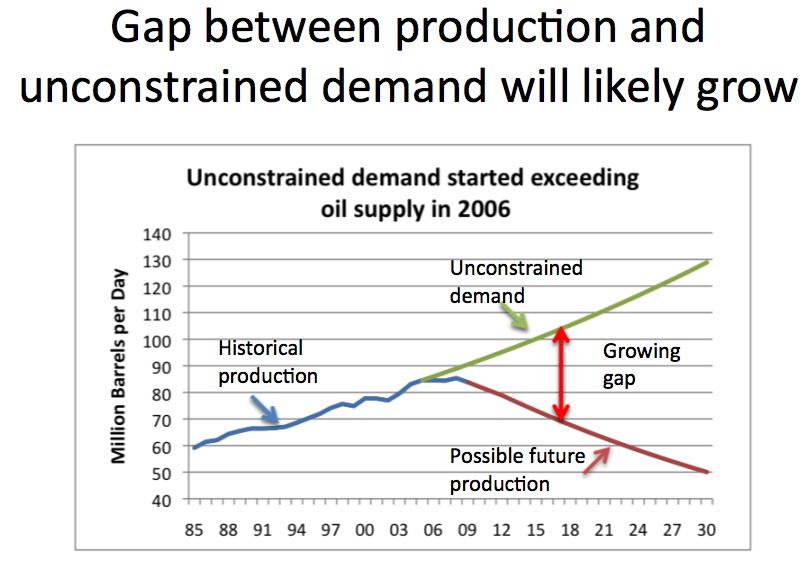
 <http://www.theoildrum.com/files/Gap%20will%20likely%20grow.png>

The growing gap is the concern. Regardless of whether oil production remains
flat, or declines fairly steeply, we have a major problem. With many people
from around the world interested in using oil products, and many new cars in
places like China and India, the gap between production and what we would
normally consume (if prices were low and credit were available) is likely to
continue to grow, even if somehow oil production could be kept flat. If we
intentionally decrease deep water drilling, it will tend to make the gap
worse.


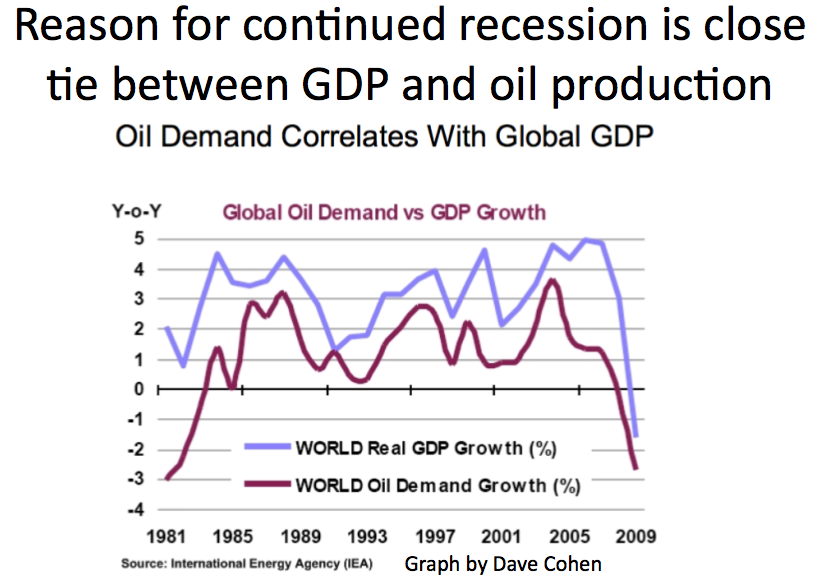
<http://www.theoildrum.com/files/Lower%20oil%20production%20lead%20to%20rece
ssion.png>

The advanced economies have in the recent past been able to "offshore" their
energy intensive industries to places like China, giving the illusion that
countries can get along with only non-energy intensive services like
finance. But for the world as a whole, there seems to be a close
relationship between growth in oil consumption and GDP growth. Since finance
and some other services don't need much oil to grow, the relationship is not
exactly 1:1. Efficiency growth would also tend to make GDP growth higher
(but declining energy return on investment would tend to lower it).


 <http://www.theoildrum.com/files/Reason%20for%20continued%20recession.png>

My big concern is international trade. If debt defaults are a problem, this
could interfere with the workings of the whole system, especially if it
leads to major countries (perhaps Greece) defaulting on their debts.


<http://www.theoildrum.com/files/World%20population%20has%20grown%20greatly.
png>

In the years since fossil fuel use has developed, world population has
greatly expanded.


 <http://www.theoildrum.com/files/One%20concern%20is%20food.png>

We are already seeing problems with people in some of the poorer nations
having adequate food. Even in the US, there are people at the margins who
are "food insecure". Currently, there are government programs to help, but
states are finding it increasingly necessary to cut back, because of falling
tax revenue.


<http://www.theoildrum.com/files/No%20one%20telling%20us%20about%20our%20pre
dcament.png>

It would be a lot easier to get politicians to talk about the situation if
there were a good solution in sight. There are some partial mitigations, but
they likely don't get us back to "business as usual". Voters are likely to
be very unreceptive to such news.

We are in the midst of a predicament, even if we continue to ramp up deep
water oil from the Gulf of Mexico. If there is less oil from the Gulf of
Mexico, it will make our predicament even worse.

The world doesn't really have many more good, cheap places to drill any
more. Any place we do drill, requires substantial capital investment and
long lead times. Much of the remaining oil is in solid form, like the oil
sands, and oil shale. Such resources will be very slow to extract, so it is
very difficult to ramp them up, even if we decided we wanted to. There may
be other limiting resources as well, such as water, meaning that this
obstacle needs to be overcome as well. So there are no easy substitutes for
oil from the Gulf of Mexico.


<http://feeds.feedburner.com/~ff/theoildrum?a=NKXjJ8Dt-OM:EkSOXscoHy0:V_sGLi
PBpWU>
<http://feeds.feedburner.com/~ff/theoildrum?a=NKXjJ8Dt-OM:EkSOXscoHy0:F7zBnM
yn0Lo>
<http://feeds.feedburner.com/~ff/theoildrum?a=NKXjJ8Dt-OM:EkSOXscoHy0:dnMXMw
OfBR0>
<http://feeds.feedburner.com/~ff/theoildrum?a=NKXjJ8Dt-OM:EkSOXscoHy0:gIN9vF
wOqvQ>
  <http://feeds.feedburner.com/~r/theoildrum/~4/NKXjJ8Dt-OM>


Things you can do from here:


*       Subscribe
<http://www.google.com/reader/view/feed%2Fhttp%3A%2F%2Ffeeds.feedburner.com%
2Ftheoildrum?source=email> to The Oil Drum - Discussions about Energy and
Our Future using Google Reader

*       Get started using  <http://www.google.com/reader/?source=email>
Google Reader to easily keep up with all your favorite sites
_______________________________________________
Futurework mailing list
[email protected]
https://lists.uwaterloo.ca/mailman/listinfo/futurework