Not sure if this is sound reporting, but it /sounds/ promising, found in
Sam Smith's Review:
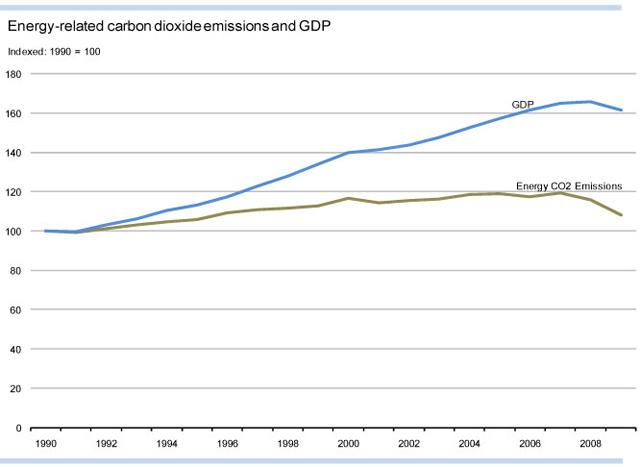
     **U.S. CARBON EMMISSIONS DROP 7% IN A YEAR

<http://arstechnica.com/science/news/2010/05/us-carbon-emissions-plunge-faster-than-the-economy.ars?utm_source=rss&utm_medium=rss&utm_campaign=rss>
     **
*
<http://1.bp.blogspot.com/_8CPSxdTVmEU/TBZri_01vvI/AAAAAAAABhs/a7zrKhRSQ58/s1600/1006CARBON.JPG>*
*Ars Technica - *The Department of Energy has run the numbers on US
carbon emissions in 2009, and found they dropped by about seven percent
compared to the previous year, the largest decline the agency has ever
seen. Although the economic downturn had been expected to lower
emissions, the slowdown in GDP only accounted for about a third of the
change. Greater efficiencies, less-energy-intensive activities, and a
shift away from coal use accounted for the rest. The numbers haven't
been this low since the mid-1990s and, even adjusting for the economy,
take us a substantial distance towards President Obama's goal of cutting
emissions to 17 percent below 2005 levels by the end of the decade.
For 2009, the report ascribes the large decline in emissions to three
factors that had roughly equivalent impacts: the decline in the GDP, a
less energy-intensive economy, and a less carbon-intensive energy
supply. The first of those factors isn't especially interesting, so
we'll look at the latter two.
Residential and commercial energy use have remained pretty flat for the
last three years, but transportation started a gradual decline in energy
consumption in 2007. Although 2008 saw a huge decline in driving due to
fuel prices, the cost of fuel dropped in 2009. As one might expect,
total miles traveled rose, although only by a small fraction of a
percent. Nevertheless, total fuel consumption was down from 2008 for
every month of the year, spurred in part by an increase of 1.5mpg in the
average fleet fuel economy. Given that the fuel economy is set to rise
rapidly through 2016, this sector is likely to continue to improve.
But the big change in the energy intensity (energy burned per unit of
GDP) came from the industrial sector, which has been declining since
2004. The report ascribes this to the rapid growth of the electronics
industry, which is less energy intensive than industries like the
production of primary metals, and therefore has a lower carbon
intensity. A growth in the service economy also contributed. The
industrial sector is still the largest consumer of energy in the US,
with transportation now a close second.
The electric power sector became greener still, seeing a drop in carbon
intensity of four percent (compared to about three percent for
industrial). In fact, the drop in carbon emissions from the electric
sector accounted for over half of the total national decline. The
biggest contributor here was the fall in coal use, which went down by
several percent. That was offset by increases in natural gas,
renewables, and nuclear power.
_______________________________________________
Futurework mailing list
[email protected]
https://lists.uwaterloo.ca/mailman/listinfo/futurework