https://asiapacificreport.nz/2019/08/23/indonesian-journalists-bought-broken-and-soul-searching-says-author/
Indonesian journalists ‘bought, broken and soul searching’, says researcher

By *Michael Andrew* <https://asiapacificreport.nz/author/michael-andrew/> -

August 23, 2019

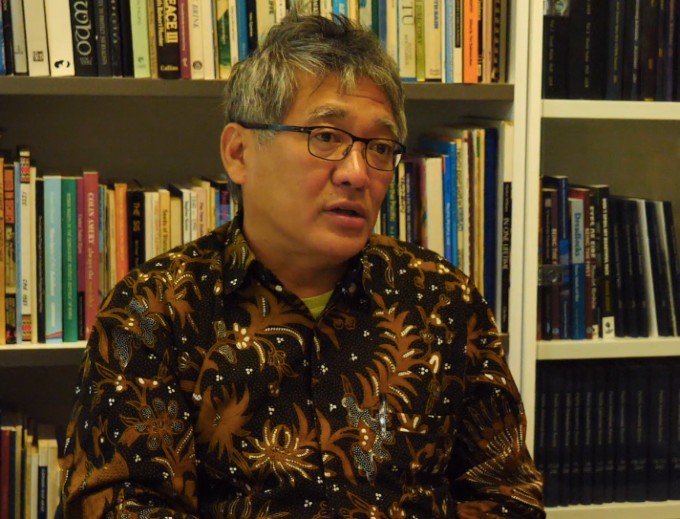
<https://asiapacificreport.nz/wp-content/uploads/2019/08/Screen-Shot-2019-08-23-at-10.15.51-pm.jpg>Andreas
Harsono ... “I believe if I am a journalist, I go out from my house and I
leave behind my background, my religion, my nationality, my ethnic
background, social status at home." Image: Michael Andrew/PMC

*By Michael Andrew*

The Indonesian media is contributing to resentment and racism toward
Papuans, according to a human rights researcher and former journalist.

Andreas Harsono of *Human Rights Watch Jakarta*
<https://www.hrw.org/about/people/andreas-harsono> told *Pacific Media
Watch* many Indonesian journalists either view Papuans as enemy
“separatists” or deviants and their reporting tends to convey these
stereotypes.

Papuan anger has erupted in widespread riots and rallies
<https://asiapacificreport.nz/2019/08/22/west-papua-riots-why-indonesia-needs-to-answer-for-its-broken-promises/>
across
Indonesia over the last week, after a militia attacked West Papuan students
in Surabaya, pelting them with stones and calling them “monkeys”
<https://pmc.aut.ac.nz/articles/indonesian-racism-towards-papuans-and-its-implications-free-west-papua-movement-5038>
..

*READ MORE:* Indonesia’s political system has failed its minorities – like
West Papuans, says author
<https://asiapacificreport.nz/2019/04/16/indonesias-political-system-has-failed-minorities-like-papua-says-author/>

Harsono, who is in New Zealand promoting his latest book *Race, Islam and
Power <https://publishing.monash.edu/books/rip-9781925835090.html>**, *says
the manner in which the media reported the attacks created further
anti-Papuan resentment which in turn sparked a backlash from the West
Papuans themselves.
<https://asiapacificreport.nz/2019/08/19/racist-attack-on-papuan-students-in-surabaya-sparks-rioting-in-manokwari/>

“The attack was reported by the media, videoed by the media, but it raised
anger back home, now almost 30 cities are having rallies protesting against
the use of the word monkey for this Papuan people.”

Part of the problem, he says, is that many journalists are working for
military or intelligence agencies and are therefore writing to a specific
agenda.

“Another bad thing that Indonesian journalists in West Papua usually do is
that many of them are collaborating with Indonesian military or Indonesian
police, some of them are even on the payroll of the intelligence service.”

According to Harsono, a 2010 leaked report revealed that 600 people were
informing for the military and at least 200 were journalists.

“Some of them are agents on the payroll, some of them informers; they are
kind of freelancers who provide information to the military.

“Also, it is quite common for intelligence officers to be stationed inside
newsrooms, either in Jayapura or Manokwari.”

Harsono wrote about a case in which a police officer had been placed under
cover inside the *Jubi*newsroom in Jayapura. Editors discovered his
identity when they saw on his computer messages detailing the editorial
meetings that he had sent to the local police headquarters.
*Michael Andrew’s video report on Andreas Harsono at the Pacific Media
Centre. Video: PMC*

*‘**Broken journalists’*
But newsrooms have also been compromised in other ways. While there are
journalists who have tried to report fairly and objectively, Harsono says
many have been “broken” through intimidation and attack.

“I have seen many journalists, Indonesian and Papuan whose spirits are
broken in Papua because of intimidation, because of being stabbed, the
police did not investigate it, they have been beaten or been arrested
<https://asiapacificreport.nz/2019/08/07/indonesian-police-not-investigating-violence-against-journalists/>,
or sexually harassed for female journalists.

“So that is another category; those that are already broken, they dare not
to do independent reporting.”

*‘**Soul searching’*
However, he says there are some newsrooms which are doing some “soul
searching” and re-evaluating the way they’ve historically reported West
Papua.

“They say that we did wrong over the last 50 years to look at Papua so
black and white. They are starting to be professional as journalists and at
least cover both sides if not all sides.”

Unlike much of the Indonesian media, these journalists are choosing to view
the world around them through the unbiased, balanced tenets of free
journalism rather than through a lens of dogmatic religion.

Harsono says this distinction is key to improving the quality of journalism
and stemming the gradual erosion of Indonesia’s democracy.

*Faith and profession*
However, it remains one the media’s greatest challenges as many journalists
– most of whom are Muslim –  struggle to differentiate between their faith
and their profession.

“They tend to see others from their Sunni Islam perspective and those who
in their view are not aligned with the Indonesian Ulama Council might be
seen as blasphemous or deviants.”

He says this is particularly telling when reporting on West Papua, a place
with an entirely different culture and set of customs that those of Islam,
such as the eating of pork and women going bare-chested.

Harsono says it is crucial that journalists do not let their background or
identity create bias and “pollute” the principals of unbiased journalism.

“I believe if I am a journalist, I go out from my house and I leave behind
my background, my religion my nationality, my ethnic background, my social
status. I’m going out there in the field reporting, interviewing, doing
research as a professional journalist.”

*Ongoing protests*
Unfortunately, the media has not helped calm the current Papuan protests in
Indonensia as people continue to rally across the archipelago, he says.

According to *The Guardian*
<https://www.theguardian.com/world/2019/aug/22/west-papua-protests-indonesia-deploys-1000-soldiers-to-quell-unrest>,
more than 1000 military have been dispatched to West Papuan cities to quell
the demonstrations while internet has been cut off from parts of the region
to prevent the unrest spreading.

Chairman of Indonesia’s Alliance of Independent Journalists Abdul Manan and
Amnesty International Indonesia’s executive director Usman Hamid have
condemned the internet block saying that it will prevent journalists from
reporting on events and stop Papuans from sharing evidence of human rights
abuses, reports Reuters.
<https://uk.reuters.com/article/uk-indonesia-papua/indonesian-police-kill-separatist-in-papua-idUKKCN1VD0IW?il=0>

The violence has already resulted in casualties with a Papuan demonstrator
shot dead
<https://uk.reuters.com/article/uk-indonesia-papua/indonesian-police-kill-separatist-in-papua-idUKKCN1VD0IW?il=0>
in
a gunfight in the town of Wamena. Another man and a police officer were
also injured.

In the Papuan towns of Jayapura, Timika, Sarong and Fakfak police
reportedly used tear gas and fired warning shots to clear crowds after they
set fire to a market and destroyed ATMs and shops. Local media report 45
people were arrested, reports *The Guardian.*
<https://www.theguardian.com/world/2019/aug/22/west-papua-protests-indonesia-deploys-1000-soldiers-to-quell-unrest>

President Joko Widodo’s plea
<https://asiapacificreport.nz/2019/08/21/papuan-protest-against-racism-and-hatred-continues/>
for
Papuans to be patient and forgive the racism has done little to appease
demonstrators who are demanding an end to oppression.

According to Indonesian news service Pojok Satu
<https://pojoksatu.id/news/berita-nasional/2019/08/20/kontras-salahkan-pernyataan-jokowi-soal-papua/>,
the coordinator of the Commission for Missing Persons and Victims of
Violencer (Kontras), Yati Andriyani has lambasted Jokowi’s efforts as
“totally inadequate” and demanded that the President apologise for the
racism and abuse Papuans have suffered.

Meanwhile, protests have spread to the Indonesian capital Jakarta, where
the West Papuan flag for independence – the *Morning Star* – has been
raised at a rally in front of the presidential palace, *reports CNN
Indonesia*
<https://www.cnnindonesia.com/nasional/20190822134936-20-423738/bintang-kejora-dikibarkan-saat-demo-papua-di-depan-istana>
..

The small flag was flown as demonstrators were dancing and singing a song
with lyrics demanding Papuan independence.

   -

   *Reports from Pojok Satu and **CNN Indonesia

<https://www.cnnindonesia.com/nasional/20190822134936-20-423738/bintang-kejora-dikibarkan-saat-demo-papua-di-depan-istana>**
are
   based on translations by James Balowski of the **Indoleft News Service
   <https://www.indoleft.org/>*