Abdulhaq,

Great examples.
http://kprayertime.sourceforge.net/calligraphy/tanween-dammataan-iqlaab.png
Note that the iqlaab marker is in addition to the normal dammataan

TM This is food for thought. It visualizes how I propose tamweem to be
encoded throughout: damma damma small-meem. The observed difference in
rendering vis-a-vis the Arabic Qur'an can best be handled in the rendering
domain. This means that Indian codices need Indian Naskh fonts.

http://kprayertime.sourceforge.net/calligraphy/ulaaika.png
No ØÙØÙØ over the ÙØÙ

TM This is not an encoding issue: the /calaamÃ/ is simply absent. In fact it
is not used in most codices.

http://kprayertime.sourceforge.net/calligraphy/tanween-idghaam-yaa.png
Nothing different about the tanween (unlike the arabic mashaf) and a waaw
over the yaa's and (waaws) for the idghaam

TM This is not a real encoding issue: Unicode could deal with it if we
encode idghaam and iqlaab separately. That way the common text elements
remain identically encoded. In this example the idghaam code is simply
absent.

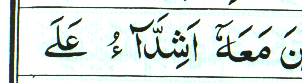
http://kprayertime.sourceforge.net/calligraphy/long-madd-reverse-waw.png

TM The inverted damma most likely indicates the lengthening of the
pronominal suffix third person caused by the preceding short syllable
(/macahu/ to /macahuu/). Since the next word begins with a hamz or glottal
stop, a "cautionary madda" is placed over it as a rule: every long vowel
that precedes any hamz gets a cautionary madda.

Regards,

t

_______________________________________________
General mailing list
[EMAIL PROTECTED]
http://lists.arabeyes.org/mailman/listinfo/general