![Ship tracks in the Bay of Biscay]()
- Ship tracks in the Bay of Biscay
Yesterday Dan Lack of NOAA gave a talk to the NCAR
media fellows about his work on pollution
from shipping, and told us something I found pretty flabbergasting.
Last year the International Maritime Organisation, as part of a number
of measures aimed at air pollution, decided to do something about the
sulphur emissions from shipping by reducing
the amount of sulphur dioxide permissible from 4.5% today to 0.5% in
2020. This would have great benefits; sulphate pollution, and
associated particulate matter, cause significant health problems.
According to a new paper in Environmental Science and Technology
by Winebrake et al,
if in 2012 the world’s shipping complied with this requirement, the
associated sulphate pollution would cause 46,000 premature deaths; if
that shipping used today’s higher sulphur fuels the death toll would be
87,000.
However, sulphur emissions from shipping have another effect:
the sulphate aerosols that form from the gas make the oceans cooler by
increasing the cloud cover above them, as the image at the top of this
post shows. The effect is large enough that shipping cools the planet
through sulphate aerosols much more than it warms the planet through
greenhouse gas emissions. In a companion paper in Environmental
Science and Technology, this time with modeller Axel
Lauer as first author, the same team
looks at this effect. Using the same 2012 scenarios they used for
the health figures the researchers find that the cooling effect using
fuel like today’s, expressed in terms of radiative
forcing, is about 0.57 watts per square metre. The cooling effect
if everyone uses the new low sulphur fuels is 0.27 W/m². That means a
difference of 0.3 W/m² — which is to say that that’s the amount of
warming that switching to low-sulphur fuels would produce.
![]()
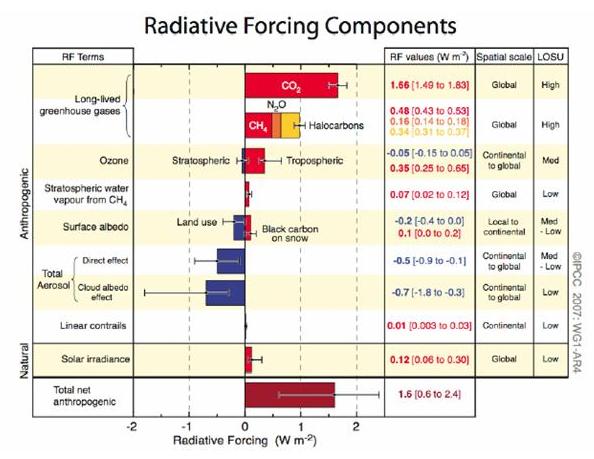
What does a radiative forcing of 0.3 W/m² mean? Here’s a chart
from the IPCC showing the radiative forcings associated with all human
climate-changing activities as of today. The total (with biggish error
bars) is 1.6 W/m², which shows straight off that 0.3 is quite a lot. It
is, for example, twice the amount of forcing as is due to N2O, 60% of
the forcing due to methane, and the same as the amount due to
halocarbons (HFCs). A huge amount of money is currently being spent on
the HFC problem.
Put another way (and I calculated these numbers myself, so
please check and correct if you have the necessary skills) 0.3 W/m² is
the radiative forcing you would expect if you dumped 47.5 billion
tonnes of carbon (in the form of carbon dioxide) into the atmosphere,
raising the concentration of CO2 from today’s 387 parts per million to
409 parts per million. That’s well over a decade’s worth of carbon
emissions and an enormous amount of warming for the IMO to have
committed the world to with no-one, as far as I can see, paying very
much attention. (The most obvious environmental response to the IMO
changes, from the Clean Air Task Force, was to applaud the health
effects of the cuts in sulphur while deploring
the lack of action on greenhouse gases and not mentioning the
cooling issues at all. If you accept Dan Lack’s figure of just 0.06
W/m² for the total warming from shipping, that seems an odd omission.)
Now there are obviously complexities and caveats. This is just
one modelling study — but its figures for the amount of cooling due to
sulphur fit with those quoted by of others, such as Dan Lack. Taken at
face value it would imply both that the total cooling effect of sulphur
on clouds was probably greater than the IPCC best guess, and that
sulphate from shipping was responsible for a disproportionate amount of
it. But the IPCC’s guess has big error bars, and you would indeed
expect sulphate from ships to be peculiarly effective — it gets sprayed
into places where the clouds are very susceptible to such things. (This
is the effect that John Latham’s geoengineering
scheme based on cloud brightening seeks to emulate). The papers
compare effects for 2012 not 2020, which is when the regulations will
call for al fuel to be low sulphur, but does anyone expect less
shipping in 2020 than 2012?
So is this a matter of balancing 40,000 lives a year against a
decade of global warming? Not necessarily. There is another sulphate
reduction option: burn low-sulphur fuels when close to land, and
ordinary fuels when far off. There are already some areas where ships
have to use low sulphur fuels, and they could be extended to all the
places where the sulphate is likely to do its greatest harm. In further
scenarios the authors of the two papers looked at a world of 2012 in
which ships’ sulphur was reduced to 0.5% or even 0.1% when within 200
nautical miles of land, but left unchanged in mid voyage. In terms of
fatalities the 0.1% in coastal waters is slightly better than 0.5% all
over the place (44,000 deaths), 0.5% in coastal waters is slightly
worse. In terms of cooling these two options are lower than business as
usual but higher than a global reduction to 0.5% — their forcing is
0.45-0.48 W/m².
Low-sulphur fuels in coastal areas could lessen the warming
associated with a global sulphur reduction and still save as many
lives — or more. They would impose other costs, though. Getting sulphur
out of fuel costs money, and this might make getting down from 0.5% to
0.1% an issue. Ships would have to carry two different types of fuel,
which is also problematic, though not impossible. And going low-sulphur
still deprives the world of a lot of cooling, even if the regulations
only apply in coastal waters. That’s largely because most shipping is
coastal. (This suggests that forcing ships to take longer, less coastal
routes — to put out straight to sea where possible, and spend more time
further from land — might be an option. Again it has costs.)
Beyond preferring coastal controls to global controls I have no
real policy case to make here. I’m aware that there is in general a
trade off between air quality reasons for reducing sulphates and the
possibility that their cooling effects can be climatically helpful. But
the fact that this measure involves reducing sulphur emissions in
places where they do no harm (the mid oceans) and where their cooling
effects are greatly enhanced (by the presence of low clouds they can
brighten) makes the question particularly pointed. I have no way to
balance the advantages of reduced global warming against the advantages
of decreased mortality. I don’t know who has. But I do think that it’s
kind of extraordinary a regulatory change with this much effect on
global warming could be made with so little apparent fuss.
And I also think this all makes the case for experiments with
Latham-type techniques that brighten clouds to cool the seas even
stronger than it already is. If, for good reason, we are actively
reducing the amount of cooling provided by shipping, surely we should
at least look at possible ways of putting it back?
Citations
“Mitigating the Health Impacts of Pollution from Oceangoing
Shipping: An Assessment of Low-Sulfur Fuel Mandates”, Winebrake, J. J. et
al, Environ. Sci. Technol., 2009, 43
(13), pp 4776–4782
DOI: 10.1021/es803224q
“Assessment of Near-Future Policy Instruments for Oceangoing
Shipping: Impact on Atmospheric Aerosol Burdens and the Earth’s
Radiation Budget” Lauer, Axel et al, Environ. Sci. Technol.,
2009, 43 (13), pp 5592–5598
DOI: 10.1021/es900922h