Hi all,

Albert says: "Geoengineers have very little time to act as the melting in
the Arctic continues to escalate beyond all of the conventional projections."
I believe geoengineering is both urgent and vital.
The sea ice may or may not reach a new record minimum this September, but
look at the volume trend [1].  The anomaly is calculated with respect to
average extents for different times of year.  "The model mean annual cycle
of sea ice volume over this period [used for the calculation of anomaly]
ranges from 28,700 km3 in April to 12,300 km3 in September."  But the
anomaly this September could be around 10,000 km3 plus/minus 2000 km3 so
their model suggests we are extraordinarily close to zero ice volume -
extremely thin ice over the whole Arctic Ocean.  We can expect a
near-ice-free ocean at end summer within a few years.

We must not lose the sea ice because of its major contribution to the
"albedo flip" effect which could reach ~30 Watts/square metre (annually
averaged) over much of the Arctic [2].

Of course, there are people with strong vested interests in losing the
Arctic sea ice, but do these people realise that the sea ice is protecting
humanity against both multimetre sea level rise and catastrophic methane
excursion?  Calculations show how Arctic conditions could allow a major
excursion of methane to cause runaway global warming within a few decades
without intervention.  I reckon we face a stark choice: rapid "emergency"
geoengineering and a life for our kids, or a future with more fuel resources
but nobody around to use them.  Anybody prove me wrong?

BTW, the Arctic methane workshop, London 15-16th October, may identify means
to stifle some methane emissions at source, but if the Arctic continues to
warm without check, it will probably be a losing battle.

John

[1]
http://psc.apl.washington.edu/wordpress/research/projects/arctic-sea-ice-volume-anomaly/

[2]
http://www.mail-archive.com/[email protected]/msg03696.html

[quote]

When Jeff Ridley did the calculation of the [global] forcing effect of
albedo change, with just with disappearance of sea ice, he came up with 0.48
W/m-2.  But he was taking an effective albedo change of 0.23 which seems
very small to me.  And this is without taking into account the added albedo
change when snow on land melts - over a massive area in Siberia and Canada.
I believe we have had this additional forcing this year [writing in June
2010].  Of course the local forcing is going to be much greater than the
global forcing - so where it occurs it is around 30 W/m-2.  That is an
enormous forcing to counter with a reflective aerosol haze.

[end quote]

---

On Wed, Jul 27, 2011 at 2:58 PM, Veli Albert Kallio <
[email protected]> wrote:

>  FYI: I sent this to The Climate Intervention Googlegroup site but it has
> not appeared yet.
>
> For Andrew:
>
> I am a bit considering of putting Sea Ice Outlook. At least I am tempted on
> it. But on the other hand, I prefer to go forward on "dimmed
> headlights", especially as WattsUpWithThat.com is following the sea ice
> outlook. I am compiling various statistics that might be useful for people
> assessing the sea ice developments. Note that I have some sensitive issues
> on board that could be attacked both from the left and right and in these
> circumstances it is ideal to work on darkeness to avoid too much attention
> to be drawn into things.
>
> I am helping on the United Nations' General Assembly motion that suggest
> that both the marine and terrestrial ice covers respond rapidly to sustained
> global warming and destabilise equally fast. This motion was put forward by
> the Group of First Nations with support from some members of the Group of
> APC Countries (the Group of African, Pacific, Caribbean nations). I have a
> follow-up conference scheduled later this year at the University of Buffalo
> to present the evidence for the support of the First Nations motion at the
> United Nations.
>
> Basically, in addition of the methane / melting permafrost problem, there
> will be another problem: the melt water accummulation on the pot
> holes beneath Greenland ice sheet is creating an ever increasing layers
> of melt water that separates the ice from the bed rock. Due to gravity, any
> free-floating ice must necessarily lean its weight on the downstream
> obstacles. The concern is that an ice sheet thrust against perimeter
> barriers results in a large scale ice avalanches and ice sheet land
> containment failure through Melville Bay coastal perimeter or NE Greenland.
>
> Also, the First Nations have always felt short-changed in any of their
> dealings with the Western peoples and there is a degree of distrust. I
> believe any risk of ice sheet slide-out will be tenfold after all the Arctic
> Ocean marine snow and ice cover has been lost. Therefore, I feel the subject
> important but not necessarily something that cannot sacrificed in order to
> keep our primary concerns protected from critical attacks.
>
> With kind regards,
>
> *Veli Albert Kallio*
>
> Chairman, Frozen Istmuses' Protection Campaign of the Arctic and North
> Atlantic Oceans
> Vice-President Environment, Sea Research Society
> Fellow, Royal Geographical Society (London)
> Fellow, The Explorers Club (New York City)
> Emeritus President, The Astronomy Association Mikkelin Ursa r.y. (est.
> 1923)
>
>  ------------------------------
> From: [email protected]
> To: [email protected]; [email protected];
> [email protected]; [email protected]; [email protected];
> [email protected]
> Subject: ARCTIC OCEAN MELTS NOW 20% EACH 10 DAYS, NORTH EAST PASSAGE OPENS
> FOR SHIPPING
> Date: Wed, 27 Jul 2011 13:10:20 +0000
>
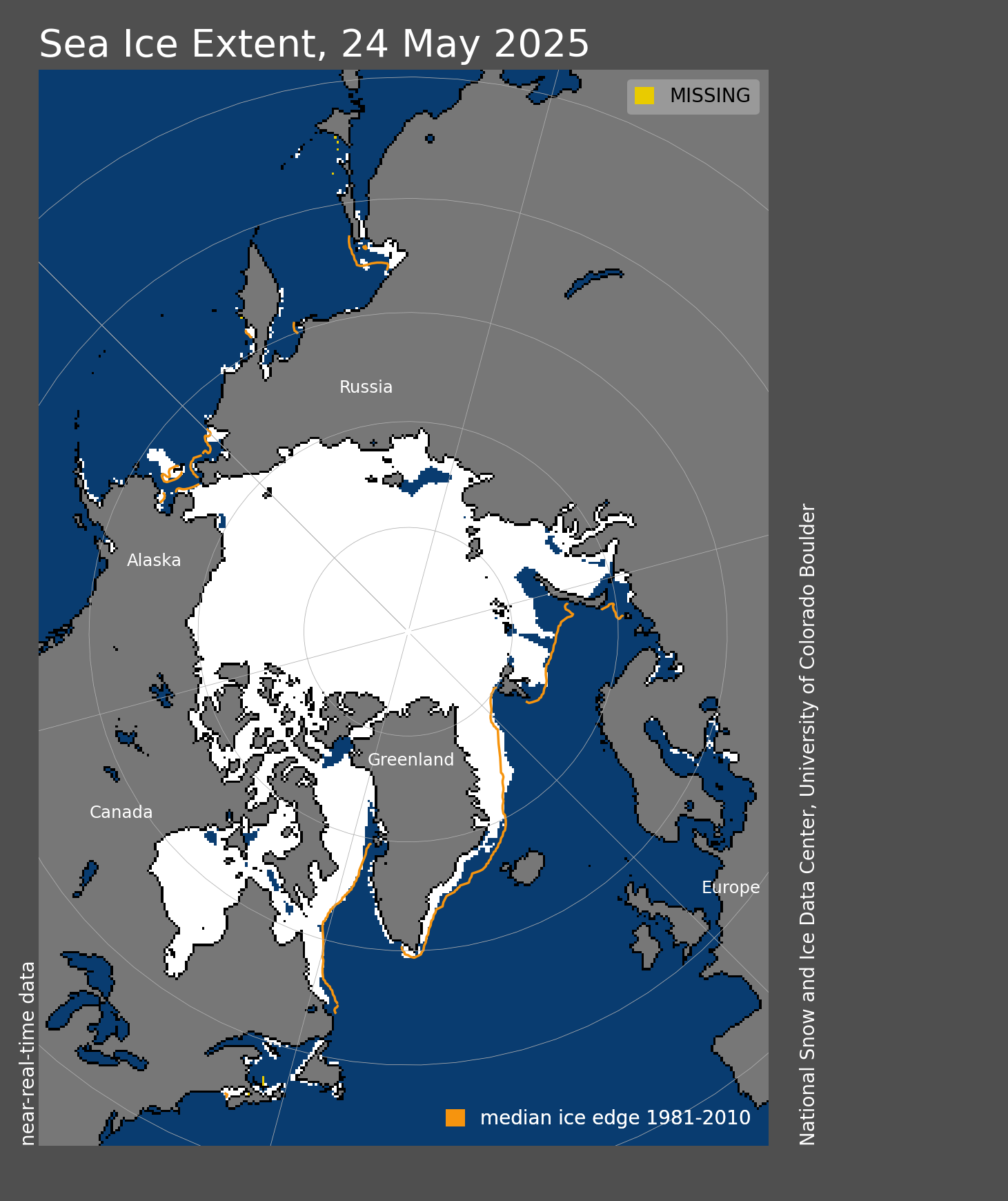
> The North East Passage has opened in North of Siberia again for shipping
> traffick:
>
> http://nsidc.org/data/seaice_index/images/daily_images/N_daily_extent_hires.png
>
> Overall, the North Pole's sea ice appears like this today:
> http://
> arctic.atmos.uiuc.edu/cryosphere/NEWIMAGES/arctic.seaice.bandw.003.png
>
>
> *North Pole's Ice Cap currently melts away at each **ten days:* *19.8%*.
>
> *Melting figures of the Arctic Ocean for the last 10** days are:*
>
> *17.07.2011*: ice area *5,456,000 km2* - melting   *98,000 km2**
> **18.07.2011*: ice area *5,383,000 km2* - melting   *73,000 km2**
> **19.07.2011*: ice area *5,283,000 km2* - melting *100,000 km2**
> **20.07.2011*: ice area *5,083,000 km2* - melting *200,000 km2*
> *21.07.2011*: ice area *4,931,000 km2* - melting *152,000 km2*
> *22.07.2011*: ice area *4,843,000 km2* - melting   *88,000 km2**
> **23.07.2011*: ice area *4,726,000 km2* - melting *117,000 km2*
> ***24.07.2011*: ice area *4,632,000 km2* - melting    *94,000 km2*
> *25.07.2011*: ice area *4,554,000 km2* - melting    *78,000 km2*
> *26.07.2011*: ice area *4,452,000 km2* - melting  *102,000 km2*
>
> At the start of the period, 16.07.2011 the ice area was 5,554,000 km2.
>
> A sustained daily sea ice melting rate 77,000 km2 could melt all ice from
> the North Pole by the autumn equinox. The current rate of disappearing sea
> ice is 110,200 km2 for the last 10 days. The open seas increase solar
> energy absorption at a higher rate than the shortening daylight hours are
> reducing the available sunlight supply. A return of cold weather and clouds
> can stop the feedback loop.
>
> *North Pole Sea Ice Cap has now lost 20%, or, 1/5th of its size in just
> over the last 10 days - a matter of immense concern as our "ice train"
> probably has already lost its breaks.*
>
> Geoengineers have very little time to act as the melting in the Arctic
> continues to escalate beyond all of the conventional projections.
>
>
> Kind regards,
>
> *Albert*
> **
> All figures by University of Illinois, Cryosphere Today. The graph by
> National Snow and Ice Data Centre (NSIDC), University of Colorado.
>
>
>

--
You received this message because you are subscribed to the Google Groups
"geoengineering" group.
To post to this group, send email to [email protected].
To unsubscribe from this group, send email to
[email protected].
For more options, visit this group at
http://groups.google.com/group/geoengineering?hl=en.