http://environmentalresearchweb.org/cws/article/opinion/68083
Mar 8, 2017
More diverse benefits from timber versus dedicated bioenergy plantations
for terrestrial carbon dioxide removal

Reducing atmospheric carbon dioxide concentrations by way of large-scale
enhancement of terrestrial carbon sinks is one climate engineering strategy
that requires comprehensive scrutiny given its complexity, say Thomas
O'Halloran and Ryan Bright.

Climate engineering (CE) projects implemented mid-century may be necessary
should mitigation efforts fail in the short term. Reducing atmospheric
CO2concentrations
by way of large-scale enhancement of terrestrial carbon sinks is one CE
strategy that requires comprehensive scrutiny given its complexity. To that
end, Boysen and colleagues make an important contribution with their
analysis of the potential for biomass plantations (BPs) to provide rapid
terrestrial carbon dioxide removal (tCDR) in the second half of this
century (Boysen *et al* 2016). Their results suggest BPs may deliver the
deep emission offsets needed to limit peak warming to 2 °C at 2100, but
only at a hefty price to both biodiversity and food production. However,
given the complexity of such an analysis, Boysen *et al* (2016) choose to
simplify the additional task of assessing the fate of C in carbon pools
outside the terrestrial biosphere. Here we focus on this element of their
analysis to show that avoided C emission through a targeted substitution of
emission-intensive products can approximately offset reduced primary
productivity on land when timber replaces dedicated bioenergy biomass
species. We argue that biomass utilization is equally relevant to consider
when evaluating climate engineering or mitigation strategies involving
terrestrial carbon sinks, since biomass products dictate the types of
biomass species that must be deployed. BP systems deploying native tree
species to produce timber, for example, can deliver greater biodiversity
and local biogeophysical cooling benefits in many regions relative to BP
systems deploying dedicated energy crops.

To evaluate the potential of biomass plantations to provide climate
engineering in the second half of the 21st century, Boysen *et al* used a
dynamic global vegetation model (DGVM) to evaluate a series of land use
transitions based on replacing either natural vegetation or existing
agricultural areas with highly productive biomass crops. In their study,
transition locations and biomass feedstocks ('Bioenergy Trees': willow,
poplar or eucalyptus, vs. 'Bioenergy grasses': miscanthus or switchgrass)
were chosen based on the areas of maximum productivity simulated by the
DGVM (Bondeau *et al* 2007) forced with offline climate model data (i.e.
temperature, precipitation and atmospheric CO2 concentration) from a
societal transition scenario resembling RCP4.5 (Thomson *et al* 2011). This
location selection scheme was chosen to develop an upper bound on the tCDR
potential of BPs by maximizing productivity. Given their approach
(highest-productivity sites targeted; CO2 fertilization included without
C-cycle and climate feedbacks; GHG emissions from N-fertilizers (e.g. Wood
and Cowie 2004) excluded, etc), one could argue that the work represents an
upper limit to the tCDR potential of a CE strategy that focuses on the
rapid and large-scale deployment of productive (photosynthesis-enhancing)
biomass species on land. However, by setting their analysis to utilize a
simple 50% capture rate for NPP, the authors limit the full potential of
tCDR.

When C in biomass is used directly as a replacement for the C in fossil
fuel (as bioenergy), or indirectly as a product that replaces a material
such as steel or concrete whose own production is emission-intensive, then
the fossil C avoided by choosing biomass is analogous to a permanent C sink
(Smith *et al* 2014). It is well-understood that using biomass to replace
emission-intensive materials in the construction sectors can result in
greater carbon cycle benefits than if used directly to replace energy
(Kauppi *et al* 2001, Nabuurs *et al* 2007, Smith *et al* 2014). Carbon
dioxide removal strategies involving terrestrial carbon sinks therefore
need to be assessed with regard to net C fluxes in both the terrestrial
biosphere and in industrial society (Smith *et al* 2014). A focus solely on
the maximization of C sinks on land inherently limits the biomass species
options to those which have little or no value for use as anything other
than bioenergy, obfuscating the emission reduction potential that exists by
way of product substitution and a reduced consumption of fossil fuels.

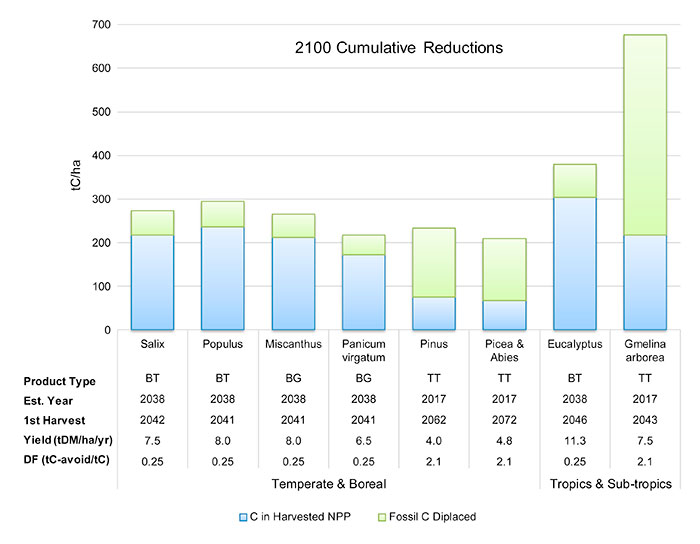
Despite often being lower in productivity, BPs that produce timber products
(i.e. forests) can contribute to deeper GHG reductions outside the land
system than those producing bioenergy, as illustrated in figure 1.
Additionally, management of commercial timber species is often less
intensive with regards to fertilizer and pesticide application (Heilman and
Norby 1998) while being more sensitive to the preservation of wildlife
habit through practices that mimic natural stand structure. In general,
forestry plantations often harbor greater biodiversity than conventional
agriculture, the latter of which more closely resembles BPs producing
dedicated crops for energy (Brockerhoff *et al* 2008). Further, recent
empirical evidence suggests that, locally, forests directly cool the
surface relative to crops and other herbaceous vegetation species in many
regions (Alkama and Cescatti 2016, Peng *et al* 2014, Zhao and Jackson
2014).
[image: Figure 1]
<http://images.iop.org/objects/erw/talkingpoint/11/3/1/pic1.jpg>
Figure 1 <http://images.iop.org/objects/erw/talkingpoint/11/3/1/pic1.jpg>

As figure 1 illustrates, in a timber focused tCDR strategy, the tradeoff
between weaker C sinks on land can be balanced by greater reductions in C
emissions off the land. By ignoring this latter contribution, studies risk
overlooking the greater biodiversity and local biogeophysical climate
benefits that timber stands likely confer over BPs that produce dedicated
energy crops (Zhao and Jackson 2014, Peng *et al* 2014, Alkama and Cescatti
2016). Arguably, however, maximizing the carbon reduction potential that
exists in the way of avoided emissions will be more challenging to realize
as it requires effective coordination amongst additional actors and greater
governance across sectors. Further, given the long rotation times for some
commercial timber species – particularly those in boreal regions –
deployment of such a carbon reduction strategy cannot afford to wait until
the 1.5 °C threshold is crossed (i.e. 2038 in Boysen *et al* 2016), but
would need to be deployed immediately in these regions. Subsequently, the
concomitant biogeophysical effects on both local and global climate need to
be evaluated more rigorously – and urgently (Jones *et al* 2013). Boysen *et
al* (2016) reference the importance of albedo in their analysis, but
without measuring the climate forcing (or response) in common units like
radiative forcing (e.g. O'Halloran *et al* 2012), or change in temperature,
it is difficult to meaningfully weigh the reported albedo changes against
the reported emission reductions. Selecting BP deployment locations in
future assessments should focus on maximum climate benefit rather than
maximum CDR, facilitated with spatially-explicit metrics that inform about
the relevance of biogeophysical effects both locally (West *et al* 2011)
and globally (Bright *et al* 2016). Siting based on the optimization of
multiple climate regulation services, in addition to other ecosystems
services like biodiversity and food production, could increase net climate
benefits while also addressing social barriers (Moser and Ekstrom 2010) to
large-scale implementation of these projects.
Acknowledgments

Technical Contribution No. 6480 of the Clemson University Experiment
Station. RMB was supported by the research project 'Approaches for
integrated assessment of forest ecosystem services under large scale
bioenergy utilization' funded by the Norwegian Research Council (grant
number: 233641/E50).

For references, see More diverse benefits from timber versus dedicated
bioenergy plantations for terrestrial carbon dioxide removal
<http://iopscience.iop.org/article/10.1088/1748-9326/aa54ec> at
environmentalresearchweb's sister journal ERL.
About the author

Thomas L O'Halloran, Department of Forestry and Environmental Conservation,
Clemson University, SC, and Baruch Institute of Coastal Ecology and Forest
Science, Clemson University, Georgetown, SC, USA, and Ryan M Bright,
Norwegian Institute of Bioeconomy Research, 1431 Ås, and Norwegian
University of Science and Technology, 7491 Trondheim, Norway

--
You received this message because you are subscribed to the Google Groups
"geoengineering" group.
To unsubscribe from this group and stop receiving emails from it, send an email
to [email protected].
To post to this group, send email to [email protected].
Visit this group at https://groups.google.com/group/geoengineering.
For more options, visit https://groups.google.com/d/optout.