Poster's note: edge-topic, but IMO heatwaves are likely to be a trigger for
calls for CE, or actual implementation. The July/August NH heatwaves this
year were transformative for public debate. Even far-right newspapers in
the UK now carry prominent op-eds calling for climate action;
simultaneously, it's becoming obvious that mitigation cannot achieve 1.5C
https://www.carbonbrief.org/restricting-global-warming-to-1-5c-would-halve-risk-of-marine-heatwaves/amp?__twitter_impression=true


[image: Carbon Brief] <https://www.carbonbrief.org/>
<https://www.carbonbrief.org/restricting-global-warming-to-1-5c-would-halve-risk-of-marine-heatwaves/amp?__twitter_impression=true#>
Restricting global warming to 1.5C would ‘halve’ risk of marine
heatwaves[image:
Dead sea fan coral, Caribbean sea. Credit: Helmut Corneli / Alamy Stock
Photo. M731Y2]

Dead sea fan coral, Caribbean sea. Credit: Helmut Corneli / Alamy Stock
Photo.

Marine heatwaves could become 41 times more likely across the globe by 2100
than in pre-industrial times if little is done to stop greenhouse gas
emissions, a new study finds.

Such a surge in heatwaves could push “marine organisms and ecosystems to
the limits of the resilience and even beyond, which could cause
irreversible changes”, the researchers write in the journal Nature
<https://www.nature.com/articles/s41586-018-0383-9>.

However, limiting global temperature rise to 1.5C above pre-industrial
levels – the aspirational target of the Paris Agreement
<https://www.carbonbrief.org/interactive-the-paris-agreement-on-climate-change>
–
could more than halve the rise in frequency and intensity of marine
heatwaves, the lead author tells Carbon Brief.
Scorching seas

As with a heatwave on land
<https://www.carbonbrief.org/media-reaction-2018-summer-heatwaves-and-climate-change>,
a marine heatwave
<https://www.carbonbrief.org/marine-heatwaves-have-become-34-more-likely-over-past-century>
is
an extended period of unusually high temperatures.

Surges in sea temperatures can have large impacts on underwater ecosystems.
The Great Barrier Reef, for example, has experienced four mass coral
bleaching events
<https://www.carbonbrief.org/great-barrier-reef-at-unprecedented-risk-of-collapse-after-major-bleaching-event>
caused
by prolonged exposure to high sea surface temperatures (SSTs) in the past
two decades.

In 2010-11, a marine heatwave caused the loss of 36% of the seagrass meadows
<https://www.nature.com/articles/s41558-018-0096-y> in Shark Bay in Western
Australia – an important refuge for dugongs, green turtles and manta rays.

The new research uses a combination of satellite data and modelling to
investigate how climate change has influenced the frequency and severity of
marine heatwaves to date. It then uses this information to, for the first
time, make projections about how marine heatwaves are likely to change in
the coming decades.

The results show that marine heatwaves have “already become longer-lasting
and more frequent, extensive and intense in the past few decades”, says
lead author Prof Thomas Frölicher <https://www.tfroelicher.com/>, a
researcher at the ocean modelling
<http://www.climate.unibe.ch/research/research_groups/ocean_modelling/index_eng.html>
group
at the University of Bern <http://www.unibe.ch/index_eng.html>. He tells
Carbon Brief:

“If temperatures were to rise by 3.5C relative to pre-industrial levels –
as is predicted
<https://www.carbonbrief.org/explainer-what-are-intended-nationally-determined-contributions>
to
result from current national policies for the reduction of global carbon
emissions – the number of marine heatwave days will be 41 times higher than
in pre-industrial times.”

Ocean gazing

For the study, the researchers used a set of 12 global climate models
<https://www.carbonbrief.org/qa-how-do-climate-models-work> to explore how
marine heatwaves have changed from pre-industrial times
<https://www.carbonbrief.org/challenge-defining-pre-industrial-era> (starting
in 1861) to 2100.

For the future period (2006-2100), the researchers simulated heatwave
frequency under two scenarios: a scenario where global warming reaches
3.5C, using a “business as usual” baseline (“RCP8.5
<https://link.springer.com/article/10.1007/s10584-011-0149-y>”) and a
scenario where future temperature rise is limited to 1.5-2C (“RCP2.6
<https://link.springer.com/article/10.1007/s10584-011-0152-3>”).

The researchers defined a marine heatwave as any day where SSTs are in the
top 1% of the local range of the current climate.

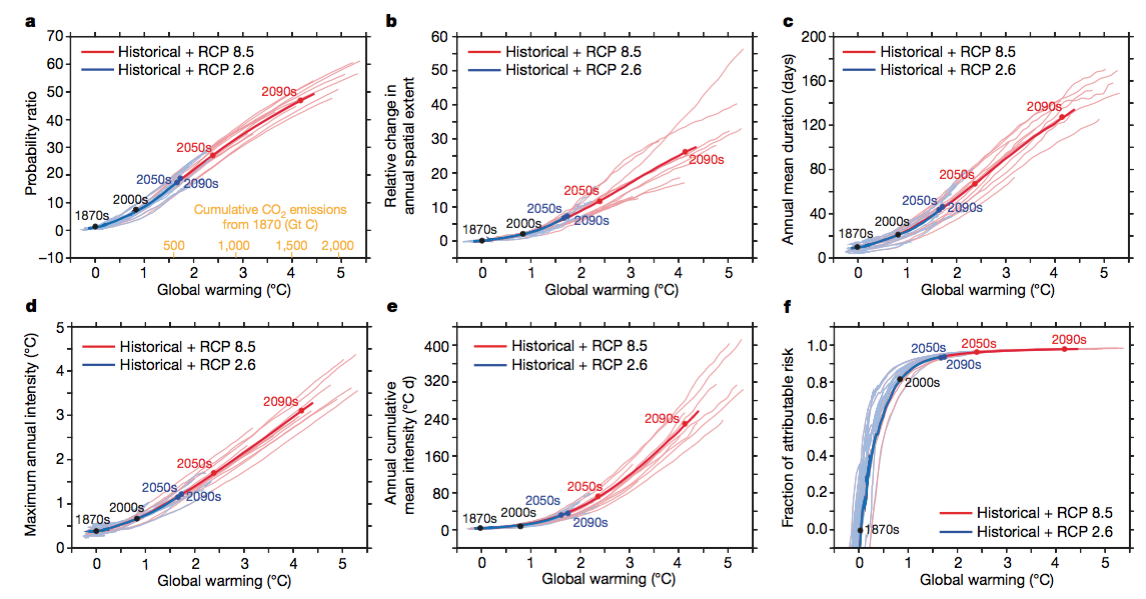
The charts below show the expected impact of global warming on: (a) the
“annual probability ratio” – the fraction by which the number of marine
heatwave days per year has changed; (b) the average area of an individual
heatwave; (c) the average length of a heatwave; (d) the maximum temperature
of a heatwave; and (e) the “annual cumulative mean intensity” of a heatwave
– which is a product of the expected number of heatwave days and maximum
heatwave temperature.

On the charts, the results for RCP2.6 (blue) and RCP8.5 (red) are shown.
<https://www.carbonbrief.org/wp-content/uploads/2018/08/simulated-impact-of-global-warming.png>

The simulated impact of global warming on (a) the annual probability ratio
for heatwave days, (b) the average area of an individual heatwave, (c) the
average length of a heatwave, (d) the maximum temperature of a heatwave,
(e) the annual cumulative mean intensity of a heatwave and (f) the
proportion of marine heatwaves that are attributable to human-caused global
warming. Results are shown for RCP2.6 (blue) and RCP8.5 (red). Source:
Frölicher et al. (2018 <https://www.nature.com/articles/s41586-018-0383-9>)

The results suggest that, at present (2000s on the chart), the chances of
marine heatwaves occuring are nine times higher than in pre-industrial
times.

Under 3.5C of global warming, the likelihood of a marine heatwave day is
expected to be 41 times higher than in pre-industrial times. In other
words, heatwaves that were likely to occur once in every 100 days in the
pre-industrial era could occur once in every three days by the end of the
century.

Additionally, the average area covered by a heatwave is expected to be 21
times larger and each event is expected around 100 days longer.

However, if warming is restricted to 2C – the upper limit set by the Paris
Agreement – the number of marine heatwave days per year is expected to be
23 times higher than in pre-industrial times.

If warming is limited to 1.5C, the number of heatwave days is expected to
be around 16 times higher. In addition, marine heatwaves are expected to
cover a smaller area (25% of the area expected under 3.5C) and last for
fewer days at a time.

A sixth chart (f) shows the proportion of marine heatwaves that are
attributable to human-caused global warming.

To understand the influence of global warming on present-day heatwaves, the
researchers compared the modelling results to temperature data taken via
satellites
<https://www.carbonbrief.org/interactive-satellites-used-monitor-climate-change>
, ships and buoys
<https://www.carbonbrief.org/explainer-how-data-adjustments-affect-global-temperature-records>
.

They found a high degree of similarity between the observed data and the
results from models that included the historical global warming trend. This
suggests that global warming has played a large role in driving changes to
marine heatwaves, Fröelicher explains:

“We show that this change is very likely due to human-caused global
warming. That’s because the observed change is mostly outside the range of
the changes expected from natural internal variability.”

Their calculations show that, at present, around 87% of marine heatwaves
are attributable to climate change. However, this figure could rise to
nearly 100% with more than 2C of warming, they add.
Sweltering Arctic

The researchers also explored how the distribution of marine heatwaves is
likely to change by the end of the century.

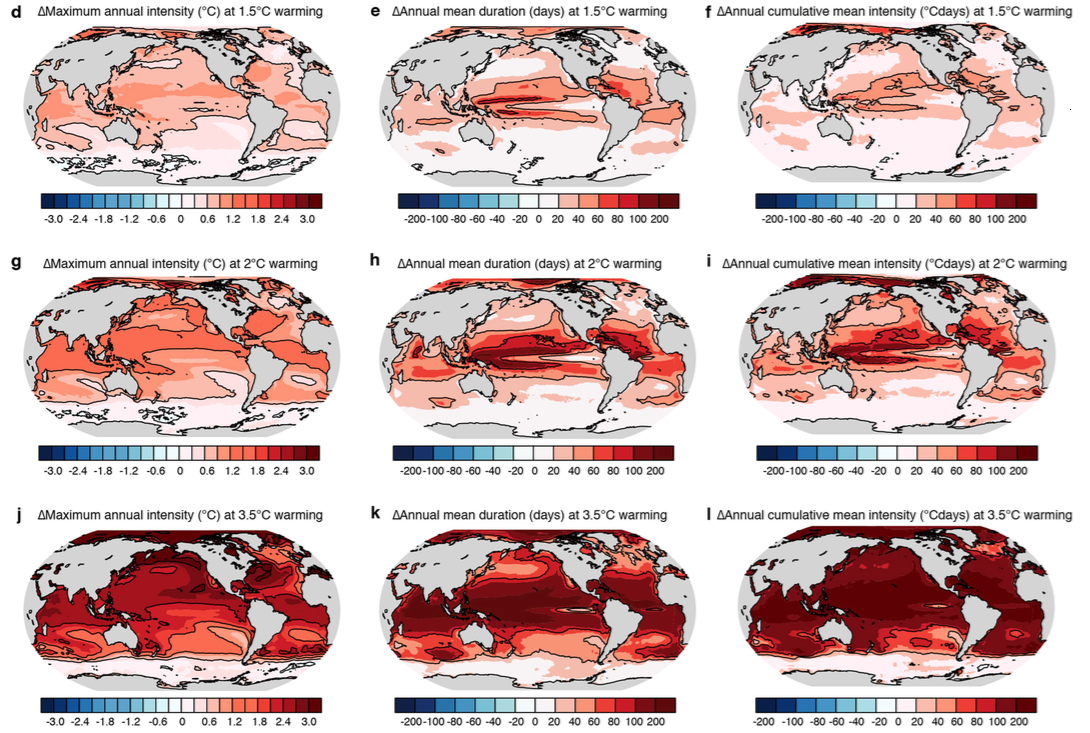
The maps below show the expected changes to maximum temperature, length and
mean intensity of marine heatwaves in different parts of the world under
1.5C (top), 2C (middle) and 3.5C (bottom) of warming. On the maps, dark red
is used to show large increases while white shows little to no change.
<https://www.carbonbrief.org/wp-content/uploads/2018/08/expected-changes-to-maximum-temperature.png>

The expected changes to maximum temperature (left), length (middle) and
mean intensity (right) of marine heatwaves under 1.5C (top), 2C (middle)
and 3.5C (bottom) of global warming. Dark red is used to show large
increases while white shows little to no change. Source: Frölicher et al. (
2018 <https://www.nature.com/articles/s41586-018-0383-9>)

The maps show how, under 1.5-2C, marine heatwaves are expected to more
frequent and severe in the tropics. This is because, in the tropics, SSTs
vary little throughout the year, the researchers say:

“As a result, the same changes in annual mean SST lead to much larger
changes in the probability of exceeding the 99th percentile
<https://www.carbonbrief.org/impact-climate-change-health-is-major-threat-21st-century>
.”

Under 3.5C, marine heatwaves are expected to increase in length and
intensity across the tropics and northern mid-latitudes, as well as in the
Arctic, the results show.

These changes correspond to the expected large changes to global
temperatures, the researchers say. In a similar way to the tropics, the
Arctic could be vulnerable to extremes because it currently faces very
little sea temperature variability, they add.
Ecosystem meltdown

A large increase in marine heatwaves is likely to have “severe and
long-lasting impacts” on marine life, Frölicher says. However, marine
heatwaves are relatively poorly studied – and so understanding what the
scale of these impacts could be is difficult, he says:

“So far, our understanding of the impacts of marine heatwaves on marine
ecosystems has been gained opportunistically following a few recent events.

“The warm blob in the Pacific
<https://www.nationalgeographic.com/magazine/2016/09/warm-water-pacific-coast-algae-nino/>
in
2013-2015 caused increased mortality of sea lions, whales and seabirds. In
addition, a coast-wide bloom of toxigenic diatom [algae] was observed,
which resulted in elevated toxins in marine mammals.”

Marine heatwaves could also have large impacts for humans, he adds:

“The heavy rain associated with the Peruvian marine heatwave
<https://www.bbc.co.uk/news/world-latin-america-39318034> in 2017 triggered
landslides and flooding, which resulted in a death toll of several hundred,
widespread damage to infrastructure and civil works and significant
economic losses.”

The findings provide “an important step forward in understanding how humans
are changing what extreme events look like in the ocean,” says Hillary
Scannell <https://www.hillaryscannell.com/>, a PhD student at the School of
Oceanography <https://www.ocean.washington.edu/> at the University of
Washington <http://www.washington.edu/>, who was not involved in the
research. She tells Carbon Brief:

“Although these types of studies usually have a doomsday ending, it is
important to remember that these projections are dependent on the degree of
expected warming. Curbing CO2 emissions now would certainly help steer us
aways from catastrophic ecological damage in the future.”

--
You received this message because you are subscribed to the Google Groups
"geoengineering" group.
To unsubscribe from this group and stop receiving emails from it, send an email
to [email protected].
To post to this group, send email to [email protected].
Visit this group at https://groups.google.com/group/geoengineering.
For more options, visit https://groups.google.com/d/optout.